Apple Newsroom:
CUPERTINO, CALIFORNIA Apple today announced M5 Pro and M5 Max, the world’s most advanced chips for pro laptops, powering the new MacBook Pro. The chips are built using a new Apple-designed Fusion Architecture. This innovative design combines two dies into a single system on a chip (SoC), which includes a powerful CPU, scalable GPU, Media Engine, unified memory controller, Neural Engine, and Thunderbolt 5 capabilities. M5 Pro and M5 Max feature a new 18-core CPU architecture. It includes six of the highest-performing core design, now called super cores, that are the world’s fastest CPU core. Alongside these cores are 12 all-new performance cores, optimized for power-efficient, multithreaded workloads. Collectively, the CPU significantly boosts performance by up to 30 percent for pro workloads.2 The GPU scales up the next-generation architecture introduced in M5 to an up-to-40-core GPU. With a Neural Accelerator in each GPU core and higher unified memory bandwidth, M5 Pro and M5 Max are over 4x the peak GPU compute for AI compared to the previous generation. The GPU substantially increases graphics capabilities — now up to 35 percent for apps using ray tracing than M4 Pro and M4 Max — enhancing advanced visual effects and 3D rendering.2 With M5 Pro and M5 Max, the new MacBook Pro is the ultimate powerhouse for pros and is available for pre-order starting tomorrow, with availability beginning Wednesday, March 11.
“M5 Pro and M5 Max are a monumental leap forward for Apple silicon, leveraging our new Fusion Architecture to scale the capabilities of Apple silicon while preserving its core tenets of performance, power efficiency, and unified memory architecture,” said Johny Srouji, Apple’s senior vice president of Hardware Technologies. “Both chips underscore our relentless pace of innovation, integrating the world’s fastest CPU cores, a next-generation GPU with Neural Accelerators, a faster Neural Engine, and high-bandwidth, high-capacity memory — resulting in an unparalleled combination of performance, efficiency, and incredible on-device AI capabilities for MacBook Pro.”

The advanced CPU cores, next-generation GPU, and higher unified memory bandwidth on M5 Pro and M5 Max enable users to bring their biggest ideas to life with great speed and efficiency. This means users can experience accelerated code compilation and on-device agentic coding in apps like Xcode.
All-New Fusion Architecture
M5 Pro and M5 Max introduce the Apple-designed Fusion Architecture, a state-of-the-art design that connects two dies into a single SoC. This brings together two third-generation 3-nanometer dies with high bandwidth and low latency using advanced packaging. The two dies include a powerful new CPU, scalable GPU, Media Engine, unified memory controller, Neural Engine, and Thunderbolt 5 capabilities.Apple’s Fastest, Most Advanced CPU Cores
M5 Pro and M5 Max feature a new 18-core CPU with 6 super cores and 12 all-new performance cores.The industry-leading super core was first introduced as performance cores in M5, which also adopts the super core name for all M5-based products — MacBook Air, the 14-inch MacBook Pro, iPad Pro, and Apple Vision Pro. This core is the highest-performance core design with the world’s fastest single-threaded performance, driven in part by increased front-end bandwidth, a new cache hierarchy, and enhanced branch prediction.
M5 Pro and M5 Max also introduce an all-new performance core that is optimized to deliver greater power-efficient, multithreaded performance for pro workloads. Together with the super cores, the chips deliver up to 2.5x higher multithreaded performance than M1 Pro and M1 Max.2 The super cores and performance cores give MacBook Pro a huge performance boost to handle the most CPU-intensive pro workloads, like analyzing complex data or running demanding simulations with unparalleled ease.
M5 Pro: Designed to Handle Demanding Workflows
M5 Pro is designed to meet the needs of pro users — like data modelers, post-production sound designers, and STEM students — who require robust processing power and graphics, and ample amounts of unified memory to handle complex projects and workloads.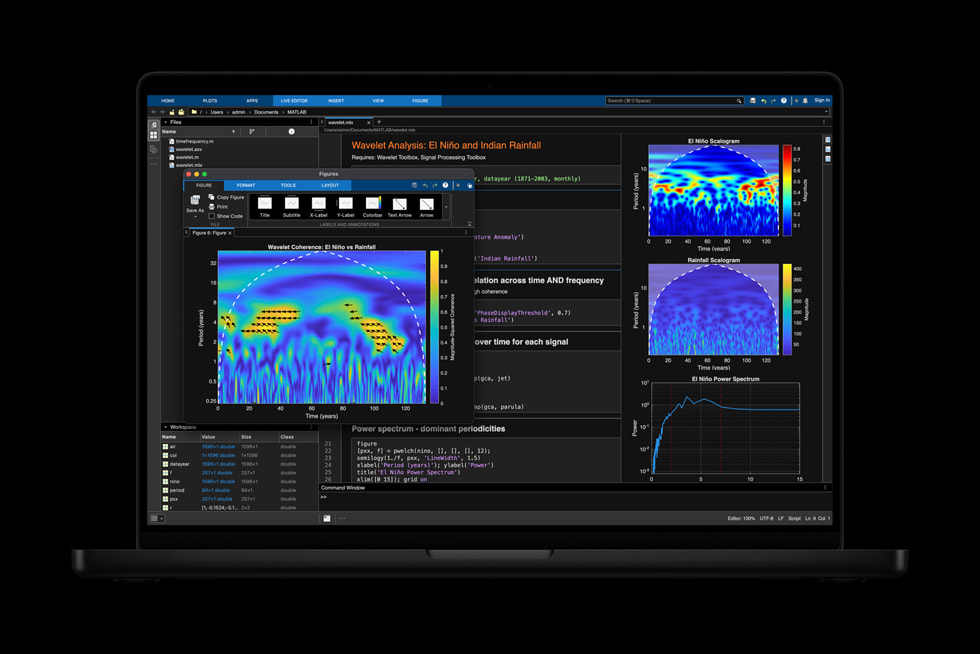
M5 Pro and M5 Max empower engineers, scientists, researchers, and students to unlock complex computations and simulations by easily powering through massive datasets in apps like MATLAB.
Scaling up from the M5 chip, M5 Pro pairs the up-to-18-core CPU with a next-generation up-to-20-core GPU featuring a Neural Accelerator in each core. With four additional CPU cores compared to M4 Pro, the new CPU architecture in M5 Pro significantly boosts multithreaded performance by up to 30 percent for pro workloads.2 M5 Pro supports up to 64GB of unified memory with higher unified memory bandwidth up to 307GB/s. With all these features, M5 Pro delivers over 4x the peak GPU compute compared to M4 Pro, and over 6x the peak GPU compute than M1 Pro for AI performance.
M5 Pro has an enhanced shader core with second-generation dynamic caching and hardware-accelerated mesh shading, delivering significantly increased graphics performance — up to 20 percent higher than M4 Pro and 2.2x higher than M1 Pro.2 And with Apple’s third-generation ray-tracing engine, M5 Pro provides up to a 35 percent graphics uplift in apps using this rendering technique as compared to M4 Pro.

With Apple’s third-generation ray-tracing engine in M5 Pro and M5 Max, users experience an up to 35 percent graphics uplift as compared to the previous generation when rendering intricate 3D designs with incredible detail.
M5 Max: Unmatched Capabilities
M5 Max is designed for pro users — such as 3D animators, app developers, and AI researchers — who run workloads that demand maximum GPU compute and the highest unified memory bandwidth.Featuring the same breakthrough GPU architecture with double the cores as M5 Pro, M5 Max pairs the 18-core CPU with an up-to-40-core GPU. The new CPU architecture offers up to 15 percent higher multithreaded performance when compared to M4 Max.2 M5 Max supports up to 128GB of unified memory with higher unified memory bandwidth up to 614GB/s. This bandwidth increase means users achieve incredible results when working with complex scenes, massive datasets, and higher token generation for LLMs. M5 Max offers over 4x the peak GPU compute compared to the previous generation, and over 6x the peak GPU compute than M1 Max for AI performance.
The graphics performance for M5 Max is up to 20 percent higher than M4 Max and 2.2x higher than M1 Max.2 For apps using ray tracing, M5 Max provides a graphics uplift of up to 30 percent more than M4 Max.

M5 Pro and M5 Max unleash the full potential of LLMs in LM Studio. The next-generation GPU architecture with Neural Accelerators and higher unified memory bandwidth deliver a massive increase in AI performance.
Advanced Technologies Across M5 Pro and M5 Max
M5 Pro and M5 Max feature a number of additional advanced technologies right on the chip, including:- A faster 16-core Neural Engine with a higher bandwidth connection to memory to accelerate on-device AI features and Apple Intelligence.
- Apple’s latest Media Engine with support for hardware-accelerated H.264 and HEVC, AV1 decode, and ProRes encode and decode engines.
- Support for Memory Integrity Enforcement — an industry-first, always-on memory safety protection that does not compromise device performance.
- Thunderbolt 5 ports, each supported by its own custom-designed controller directly on the chip — making this the industry’s most capable implementation of Thunderbolt 5.
Apple Silicon and the Environment
Apple 2030 is the company’s ambitious plan to be carbon neutral across its entire footprint by the end of this decade by reducing product emissions from their three biggest sources: materials, electricity, and transportation. The power-efficient performance of M5 Pro and M5 Max helps MacBook Pro meet Apple’s high standards for energy efficiency, and reduces the total amount of energy consumed over the product’s lifetime. Source:

Apple debuts M5 Pro and M5 Max to supercharge the most demanding pro workflows
Apple today announced M5 Pro and M5 Max, the world’s most advanced chips for pro laptops, powering the new MacBook Pro.
www.apple.com