- Local time
- 5:23 PM
- Posts
- 187
- OS
- Windows 11 [22H2] [22621.2428]
When doing a clean install I accidentally deleted the partition on my D drive; none of the partitions on it have anything to do with windows (like boot or system) so this shouldn't be too hard?
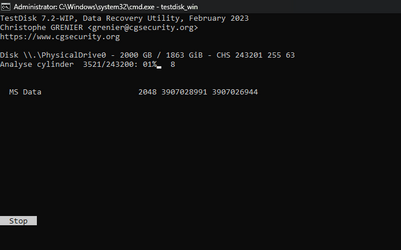
I'm running testdisk deep scan on the drive and it looks like it will take days. Is there no faster way to find and restore lost partitions on non-windows drives?
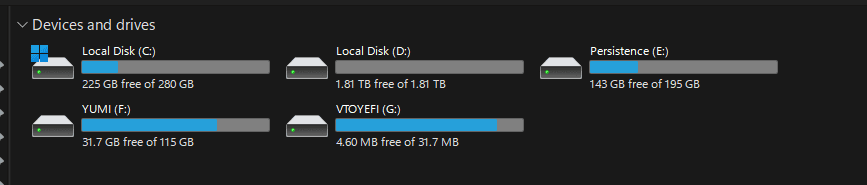
(The drive in question is D)
On the install setup I think I probably formatted it, or deleted and formatted it, I dont know cause I was pretty careful but oh well..
So am I trying to find and restore a lost partition, or should I be looking at just deep scanning the drive with a file recovery program and grabbing as much data as I can?
I'm running testdisk deep scan on the drive and it looks like it will take days. Is there no faster way to find and restore lost partitions on non-windows drives?
(The drive in question is D)
On the install setup I think I probably formatted it, or deleted and formatted it, I dont know cause I was pretty careful but oh well..
So am I trying to find and restore a lost partition, or should I be looking at just deep scanning the drive with a file recovery program and grabbing as much data as I can?
- Windows Build/Version
- W11 23H2
Attachments

My Computer
At a glance
Windows 11 [22H2] [22621.2428]Intel Core i9-14900K 3.2 GHz 24-Core ProcessorG.Skill Trident Z5 RGB 32 GB (2 x 16 GB) DDR5...AMD Radeon RX 6950 XT
- OS
- Windows 11 [22H2] [22621.2428]
- Computer type
- PC/Desktop
- Manufacturer/Model
- Culture-Virus v7.0
- CPU
- Intel Core i9-14900K 3.2 GHz 24-Core Processor
- Motherboard
- Asus ROG MAXIMUS Z790 APEX ENCORE ATX LGA1700 Motherboard
- Memory
- G.Skill Trident Z5 RGB 32 GB (2 x 16 GB) DDR5-7200 CL34 Memory
- Graphics Card(s)
- AMD Radeon RX 6950 XT
- Monitor(s) Displays
- AOC CQ27G2U/BK
- Screen Resolution
- 2560x1440
- Hard Drives
- M.2 1: Samsung SSD 990 PRO 2TB
M.2 2: Samsung SSD 970 EVO Plus 2TB
- PSU
- Corsair RM1000X SHIFT
- Case
- Phanteks NV9
- Cooling
- Custom Water / Direct-Die Cooling
- Keyboard
- Corsair K95 RGB PLATINUM XT Wired Gaming Keyboard
- Mouse
- ROCCAT LEADR Optical
- Internet Speed
- 500mb Direct Fiber
- Browser
- Chrome