WinHEC Online Blog:
One place to stay current on the Driver Quality Initiative, understand what is changing across Windows, and know what it means for you.
One place to follow the work
At WinHEC 2026, we made a commitment with the hardware ecosystem: raise the bar on Windows driver quality, together.The Driver Quality Initiative (DQI) is how we are putting that commitment into action. It brings together work across driver architecture, trust, lifecycle, and quality measurement to improve the reliability, security, and overall experience of Windows devices.
Each month, WinHEC Online will bring together the most important updates affecting the Windows driver ecosystem. We’ll cover what has shipped, what is changing, what is coming next, and most importantly what it means for the partners who build, integrate, certify, and deploy Windows drivers.
We’ll continue to link directly to the Hardware Dev Center, Windows Driver Developer, Windows Hardware Certification, Microsoft Learn, and other sources for the technical details.
A quick refresher on DQI
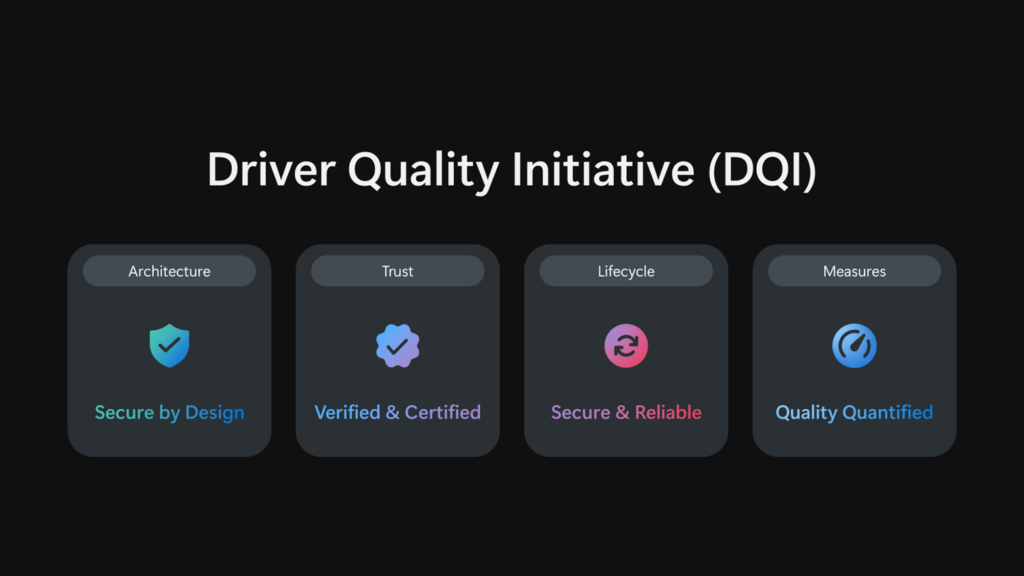
The Driver Quality Initiative is our ecosystem-wide effort to improve driver quality across Windows.It focuses on four areas:
- Architecture: Reduce risk by hardening kernel-mode drivers and moving more functionality to user-mode or Microsoft class drivers where it makes sense.
- Trust: Strengthen partner verification, vulnerability scanning, and Windows Hardware Compatibility Program requirements.
- Lifecycle: Improve how drivers are published, maintained, updated, and retired across the ecosystem.
- Quality measures: Expand how we measure driver quality beyond crashes to include stability, functionality, performance, and security.
Summer 2026 Recap
Across the various blogs, we’ve published several updates that affect how drivers are built, certified signed, published, targeted, and recovered. If you don’t follow every forum, you may have missed one.Catching quality issues earlier
The Driver Shiproom Publishing Blocklist is now enforced during driver signing, rather than only later in the publishing process. If a submission contains a known problematic file, it can now be rejected earlier, giving partners a clearer opportunity to fix the issue before the driver moves further through the pipeline.Read the Hardware Dev Center update
Recovering more quickly when problems reach customers
Cloud-Initiated Driver Recovery adds another safeguard. When a problematic driver is identified, Microsoft can use Windows Update to move affected devices back to a previously known-good version. This uses the existing Windows Update infrastructure and does not require new partner tooling. Cloud-Initiated Driver Recovery is currently targeted for September 2026.Read the Hardware Dev Center update
Improving graphics driver targeting
We are also piloting a new publishing model for display (graphics) drivers using 2-Part Hardware IDs plus Computer Hardware IDs (CHIDs) that impacts Microsoft partners, IHVs and OEMs. The goal is more precise targeting: getting the highest quality driver to the right systems. The pilot runs through September 2026, with broader availability targeted for late 2026 into early 2027 on new devices that have not had a 4-Part Hardware ID Windows Update driver installed.Read the Hardware Dev Center update
Building drivers with Visual Studio 2026
The Windows Driver Kit (WDK) now supports Visual Studio 2026, giving driver developers the latest Visual Studio environment for building, testing, and packaging Windows drivers.Read the Windows Driver Developer Blog update
Keeping certification tooling current
The Hardware Lab Kit also continues to evolve alongside Windows. The May HLK refresh supported Windows 11, version 25H2 and Windows Server 2025, followed by the August HLK and VHLK refresh for Windows 11, version 26H1. Partners certifying hardware should continue to make sure they are using the appropriate kit for their target Windows release.What’s next
Over the coming months, we’ll continue to track progress across DQI, including:- Cloud-Initiated Driver Recovery
- Graphics driver targeting
- User-mode and class-driver architecture investments
- Windows Hardware Compatibility Program requirements
- Windows Update catalog quality
- SBOM alignment
- Driver symbols and diagnostic improvements
- New and expanded driver quality measures
Stay connected
WinHEC may bring the ecosystem together at key moments. WinHEC Online is how we keep that work moving between them.Check back each month for the latest Driver Quality Initiative updates and use the comments to tell us where you need more clarity, guidance, or detail.
Our shared goal is straightforward: better drivers, more reliable Windows devices, and a better experience for customers. And getting there takes all of us.
-Driver Quality Initiative Program Leads
Source:
Welcome to WinHEC Online | Microsoft Community Hub
One place to follow the work At WinHEC 2026, we made a commitment with the hardware ecosystem: raise the bar on Windows driver quality, together. The Driver...
 techcommunity.microsoft.com