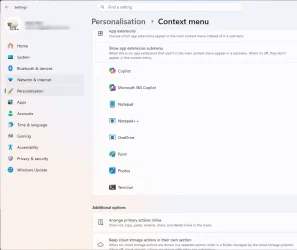
This tutorial will show you how to add or remove App extensions on the modern context menu for your account in Windows 11.
Starting with Windows 11 build 26340.9212 (Experimental 26H2) for Insiders, Microsoft is beginning to roll out an updated Customize menu context menu experience in File Explorer, designed to feel faster, cleaner, and easier to tailor to the way you work. The new design reduces top-level clutter, keeps commonly used actions easy to access, and adds a new Settings experience that gives you more control over what appears in the menu. As Microsoft continues refining this experience with Insider feedback, their goal is to make right-click feel more responsive, predictable, and personal.
The App actions section on the modern context menu is about options for app extensibility, so you can choose which app extensions appear in the main menu or submenu, including hiding the submenu altogether.
You can turn on or off the Show app extensions submenu setting to add (on) or remove (off) the App extensions submenu on the modern context menu.
You can turn on or off app extensions to either show them in the App extensions submenu when turned off or show inline on the main modern context menu when turned on.
This does not affect the Shift + Right Click classic context menu.
If you don't have the new Customize menu context menu settings feature in the build above and would like to test it now, then you can use the vivetool command below to enable this feature.
vivetool.exe /enable /id:60813048

Enable or Disable Hidden Feature Flags in Windows 11
This tutorial will show you how to enable or disable hidden experimental feature flags in Windows 11. ViVeTool is an open source tool that can be used to enable hidden features that are part of controlled feature roll-outs or A/B testing in Insider builds of Windows 11. Starting with Windows...
 www.elevenforum.com
Contents
- Option One: Add or Remove "App extensions" Submenu on Context Menu in Settings
- Option Two: Add or Remove "App extensions" Submenu on Context Menu using REG file
- Option Three: Turn On or Off Show App Extensions Inline on Context Menu in Settings
- Option Four: Turn On or Off Show App Extensions Inline on Context Menu in Registry Editor
EXAMPLE: "App extensions" submenu and inline app extensions on modern context menu
1 Open Settings (Win+I).
2 Click/tap on Personalization in the left pane, and click/tap on Context menu. (see screenshot below)
3 Under File actions, click/tap on App extensions to expand it open. (see screenshot below step 4)
4 Turn On (add - default) or Off (remove) Show app extensions submenu for what you want. (see screenshot below)
5 You can now close Settings if you like.
1 Do step 2 (on) or step 3 (off) below for what you would like to do.
2 Add "App extensions" Submenu to Context Menu
This is the default setting.
A) Click/tap on the Download button below to download the REG file below, and go to step 4 below.
Add_App_extensions_submenu_to_context_menu.reg
Download
(Contents of REG file for reference)
Code:
Windows Registry Editor Version 5.00

[HKEY_CURRENT_USER\Software\Microsoft\Windows\CurrentVersion\Explorer\ContextMenu\Preferences\ShowExtensions]
"Enabled"=dword:00000001
3 Remove "App extensions" Submenu from Context Menu
A) Click/tap on the Download button below to download the REG file below, and go to step 4 below.
Remove_App_extensions_submenu_from_context_menu.reg
Download
(Contents of REG file for reference)
Code:
Windows Registry Editor Version 5.00

[HKEY_CURRENT_USER\Software\Microsoft\Windows\CurrentVersion\Explorer\ContextMenu\Preferences\ShowExtensions]
"Enabled"=dword:00000000
4 Save the .reg file to your desktop.
5 If you have Smart App Control turned on, you will need to unblock the downloaded REG file.
6 Double click/tap on the downloaded .reg file to merge it.
7 When prompted, click/tap on Run, Yes (UAC), Yes, and OK to approve the merge.
8 You can now delete the downloaded .reg file if you like.
1 Open Settings (Win+I).
2 Click/tap on Personalization in the left pane, and click/tap on Context menu. (see screenshot below)
3 Under File actions, click/tap on App extensions to expand it open. (see screenshot below step 4)
4 Turn On (show on main context menu) or Off (show in "App extensions" submenu) listed app extensions for what you want. (see screenshot below)
5 You can now close Settings if you like.
1 Open Registry Editor (regedit.exe).
2 Navigate to and expand open the key below in the left pane of Registry Editor. (see screenshot below)
HKEY_CURRENT_USER\Software\Microsoft\Windows\CurrentVersion\Explorer\ContextMenu\Preferences\extensions
3 Under the extensions key in the left pane, click/tap on a listed app extension you want to turn on (show on main context menu) or off (show in "App extensions" submenu). (see screenshot below step 4)
App extensions will only be listed here after they have been toggled on/off for the first time in Settings in Option Three.
4 In the right pane of the selected app extension (ex: "Windows Terminal"), double click/tap on the Enabled DWORD value to modify it. (see screenshot below)
5 Type 0 (off - show in "App extensions" submenu) or 1 (on - show on main context menu) for what you want, and click/tap on OK. (see screenshot below)
6 When finished, you can close Registry Editor if you like.
That's it,
Shawn Brink
Related Tutorials
- Add or Remove "Ask Copilot" Context Menu in Windows 11 and 10
- Add or Remove "Edit with Clipchamp" Context Menu in Windows 11
- Add or Remove "Edit in Notepad" Context Menu in Windows 11
- Add or Remove "Edit with Paint" Context Menu in Windows 11
- Add or Remove "Edit with Photos" and "Photos" Context Menu in Windows 11
- Add or Remove "Open in Terminal" context menu in Windows 11
- Add or Remove "Open in Intelligent Terminal" context menu in Windows 11
- Add or Remove "Open in Terminal Preview" context menu in Windows 11
Attachments
Last edited: