Solved garlin's PowerShell scripts for updating Secure Boot CA 2023


MS posted a new page for IT admins:
IT admin guide: Secure Boot certificate update status in the Windows Security app

Here's a schedule of when you'll get the new Security Center app. W11 will receive it as a WU download. W10 requires a CU, because the current version of SecurityHealthUI is marked only for W11, and not for W10 (inside the embedded AppxManifest.xml file).

Operating system Available
Windows 11 (23H2, 24H2, 25H2, 26H1)April 8, 2026 (app update)
Windows Server 2025April 8, 2026 (app update)
Windows 10 (22H2, 21H2, 1809)April 14, 2026 (cumulative update)
Windows Server 2019 & 2022 (Desktop Experience)April 14, 2026 (cumulative update)
 

My Computer My Computer

At a glance

Windows 7
OS
Windows 7
If you're on Enterprise (LTSC) or Server, you get no notification because MS assumes you're a real IT admin and will use other methods to collect the Secure Boot status.

Setting Details
Registry subkey HKEY_LOCAL_MACHINE\SOFTWARE\Policies\Microsoft\Windows Defender Security Center\Device security
Name HideSecureBootStates
Type REG_DWORD
Values 0 = Enabled (Show Secure Boot certificate status.)
1 = Disabled (Hide Secure Boot certificate status.)
Not present = Default (Enabled for Home/Pro; Disabled for Enterprise/Server)
 

My Computer My Computer

At a glance

Windows 7
OS
Windows 7
OK thanks for the info! Mine was not present so I made the registry punch for my 24H2 IOT LTSC and it done Nothing, not even after a reboot,
so I removed it again.
To be more clear:
HKEY_LOCAL_MACHINE\SOFTWARE\Policies\Microsoft\Windows Defender Security Center\Device security does not exist.
 

My Computer My Computer

At a glance

Win11 24H2 IOT LTSC / Win11 Pro 25H2AMD Ryzen 7 8700G / AMD Ryzen 7 8700GF5-6000J3636F16GX2-FX5 32GB / Lexar Ares RGB ...internal
OS
Win11 24H2 IOT LTSC / Win11 Pro 25H2
Computer type
PC/Desktop
Manufacturer/Model
Gigabyte / Asus Home build
CPU
AMD Ryzen 7 8700G / AMD Ryzen 7 8700G
Motherboard
Gigabyte B650 AORUS ELITE AX V2 / ASUS TUF GAMING B650-PLUS
Memory
F5-6000J3636F16GX2-FX5 32GB / Lexar Ares RGB LD5BU016G-R6000GDLA 32GB
Graphics Card(s)
internal
Sound Card
Realtek
Monitor(s) Displays
BenQ 27 L EW2780
Screen Resolution
1920x1080
Hard Drives
Many M.2's
Internet Speed
400 mbs
Browser
Vivaldi
Antivirus
Eset
@gunrunnerjohn: In my blog post and in its cited Windows Latest article you would have found an explanation that the green checkmark in the little icon to the left of the "Secure Boot" text is the OK marker. Sorry if that wasn't crystal clear. It's there: you needed more info to recognize it for what it is. And FWIW, I agree with @garlin that this dumbed down version doesn't tell us everything we might need or want to know about Secure Boot status. His Check_UEFI-CA2023.ps1 script remains my "gold standard" for insight into what's up with Secure Boot on any of my Windows systems.
--Ed--
OK, the little green checkmark was too dumbed down, even for me! 🤣
 

My Computers My Computers

  • At a glance

    Win 11 Pro 25H2, Build 26200.8737Intel Core i5 1450064GB DDR4GeForce RTX 4060
    OS
    Win 11 Pro 25H2, Build 26200.8737
    Computer type
    PC/Desktop
    Manufacturer/Model
    Home Brew
    CPU
    Intel Core i5 14500
    Motherboard
    Gigabyte B760M G P WIFI
    Memory
    64GB DDR4
    Graphics Card(s)
    GeForce RTX 4060
    Sound Card
    Chipset Realtek
    Monitor(s) Displays
    LG 45" Ultragear, Acer 24" 1080p
    Screen Resolution
    5120x1440, 1920x1080
    Hard Drives
    Crucial P310 2TB 2280 PCIe Gen4 3D NAND NVMe M.2 SSD (O/S)
    Silicon Power 2TB US75 NVMe PCIe Gen4 M.2 2280 SSD (backup)
    Crucial BX500 2TB 3D NAND (2nd backup)
    Seagate 4TB Ironwolf, rotating HDD archive files
    External off-line backup Drives: 2 NVMe 4TB drives in external enclosures
    PSU
    Thermaltake Toughpower GF3 750W
    Case
    LIAN LI LANCOOL 216 E-ATX PC Case
    Cooling
    Lots of fans!
    Keyboard
    Microsoft Comfort Curve 2000
    Mouse
    Logitech G305
    Internet Speed
    Verizon FiOS 1GB
    Browser
    Firefox
    Antivirus
    Malware Bytes & Windows Defender Security
  • At a glance

    Win 11 Pro 25H2, Build 26200.8655Intel Core i5 1440032GB DDR5Intel 700 Embedded GPU
    Operating System
    Win 11 Pro 25H2, Build 26200.8655
    Computer type
    PC/Desktop
    Manufacturer/Model
    Home Brew
    CPU
    Intel Core i5 14400
    Motherboard
    Gigabyte B760M DS3H AX
    Memory
    32GB DDR5
    Graphics card(s)
    Intel 700 Embedded GPU
    Sound Card
    Realtek Embedded
    Monitor(s) Displays
    27" HP 1080p
    Screen Resolution
    1920x1080
    Hard Drives
    Crucial P310 2TB 2280 PCIe Gen4 eD NAND PCIe SSD
    Samsung EVO 990 2TB NVMe Gen4 SSD
    Samsung 2TB SATA SSD
    PSU
    Thermaltake Smart BM3 650W
    Case
    Okinos Micro ATX Case
    Cooling
    Fans
    Keyboard
    Microsoft Comfort Curve 2000
    Mouse
    Logitech G305
    Internet Speed
    Verizon FiOS 1GB
    Browser
    Firefox
    Antivirus
    Malware Bytes & Windows Defender Security
  • Nimo N171 17" Laptop, (Intel i3-1215U, 16GB RAM, 2TB NVMe, Win11 Pro)
    Acemagic Vista Mini PC V1 (Intel N150, 16GB RAM, 1TB NVMe, Win11 Pro)
    HP ENVY h8-1540t, (24GB RAM, 2TB SSD, 2TB HDD, Win11 Pro)
hmm lots to process.
I just want to get my old X99 board updated with 2023 secure boot.
Theres an option in bios to use custom (instead of standard)
Should i just enable custom?

I will linger around as this becomes more of a concern closer we get.

What i get:

REQUIRED ACTION
===============

Run the command:
Update_UEFI-CA2023.ps1 -Revoke

Finish the UEFI steps to manually add the Platform Key (PK) cert, if the script provided instructions.

Finish the UEFI steps to manually add the [KEK CA 2023] cert, if the script provided instructions.
 

My Computer My Computer

At a glance

Windows 10
OS
Windows 10
I just have a question regarding revoking PCA 2011. How safe is it to run the command? Like, can I have issues booting my device if I do? Should I also run the SkuSiPolicy install command? Sorry if that is a stupid question
 

Attachments

  • Screenshot 2026-04-04 140422.webp
    Screenshot 2026-04-04 140422.webp
    93.2 KB · Views: 2

My Computer My Computer

At a glance

Windows 11Intel i7-11370H24GB
OS
Windows 11
Computer type
Laptop
Manufacturer/Model
Asus
CPU
Intel i7-11370H
Memory
24GB
I just have a question regarding revoking PCA 2011. How safe is it to run the command? Like, can I have issues booting my device if I do? Should I also run the SkuSiPolicy install command? Sorry if that is a stupid question
You should get all the other stuff laying flat so that the only thing left is revoking the 2011 cert before you take that step. Also, note that any bootable USB drives for recovery, etc. may need to be updated with the later boot files in order to boot with the 2023 certs.

If the wheels fall off when you revoke the 2011 cert, you can disable secure boot in the BIOS to get back in business and sort things out.
 

My Computers My Computers

  • At a glance

    Win 11 Pro 25H2, Build 26200.8737Intel Core i5 1450064GB DDR4GeForce RTX 4060
    OS
    Win 11 Pro 25H2, Build 26200.8737
    Computer type
    PC/Desktop
    Manufacturer/Model
    Home Brew
    CPU
    Intel Core i5 14500
    Motherboard
    Gigabyte B760M G P WIFI
    Memory
    64GB DDR4
    Graphics Card(s)
    GeForce RTX 4060
    Sound Card
    Chipset Realtek
    Monitor(s) Displays
    LG 45" Ultragear, Acer 24" 1080p
    Screen Resolution
    5120x1440, 1920x1080
    Hard Drives
    Crucial P310 2TB 2280 PCIe Gen4 3D NAND NVMe M.2 SSD (O/S)
    Silicon Power 2TB US75 NVMe PCIe Gen4 M.2 2280 SSD (backup)
    Crucial BX500 2TB 3D NAND (2nd backup)
    Seagate 4TB Ironwolf, rotating HDD archive files
    External off-line backup Drives: 2 NVMe 4TB drives in external enclosures
    PSU
    Thermaltake Toughpower GF3 750W
    Case
    LIAN LI LANCOOL 216 E-ATX PC Case
    Cooling
    Lots of fans!
    Keyboard
    Microsoft Comfort Curve 2000
    Mouse
    Logitech G305
    Internet Speed
    Verizon FiOS 1GB
    Browser
    Firefox
    Antivirus
    Malware Bytes & Windows Defender Security
  • At a glance

    Win 11 Pro 25H2, Build 26200.8655Intel Core i5 1440032GB DDR5Intel 700 Embedded GPU
    Operating System
    Win 11 Pro 25H2, Build 26200.8655
    Computer type
    PC/Desktop
    Manufacturer/Model
    Home Brew
    CPU
    Intel Core i5 14400
    Motherboard
    Gigabyte B760M DS3H AX
    Memory
    32GB DDR5
    Graphics card(s)
    Intel 700 Embedded GPU
    Sound Card
    Realtek Embedded
    Monitor(s) Displays
    27" HP 1080p
    Screen Resolution
    1920x1080
    Hard Drives
    Crucial P310 2TB 2280 PCIe Gen4 eD NAND PCIe SSD
    Samsung EVO 990 2TB NVMe Gen4 SSD
    Samsung 2TB SATA SSD
    PSU
    Thermaltake Smart BM3 650W
    Case
    Okinos Micro ATX Case
    Cooling
    Fans
    Keyboard
    Microsoft Comfort Curve 2000
    Mouse
    Logitech G305
    Internet Speed
    Verizon FiOS 1GB
    Browser
    Firefox
    Antivirus
    Malware Bytes & Windows Defender Security
  • Nimo N171 17" Laptop, (Intel i3-1215U, 16GB RAM, 2TB NVMe, Win11 Pro)
    Acemagic Vista Mini PC V1 (Intel N150, 16GB RAM, 1TB NVMe, Win11 Pro)
    HP ENVY h8-1540t, (24GB RAM, 2TB SSD, 2TB HDD, Win11 Pro)
hmm lots to process.
I just want to get my old X99 board updated with 2023 secure boot.
Theres an option in bios to use custom (instead of standard)
Should i just enable custom?

I will linger around as this becomes more of a concern closer we get.

What i get:

REQUIRED ACTION
===============

Run the command:
Update_UEFI-CA2023.ps1 -Revoke

Finish the UEFI steps to manually add the Platform Key (PK) cert, if the script provided instructions.

Finish the UEFI steps to manually add the [KEK CA 2023] cert, if the script provided instructions.
Check if your BIOS menu has an option for manual key enrollment (importing a cert file from a disk). The script should have copied two certs into the EFI partition. If you have that option, separately import the cert file by browsing the local disk and searching for the "\EFI\Certs" folder.

In case you don't have this option, or it fails to work, then enter Custom mode and delete all keys. Re-run the update script, it should recognize you're in Setup mode and replace all the certs.
 

My Computer My Computer

At a glance

Windows 7
OS
Windows 7
I just have a question regarding revoking PCA 2011. How safe is it to run the command? Like, can I have issues booting my device if I do? Should I also run the SkuSiPolicy install command? Sorry if that is a stupid question
You've added all the CA 2023 certs, but have not revoked PCA 2011. It's safe to run the revocation.

Updating the SkuSiPolicy adds more security, but sometimes it can conflict if you like playing around with Windows Insider (or different Windows versions on the same system), and some Macrium USB recovery drives. If you don't do anything of those things, then it's safe to update SkuSkiPolicy.

There is a way to undo the SkuSkiPolicy push if it turns out to cause a problem.
 

My Computer My Computer

At a glance

Windows 7
OS
Windows 7
Apologies but I'm not sure if I would really need this and getting up to date with 52 pages is... a lot 🫠

I got this while running the script:
Code:
Secure Boot: OFF
Virtualization Based Security: OFF
BitLocker on (C:) OFF

UEFI is in Setup Mode (NO CERTS)

EFI Files
---------
    Disk 0: Windows Boot Manager [Production PCA 2011] is ALLOWED.

    Registry: WindowsUEFICA2023Capable = 0
        [Windows UEFI CA 2023] not in UEFI DB.

I know that both Secure Boot and VBS are off, I'm dual booting Linux and had some issues with Secure Boot on.
I guess my question is, would this affect me in any way on the long run on Windows itself?
 

My Computer My Computer

At a glance

Windows 11 Enterprise 23H2AMD Ryzen 5 5600X32 GB DDR4RTX 3060 12 GB variant
OS
Windows 11 Enterprise 23H2
Computer type
PC/Desktop
CPU
AMD Ryzen 5 5600X
Memory
32 GB DDR4
Graphics Card(s)
RTX 3060 12 GB variant
You're not required to enable Secure Boot. But advanced kernel protections are not available when Secure Boot is off. If you play certain games, they will demand Secure Boot in order to have their anti-cheat drivers loaded.

For a dual-boot scenario with Linux, one of two options needs to happen:

1. Install the complete set of legacy CA 2011 certs and the new CA 2023 certs. Most of the major distros have a boot loader shim which is signed by the Microsoft UEFI CA 2023 key. This key exists solely so the major distros can co-exist with Windows, because the shim chain boots into the normal Linux boot loader.

2. You can create your own custom PK, and then self-sign the MS provided certs (from GitHub). With the same PK, you also sign your Linux distro's cert files. Install both sets of self-signed certs (MS and Linux) at the same time. But this is probably too much work for most people, unless you've done this before. The process isn't super difficult but you have to get the details exactly right.

From a practical point of view, you can continue to run Windows and Linux without Secure Boot. Or check if your Linux has a boot shim that's signed by Microsoft (not Windows) UEFI CA 2023. When the latter is possible, you can go forward with normal Windows steps to update Secure Boot.

Worse case, you can always turn Secure Boot if it doesn't work out. The one problem with Setup mode is you are possibly exposed to UEFI malware since you have no certs protecting what can be added to your UEFI's software. You have zero signature protection against added UEFI code.
 
Last edited:

My Computer My Computer

At a glance

Windows 7
OS
Windows 7
Awesome, thanks for the explanation, what a legend! 🙇‍♂️ :clap:
 

My Computer My Computer

At a glance

Windows 11 Enterprise 23H2AMD Ryzen 5 5600X32 GB DDR4RTX 3060 12 GB variant
OS
Windows 11 Enterprise 23H2
Computer type
PC/Desktop
CPU
AMD Ryzen 5 5600X
Memory
32 GB DDR4
Graphics Card(s)
RTX 3060 12 GB variant
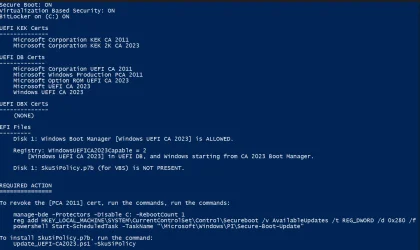
I have changed to MANUAL permanently instead of STANDARD so it would have a better chance of updating then ran the .\Check_UEFI-CA2023.ps1 script again:

Secure Boot: ON
Virtualization Based Security: OFF
BitLocker on (C:) OFF

UEFI PK Cert
------------
DO NOT TRUST - AMI Test PK
Platform Key is UNTRUSTED.

UEFI KEK Certs
--------------
Microsoft Corporation KEK CA 2011

UEFI DB Certs
-------------
Microsoft Corporation UEFI CA 2011
Microsoft Windows Production PCA 2011
Microsoft Option ROM UEFI CA 2023
Microsoft UEFI CA 2023
Windows UEFI CA 2023

UEFI DBX Certs
--------------
(NONE)

EFI Files
---------
Windows Boot Manager [Windows UEFI CA 2023] is BANNED.

Registry: WindowsUEFICA2023Capable = 2
[Windows UEFI CA 2023] in UEFI DB, and Windows starting from CA 2023 Boot Manager.


REQUIRED ACTION
===============

Run the command:
Update_UEFI-CA2023.ps1 -Revoke

Finish the UEFI steps to manually add the Platform Key (PK) cert, if the script provided instructions.

Finish the UEFI steps to manually add the [KEK CA 2023] cert, if the script provided instructions.

--------------------------------------------------------------------------------------------------------------------------------------------------------------------


Some screenshots from eufi when CUSTOM is enabled:
SecureBootCustom0.webpSecureBootCustom01.webpSecureBootCustom02.webp
 

My Computer My Computer

At a glance

Windows 10
OS
Windows 10
I have changed to MANUAL permanently instead of STANDARD so it would have a better chance of updating then ran the .\Check_UEFI-CA2023.ps1 script again:

Secure Boot: ON
Virtualization Based Security: OFF
BitLocker on (C:) OFF

UEFI PK Cert
------------
DO NOT TRUST - AMI Test PK
Platform Key is UNTRUSTED.

UEFI KEK Certs
--------------
Microsoft Corporation KEK CA 2011
You have the dreaded "AMI Test PK", which is considered insecure.

It's a default PK provided to OEM's as an example BIOS. But some OEM's unintentionally rolled it out to live PC's. If your OEM has never fixed the problem by replacing this BIOS, then you need to stay in Custom mode and delete all of the current certs.

MS created a special set of "Windows OEM Devices PK" certs for situations like your BIOS, as a direct replacement.

Disable Secure Boot mode, and delete all the certs. Run the check script again, and if you're confirmed in Setup mode then run the update script. The update script should recognize you're in Setup mode, and replace all the certs so you have the complete set of KEK's and DB's.

Afterwards, you can decide if it's time to revoke the CA 2011 cert or not.
 

My Computer My Computer

At a glance

Windows 7
OS
Windows 7
Not sure why I need to do anything if I have the KEK and the cert is in the DB and windows is starting from the CA 2023 boot manager? I've rebooted several times.

1775642910525.webp
 

My Computer My Computer

At a glance

11
OS
11
Computer type
Laptop
Not sure why I need to do anything if I have the KEK and the cert is in the DB and windows is starting from the CA 2023 boot manager? I've rebooted several times
You're done adding the required CA 2023 certs, except for the Option ROM cert (which may be needed by graphics cards that use signed firmware).

At this point, you can revoke the PCA 2011 cert or wait for MS to perform revocation later this year.

The script has a bug where it thinks the Option ROM is needed. Most users will add it any way so they don't worry about why their PC looks different from other PC's. Run these commands as Admin:
Code:
reg add HKEY_LOCAL_MACHINE\SYSTEM\CurrentControlSet\Control\Secureboot /v AvailableUpdates /t REG_DWORD /d 0x800 /f
powershell Start-ScheduledTask -TaskName "\Microsoft\Windows\PI\Secure-Boot-Update"
 

My Computer My Computer

At a glance

Windows 7
OS
Windows 7
I have a couple of cheap Mini PCs (Acemgic & Nipogi), and, despite the fact that they are both less than 2 years old there is little prospect of the manufacturer(s) updating their AMI based BIOS.
On my Acemagic S1
I have a similar output to GunnzAkimbo except that, after running the Update Script with the BIOS in Custom Mode, the Check Script shows:

UEFI PK Cert is:
------------
Windows OEM Devices PK

Running the Check Script shows:
BIOS Firmware
-------------
Default string Default string
Version: 5.26
Date: 2023-09-27

Factory Default UEFI PK Cert
----------------------------
DO NOT TRUST - AMI Test PK

Do I still need to clear all the certificates in the BIOS, with Secure Boot Disabled, and then re-run the update script? I cannot see how the Update script can actually write to the BIOS, which is where I presume the Factory Default PK is coming from?

I await, with interest, what the revised Secure Boot Status reports in the Security Centre, after the Windows Update to the Security Centre expected today (April 08).

Regards
SaliesBuzz
 

My Computer My Computer

At a glance

Windows11Intel(R) N97, 2000 Mhz, 4 Core(s), 4 Logical16GbIntel(R) UHD Graphics
OS
Windows11
Computer type
PC/Desktop
Manufacturer/Model
Acemagic S1
CPU
Intel(R) N97, 2000 Mhz, 4 Core(s), 4 Logical
Memory
16Gb
Graphics Card(s)
Intel(R) UHD Graphics
Sound Card
(Generic USB Audio)
Monitor(s) Displays
2
Screen Resolution
2560 x 1440 x 59 hertz
Hard Drives
Model KPART512GBC2DVT 512Gb
It doesn't look good for me as my OEM won't be providing an updated BIOS to my 5 years old laptop. What is the Setup Mode and how do I enter it as my laptop's BIOS does not allow manual addition of the certificates I think. This is what it shows for now:
1775662340622.webp
 

My Computer My Computer

At a glance

Windows 11 Pro 25H2Intel Core i7-11800H16GB (2x8 GB)RTX 3060 Laptop GPU
OS
Windows 11 Pro 25H2
Computer type
Laptop
Manufacturer/Model
Acer Predator Helios 300 PH314-54-72ZJ
CPU
Intel Core i7-11800H
Motherboard
TGL
Memory
16GB (2x8 GB)
Graphics Card(s)
RTX 3060 Laptop GPU
Sound Card
Realtek ALC295
Monitor(s) Displays
1
Screen Resolution
2560 x 1440 @ 165Hz
Hard Drives
1TB NVMe SSD, 512GB NVMe SSD, 1TB 7200 RPM HDD
Cooling
Aeroblade 5th Gen 3D fan
Keyboard
RGB Laptop keyboard
Mouse
Logitech Lightsync G203
Internet Speed
175 Mbps up/175 Mbps down
Browser
Firefox with uBlock Origin and YouTube enhancing extensions..
Antivirus
Windows Security with Core Isolation on
I have a couple of cheap Mini PCs (Acemgic & Nipogi), and, despite the fact that they are both less than 2 years old there is little prospect of the manufacturer(s) updating their AMI based BIOS.
On my Acemagic S1
I have a similar output to GunnzAkimbo except that, after running the Update Script with the BIOS in Custom Mode, the Check Script shows:

UEFI PK Cert is:
------------
Windows OEM Devices PK
Do I still need to clear all the certificates in the BIOS, with Secure Boot Disabled, and then re-run the update script? I cannot see how the Update script can actually write to the BIOS, which is where I presume the Factory Default PK is coming from?
If you have the Windows OEM Devices PK, the update script can install all of the required certs because MS provides a complete set of post-signed certs for vendors using this PK.

The easiest method is to clear all certs (with Secure Boot disabled) and run the update script. It should recognize you're in Setup Mode and install everything in one pass. I don't know if you cleared the non-PK certs. It's better in this case to have a clean slate so the replacement certs don't get a conflict with pre-existing ones.

That's just how MS packages these certs for use. Since your factory default is the AMI Test PK, MS would instruct you to do the same thing.
 

My Computer My Computer

At a glance

Windows 7
OS
Windows 7
It doesn't look good for me as my OEM won't be providing an updated BIOS to my 5 years old laptop. What is the Setup Mode and how do I enter it as my laptop's BIOS does not allow manual addition of the certificates I think. This is what it shows for now:
You're missing KEK CA 2023, which is the important one.

Depending on your BIOS, there's normally a setting for Custom (non-factory) mode. Once enabled, there might be an option to Remove All Keys or something similar to wipe all the current certs. This leaves your Secure Boot UEFI in a blank state, where we can install the MS provided Windows OEM Devices PK as a replacement set of certs.

That part is a little tricky, the exact screens or wording can be different on your BIOS version. Otherwise you may have menu options to delete individual keys, and you can try deleting all of them until none are left.
 

My Computer My Computer

At a glance

Windows 7
OS
Windows 7
Back
Top Bottom