Intel demos early prototype of next-generation Thunderbolt


newsroom-intel-next-gen-thunderbolt-2.jpg.rendition.intel.web.1648.927.jpg

newsroom-intel-next-gen-thunderbolt-3.jpg.rendition.intel.web.1648.927.jpg

newsroom-intel-next-gen-thunderbolt-4.jpg.rendition.intel.web.1648.927.jpg

newsroom-intel-next-gen-thunderbolt-5.jpg.rendition.intel.web.1648.927.jpg

newsroom-intel-next-gen-thunderbolt-6.jpg.rendition.intel.web.1648.927.jpg

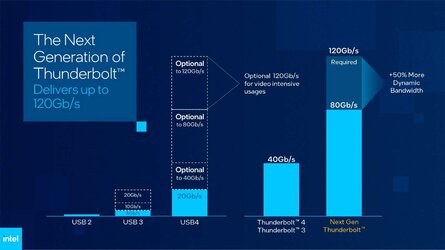
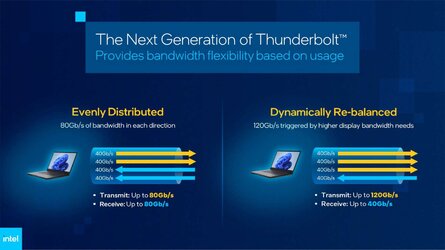
What’s New: Intel has demonstrated an early prototype of next-generation Thunderbolt™ in action, aligned to the USB Implementers Forum’s (USB-IF) release of the USB4 v2 specification this week. Next-generation Thunderbolt will deliver 80 gigabits per second (Gbps) of bi-directional bandwidth and enable up to 120 Gbps for the best display experience, providing up to three times the capability of today’s technologies to meet the growing needs of content creators and gamers, all while maintaining compatibility with previous versions of Thunderbolt and USB.

“Intel has always been the industry pioneer and leader for wired connectivity solutions, and Thunderbolt is now the mainstream port on mobile PCs and integrated into three generations of Intel mobile CPUs. We’re very excited to lead the industry forward with the next generation of Thunderbolt built on the USB4 v2 specification, advanced to this next generation by Intel and other USB Promoter Group members.”
–Jason Ziller, general manager of the Client Connectivity Division at Intel

Why It Matters: This prototype demonstration marks a major milestone in the journey to delivering next-generation Thunderbolt to the industry. The bandwidth needs of content creators and gamers are increasing significantly for high-resolution displays, low latency visuals, and the backup or transfer of huge video and data files. Next-generation Thunderbolt will deliver up to three times the capability of Thunderbolt™ 4 and make creating and gaming more efficient and immersive. In addition to supporting the latest version of USB4, the next generation of Thunderbolt will include improvements across a variety of areas including:
  • Two times the total bandwidth of Thunderbolt 4 to 80 Gbps, while providing up to three times the bandwidth to 120 Gbps for video-intensive usages.
  • Support for the newly released DisplayPort 2.1 for the best display experience.  
  • Two times the PCI Express data throughput for faster storage and external graphics.  
  • Works with existing passive cables up to 1m via a new signaling technology.
  • Compatible with previous versions of Thunderbolt, USB and DisplayPort.
  • Supported by Intel’s enabling and certification programs.


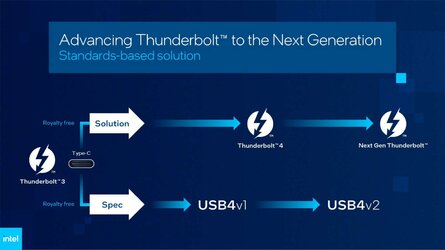
How Thunderbolt Drives the Industry: With the vision to make Thunderbolt available to everyone, Intel in 2019 contributed to the USB Promoter Group its Thunderbolt protocol specification, which served as the basis for USB4. As a leader in this industry group, Intel has worked to extend the performance of USB4 to the next level. 

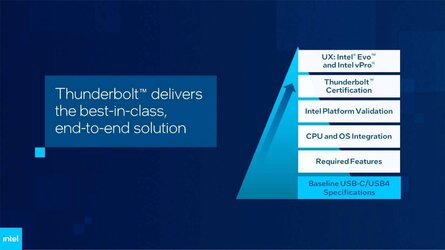
Intel has a long history of leading the industry in I/O innovation. Intel works closely with PC, accessory and cable partners to deliver the most advanced and complete wired connectivity solution through dedicated enabling and testing programs. All Thunderbolt products undergo stringent certification testing, and upon passing can use the Thunderbolt name and logo royalty-free on devices or in marketing. That’s why the Thunderbolt logo provides a simple, easily recognized indicator of the best wired connectivity solutions for PCs and accessories. 

What’s Next: Look for more detail on next-generation Thunderbolt’s official brand name, features and capabilities in 2023.

More Context: Intel Thunderbolt Technology | Engineered for Intel® Evo™ Accessory Program
Source:

 
Last edited:
I want to believe. Really, I do. It has taken Intel a long, long time to get USB4 to be a thing on PC system boards for the domestic end user and I can't help but to wonder if this sort of thing won't go sideways much the same way. People really, really need to know that USB4 and TB4 are not the same thing. No worries for me, personally, as I likely won't be able to upgrade my hardware to that extent anyway. Still, it seems rather sad that my Gen 4 platform can't do USB4 because to the best of my knowledge there's still no expansion card to pop into my PCIe that will give me those sorts of speeds on my AMD platform that I can call USB4. Year after year Intel kept saying USB4 would be here in the next quarter, but I haven't seen native on board USB4 available to the end user on a PC platform until just this year. They'll likely get some similitude of of this next generation TB5 going at some point as well, but I advise taking it all with a grain. Get ready to wait years and if I'm wrong, well good. That would be refreshing. *meh* Sour grapes. Low hanging fruit. Call me jaded.
 

My Computer My Computer

At a glance

WIN 11, WIN 10, WIN 8.1, WIN 7 U, WIN 7 PRO, ...Intel i7 6900K and i9-7960X / AMD 3800X (8 core)128 GB CORSAIR DOMINATOR PLATINUM (B DIE)NVIDIA 1070 and RTX 3070
OS
WIN 11, WIN 10, WIN 8.1, WIN 7 U, WIN 7 PRO, WIN 7 HOME (32 Bit), LINUX MINT
Computer type
PC/Desktop
Manufacturer/Model
DIY, ASUS, and DELL
CPU
Intel i7 6900K and i9-7960X / AMD 3800X (8 core)
Motherboard
ASUS X99E-WS USB 3.1 and ASUS X299 SAGE
Memory
128 GB CORSAIR DOMINATOR PLATINUM (B DIE)
Graphics Card(s)
NVIDIA 1070 and RTX 3070
Sound Card
Crystal Sound (onboard)
Monitor(s) Displays
single Samsung 30" 4K and 8" aux monitor
Screen Resolution
4K and something equally attrocious. I'll be working on this.
Hard Drives
A, B, C, D, E, F, G, H, I, J, K, L, M, N, O, P, Q, R, S, T, U, V, W

Ports X, Y, and Z are reserved for USB access and removable drives.

Drive types consist of the following: Various mechanical hard drives bearing the brand names, Seagate, Toshiba, and Western Digital. Various NVMe drives bearing the brand names Kingston, Intel, Silicon Power, Crucial, Western Digital, and Team Group. Various SATA SSDs bearing various different brand names.

RAID arrays included:

LSI RAID 10 (WD Velociraptors) 1115.72 GB
LSI RAID 10 (WD SSDS) 463.80 GB

INTEL RAID 0 (KINGSTON HYPER X) System 447.14 GB
INTEL RAID 1 TOSHIBA ENTERPRIZE class Data 2794.52 GB
INTEL RAID 1 SEAGATE HYBRID 931.51 GB
PSU
SEVERAL. I prefer my Corsair Platinum HX1000i but I also like EVGA power supplies
Case
ThermalTake Level 10 GT (among others)
Cooling
Noctua is my favorite and I use it in my main. I also own various other coolers.
Keyboard
all kinds.
Mouse
all kinds
Internet Speed
360 mbps - 1 gbps (depending)
Browser
FIREFOX
Antivirus
KASPERSKY (no apologies)
Other Info
Gave Dell touch screen with Windows 11 to daughter and got me an OTVOC. Being a PC builder I own many desktop PCs as well. I am a father of five providing PCs, laptops, and tablets for all my family, most of which I have modified, rebuilt, or simply built from scratch. I do not own a cell phone, never have, never will.

Latest Support Threads

Back
Top Bottom