KB5094126 causing app launch delays and service start timeout errors


Techie007

Well-known member
Member
Local time
10:32 AM
Posts
41
Location
Ohio
OS
Windows 11
Windows Update automatically rolled KB5094126 (2026-06 Security Update, build 8655) out to most computers running Windows 11 over the last few days, and I am experiencing some serious issues on several PCs after this update. Interestingly, I have more PCs configured identically and being used the same way (as an NVR) that are running the update just fine.

Initial symptoms that brought this issue to my immediate attention:
  • Blue Iris service doesn't autostart; EventLog records "A timeout was reached (45000 milliseconds) while waiting for the Blue Iris Service service to connect."
  • Jump Desktop service doesn't autostart; EventLog records "A timeout was reached (45000 milliseconds) while waiting for the JumpConnect service to connect."
  • OpenVPN service doesn't autostart; EventLog records "A timeout was reached (45000 milliseconds) while waiting for the OpenVPNService service to connect."
As these PCs are headless, the above results in them appearing to be offline. No other services are flagged as timing out. Apart from OpenVPN (which depends on DHCP), these services do not depend on any other services. None of these services logged any errors or even an attempt at being started to their own log files (i.e. Windows never launched them, or they were hung at a very early stage of initialization for 45 seconds before being terminated by Services.exe for failure to register, never getting a chance to log anything).

OpenVPN somehow gets automatically started at a later time, but the other two services (despite having Restart the Service as an unlimited failure action) never manage to get started. Another piece of software I wrote which launches at startup in the background via the Task Scheduler is starting fine, but delayed: Usually it logs something like "App started, system uptime 0:04/0:03" (mins:secs) every time a PC is booted, but on these PCs, it's logging "App started, uptime 1:45/uptime 2:02/uptime 1:55/uptime 2:05/uptime 2:11"—something is causing a significant startup delay.

Further diagnosis reveals:
  1. No setup actions are occurring at bootup—these PCs boot up to the login screen while processes in the background struggle to launch. Worth noting, there were several updates released a few months ago that all had update loop issues, which despite being successfully installed (at least according to winver), Windows would keep force-rebooting the PC to install them again and again—but this never caused any services to fail to start (they'd just start normally once the update process completed). A few days later, Microsoft would pull the update, release a new one the following week, and the forced reboot cycles (sometimes a dozen times every night) would go away after installing the replacement update.
  2. When I log in to Windows (local account) for the first time after rebooting, they log in to a black screen. The desktop takes 40 seconds to appear, and the taskbar takes another 10 seconds to appear after that. Clicking the notification area then takes about 5 seconds for the notification panel to open (it opens immediately after the first time). Normally, these PCs log in to a fully loaded desktop in about 2 seconds and there is never a delay in opening anything. The Start Menu works fine, but that's because I'm using OpenShell—I bet it would be having delays too if the Windows Start Menu was enabled. This happens whether I'm logging in immediately after system boot or hours later. However, it does not occur if I log out and log back in—2 seconds to the desktop no problem.
  3. Opening the Settings app, it sits there showing a big gear for 15 seconds before displaying normally. Subsequent opens occur in half a second as usual.
  4. Running System Informer (or any other program) as administrator, nothing happens for several seconds, the desktop dims for several seconds, the UAC dialog appears with no content or buttons for several seconds, then the content+buttons appear. System Informer starts immediately after clicking [Yes], showing low CPU usage and plenty of free memory. The PCs otherwise feel fast, and subsequent UAC dialogs pop up right away (even after logging out and back in). HwInfo shows the CPU core speeds bouncing around normally, so it's not stuck on low clocks with just one core unparked (for example). CPUs are Intel 10700K and 13900HX, 48GB RAM, all NVMe drives, etc.
  5. Standalone Win32 programs all seem to open instantly every time; this just seems to affect some programs—primarily ones using the modern/UWP platform (including the UAC dialog)—and the select Win32 sevices I mentioned above.
  6. There are no unusual errors/warnings in the main Event Logs. Drilling down into specific Application and Service logs:
  7. BitLocker-API/Management is reporting "BitLocker determined that the TCG log is invalid for use of Secure Boot. The filtered TCG log for PCR[7] is included in this event." as info. Another affected PC is alternating this and a warning "BitLocker cannot use Secure Boot for integrity because the expected TCG Log separator entry is missing or invalid." These errors first appear 6/10 after the update installed and seem to appear upon every boot. BitLocker is not in use whatsoever on these PCs and I'd love to uninstall it completely.
  8. State Repository/Operational is frequently logging error "Error 0x15: misuse at line 185353 of [737ae4a347] SQL" on the affected machines. This started after the update, but is not seen on the several updated yet unaffected machines I checked.
  9. WFP/Operational is logging a lot of warnings like "Transaction Watchdog Timeout. The filtering engine has exceeded the configured threshold to process a transaction. This could indicate a suboptimal policy configuration that may cause temporary network outages. Owning Process ID: 0. Transaction Time (msec): 3203. Transaction Commit Time (msec): 406. Configured Threshold (msec): 500". These warnings started 6/10 after the update.
  10. Windows Firewall With Advanced Security/FirewallDiagnostics is logging a lot of information like "FwThreadWaitTimeAndHoldTimeForFwLock. callersAppCommandLine: MPSSVC, callerFunctionName: FwProfileMgrUpdateCachedPolicy, threadWaitAndLockHoldTimeMs: 11969, fwLockHoldTimeMs: 11969". These informations started 6/10 after the update.
It's like the system is waiting on something in the background, but I can't seem to find any more information besides the above on what it could be. I added code to my software that would allow me to remotely start the services that were failing to autostart, and they come online just fine after making that request. But all the problems described above come back after a reboot—the affected services fail to start again, login takes forever, first UAC dialog is sluggish, etc. For the time being, I will just make it my program's responsibility to send a start request to the two services that are failing to autostart to work around the issues, and hope that a later Windows Update will resolve them.

Anyone else experiencing similar issues with this update? This update was supposed to make things faster, not slower! Any ideas what Microsoft broke this time?
 
Windows Build/Version
Windows 11 Pro 26200.8655

My Computer My Computer

At a glance

Windows 11
OS
Windows 11
Computer type
PC/Desktop
Manufacturer/Model
Intel i9-14900K
I experienced the same. It's specifically the KB5089573 update, that was rolled into that update.

At login, background apps are slow to start. My scheduled tasks in task scheduler are also slow to execute. What used to be a total of 30 second bootup/startup time turned into 3 minutes. I have auto login on boot, and I have autolock script to run at login to keep it protected. But since it doesn't run until a whole 1-2 minutes. I leaves my machine vulnerable for that amount of time.


Edit: The fix is to disable the new low latency profile with "vivetool.exe /disable /id:58989092"

You'll have to download vivetool and use the command line
 
Last edited:

My Computer My Computer

At a glance

windows 11AMD 5900x2x16GB Corsair DDR-3200RTX 2060 6GB
OS
windows 11
Computer type
PC/Desktop
Manufacturer/Model
Home Made
CPU
AMD 5900x
Motherboard
MSI MPG X570 GAMING EDGE WIFI (MS-737)
Memory
2x16GB Corsair DDR-3200
Graphics Card(s)
RTX 2060 6GB
Sound Card
none
Monitor(s) Displays
LG 32"
Screen Resolution
1440p
Hard Drives
Corsair MP400 8TB
Samsung 980 Pro 1TB
Cooling
NZXT Kraken AIO
Keyboard
Lily 58 Split
Mouse
Logitech G Pro 2 Wireless
Internet Speed
380/380mbps ATT Fiber
Browser
Firefox
Have you checked the Timeout Detection and Recovery,TDR, time is set at the default time of 2 seconds,in milliseconds ?
HKEY_Local_Machine\System\CurrentControlSet\Control\GraphicsDriver
The Reg key is TdrDelay.
Also have you tried disabling all non Microsoft Apps from auto starting,then re-enabling them,one at a time to see if if the cause of the problem lies there ?
 

My Computer My Computer

At a glance

win 10amd ryzen 5-2600ng skill sniper x 16gbnvidea gtx 1050
OS
win 10
Computer type
PC/Desktop
Manufacturer/Model
home built
CPU
amd ryzen 5-2600
Motherboard
gigabyte b450m-ds3h
Memory
ng skill sniper x 16gb
Graphics Card(s)
nvidea gtx 1050
Monitor(s) Displays
benq fp 92
Hard Drives
samsung 860 evo 500gb m2 ssd
PSU
antec ea550g
Case
nzxt noctis 450
Browser
edge
@duhk Wow, it's hard to believe it's the low latency profile causing the issue. Operating CPU speed is plenty fast during these issues due to background loads, and the systems aren't normally anywhere near this slow even if I manually force the CPU to run at its lowest speed (800 MHz) with only one core. But I refuse to use vivetool, so no verification on my end unless someone knows the actual FeatureFlags to toggle in the registry. I wonder if it's a notification issue (why would Microsoft make that a blocking call!), or something unrelated also attached to that feature flag.

@joeandmarg0 TdrDelay values are not present in any of the machines I checked (affected and not affected). Not seeing any visual evidence (or logs) that the video driver is getting restarted.
 

My Computer My Computer

At a glance

Windows 11
OS
Windows 11
Computer type
PC/Desktop
Manufacturer/Model
Intel i9-14900K
@duhk Wow, it's hard to believe it's the low latency profile causing the issue. Operating CPU speed is plenty fast during these issues due to background loads, and the systems aren't normally anywhere near this slow even if I manually force the CPU to run at its lowest speed (800 MHz) with only one core. But I refuse to use vivetool, so no verification on my end unless someone knows the actual FeatureFlags to toggle in the registry. I wonder if it's a notification issue (why would Microsoft make that a blocking call!), or something unrelated also attached to that feature flag.

@joeandmarg0 TdrDelay values are not present in any of the machines I checked (affected and not affected). Not seeing any visual evidence (or logs) that the video driver is getting restarted.
It's what fixed the issue for me. I prefer to utilize windows feature flags myself either through registry or group policy. But so far, I wasn't able to find any info on it. vivetool was the only solution. You can obviously re-enable if needed. But that's the only fix at the moment aside from rolling back the update.. I am also curious as to what it is exactly in the "Performance Update" that is causing the slow startup.

edit: Also the reason why only some of your machines are affected is because it's one of those "slow rollout" features. That could be why not soo many people are seeing the issue.
 
Last edited:

My Computer My Computer

At a glance

windows 11AMD 5900x2x16GB Corsair DDR-3200RTX 2060 6GB
OS
windows 11
Computer type
PC/Desktop
Manufacturer/Model
Home Made
CPU
AMD 5900x
Motherboard
MSI MPG X570 GAMING EDGE WIFI (MS-737)
Memory
2x16GB Corsair DDR-3200
Graphics Card(s)
RTX 2060 6GB
Sound Card
none
Monitor(s) Displays
LG 32"
Screen Resolution
1440p
Hard Drives
Corsair MP400 8TB
Samsung 980 Pro 1TB
Cooling
NZXT Kraken AIO
Keyboard
Lily 58 Split
Mouse
Logitech G Pro 2 Wireless
Internet Speed
380/380mbps ATT Fiber
Browser
Firefox
KB5095093 (2026-06 Preview Update, build 8737) has become available. Installing it did not solve the problem, but instead increased the number of machines facing this delay issue, to where it is now affecting about half of the machines I checked. After rebooting for the update, the affected machines sit on the pre-login screen just spinning with "Please wait..." for minutes, showing little to no activity. Then it would change to "Updates are underway. Please keep your computer on." for several more minutes, showing little to no activity. And then it abruptly switches to the login screen. Typically, when Windows is installing updates at this stage, you get a message like "You're 30% there. Please keep your computer on."—counting up over time. Not here—just those vanilla messages.
 

My Computer My Computer

At a glance

Windows 11
OS
Windows 11
Computer type
PC/Desktop
Manufacturer/Model
Intel i9-14900K
Now running Windows 11 build 26200.9278 with 26H2 expected to release soon, yet this bug remains unresolved and bad as ever: PCs that should boot to the desktop in 20 seconds are barely usable after several minutes—over a minute for the desktop to appear after logging in, another 30 seconds before the taskbar appears, some programs open right away when clicked, and then proceed to hang, some services repeatedly fail to start, etc.

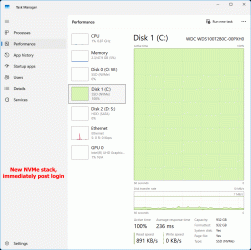
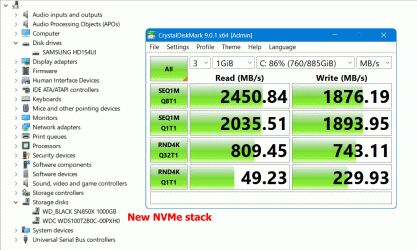
However, I recently noticed in Task Manager that the system NVMe drive is sitting there, pegged at 100% activity for minutes, with response times regularly over 100ms and transfer rates in the 1MB/s range while this is happening. Comparing with one machine that has remained unaffected, I noticed the unaffected machine is using the old NVMe stack. Back when the new NVMe stack was rolled out, I did quite a bit of testing and found universal speed improvements and reduced CPU usage during high I/O with no significant issues, and included it in my debloating script—with no problems until KB5094126 was released back in June. The unaffected machine using the old NVMe stack had all the applicable "14 series" feature switches enabled (156965516, 735209102, 1176759950, 1853569164, 3244671118)—except for 3244671118, which was not present. So for a test on an affected machine, I deleted "HKLM\SYSTEM\CurrentControlSet\Control\FeatureManagement\Overrides\14\3244671118" from the registry, ran ReconcileFeatures, and rebooted. That PC rebooted to the desktop in 20 seconds for the first time in months! Opening Device Manager confirmed it was no longer using the new NVMe stack. I ran CrystalDiskMark before and after, and the results are as expected: Faster on the new NVMe stack, and slower on the old NVMe stack. Yet there is some massive I/O bottleneck occuring under unknown circumstances that seem to trigger primarily when the system is booting up when using the new NVMe stack, causing extreme delays and service start failures. I don't know what Microsoft broke (and I bet they don't know either!), but I'm glad I found a solution. Too bad the new NVMe stack has to go on the back burner for now!

NVMe Task Manager.gif
NVMe benchmark.gif

tl,dr: The issues and massive slowdown introduced in June is caused by a negative interaction between something Microsoft added in June and the new NVMe stack. Removing override "14\3244671118" from the registry, reconciling features, and rebooting, restores normal system operation using the legacy storage stack without losing the low latency power profile improvements.
 

My Computer My Computer

At a glance

Windows 11
OS
Windows 11
Computer type
PC/Desktop
Manufacturer/Model
Intel i9-14900K
Now running Windows 11 build 26200.9278 with 26H2 expected to release soon, yet this bug remains unresolved and bad as ever: PCs that should boot to the desktop in 20 seconds are barely usable after several minutes—over a minute for the desktop to appear after logging in, another 30 seconds before the taskbar appears, some programs open right away when clicked, and then proceed to hang, some services repeatedly fail to start, etc.

However, I recently noticed in Task Manager that the system NVMe drive is sitting there, pegged at 100% activity for minutes, with response times regularly over 100ms and transfer rates in the 1MB/s range while this is happening. Comparing with one machine that has remained unaffected, I noticed the unaffected machine is using the old NVMe stack. Back when the new NVMe stack was rolled out, I did quite a bit of testing and found universal speed improvements and reduced CPU usage during high I/O with no significant issues, and included it in my debloating script—with no problems until KB5094126 was released back in June. The unaffected machine using the old NVMe stack had all the applicable "14 series" feature switches enabled (156965516, 735209102, 1176759950, 1853569164, 3244671118)—except for 3244671118, which was not present. So for a test on an affected machine, I deleted "HKLM\SYSTEM\CurrentControlSet\Control\FeatureManagement\Overrides\14\3244671118" from the registry, ran ReconcileFeatures, and rebooted. That PC rebooted to the desktop in 20 seconds for the first time in months! Opening Device Manager confirmed it was no longer using the new NVMe stack. I ran CrystalDiskMark before and after, and the results are as expected: Faster on the new NVMe stack, and slower on the old NVMe stack. Yet there is some massive I/O bottleneck occuring under unknown circumstances that seem to trigger primarily when the system is booting up when using the new NVMe stack, causing extreme delays and service start failures. I don't know what Microsoft broke (and I bet they don't know either!), but I'm glad I found a solution. Too bad the new NVMe stack has to go on the back burner for now!

View attachment 181401
View attachment 181402

tl,dr: The issues and massive slowdown introduced in June is caused by a negative interaction between something Microsoft added in June and the new NVMe stack. Removing override "14\3244671118" from the registry, reconciling features, and rebooting, restores normal system operation using the legacy storage stack without losing the low latency power profile improvements.
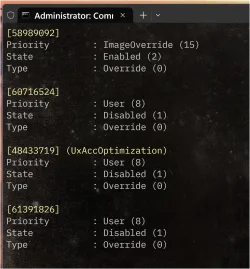
Thought I'd mention I have slow desktop app loading every boot or reboot on my old 10th gen i7 CPU machine ever since I enabled full Low Latency mode (vivetool codes 58989092,60716524,48433719,61391826). Oddly enough I can't fully disable it now since MS locks code 58989092 as enabled overriding my disabled setting if I try to disable this feature (see screen shot).

On the flip side my Intel Core Ultra 9 and ARM64 Snapdragon X Elite CPU's will NOT enable the new MS Windows Low Latency mode as their CPU architecture is not compatible with this setting and they do not need this feature because they already handle this behavior natively at the hardware level. The technology is already built into their CPU's. Of course they don't have the slow desktop loading either. I haven't played with the registry settings on the i7 CPU or looked into it any further, just an interesting observation I noticed on that machine since the Low Latency feature appeared and is standard now for it. It can NOT be fully enabled on the Core Ulltra 9 or ARM machines as MS locks certain vivetool codes from enabling which is probably a good thing for those CPU's.

Screenshot 2026-09-01 062652.webp
 

My Computers My Computers

  • At a glance

    Windows 11 25H2Intel Core Ultra 9 275HX (24-Core)64GB DDR5 6400MT/sNVIDIA GeForce RTX 5080 and Intel UHD Graphics
    OS
    Windows 11 25H2
    Computer type
    Laptop
    Manufacturer/Model
    Alienware 18 Area-51
    CPU
    Intel Core Ultra 9 275HX (24-Core)
    Motherboard
    Alienware
    Memory
    64GB DDR5 6400MT/s
    Graphics Card(s)
    NVIDIA GeForce RTX 5080 and Intel UHD Graphics
    Sound Card
    Onboard, Realtek high-performance Audio chips (ALC3329 & ALC1708))
    Monitor(s) Displays
    300HZ 18-inch QHD 500 nit Comfort View+
    Screen Resolution
    2560 x 1600
    Hard Drives
    2TB NVMe M.2 PCIe Gen 5 SSD
    Case
    Magnesium Alloy
    Cooling
    Advanced Cryo-Tech Quad-Fan Cooling system & large vapor chamber
    Keyboard
    Cherry MX ultra low profile mechanical keyboard with per key AlienFX RGB lighting
    Mouse
    Logitech MX Master 4
    Browser
    Vivaldi (main), Firefox, Chrome, Edge
    Antivirus
    MS Defender and Malwarebytes Free
  • At a glance

    Windows 11 26H2Qualcomm Snapdragon X Elite (12 Core) ARM bas...16GB LPDDR5Qualcomm Adreno X1-85
    Operating System
    Windows 11 26H2
    Computer type
    Laptop
    Manufacturer/Model
    Microsoft Surface Laptop 7
    CPU
    Qualcomm Snapdragon X Elite (12 Core) ARM based CPU
    Motherboard
    Microsoft Corp.
    Memory
    16GB LPDDR5
    Graphics card(s)
    Qualcomm Adreno X1-85
    Sound Card
    Omnisonic speakers with Dolby Atmos spatial sound
    Monitor(s) Displays
    120 Hz 13.8-inch 600 nit PixelSense Flow touchscreen
    Screen Resolution
    2304x1536
    Hard Drives
    1TB NVMe Gen 4 SSD
    Case
    Anodized Aluminum
    Cooling
    Traditional active cooling fan system
    Keyboard
    Mechanical QWERTY, backlit when in use
    Mouse
    Logitech MX Master 4 and Surface Arc Mouse
    Browser
    Vivaldi (main), Firefox, Chrome, Edge
    Antivirus
    MS Defender and Malwarebytes Free
@Techie007

Oh god, great find. I appreciate your persistence in figuring out the root cause of the issue. I can confirm that I am using the new NVME driver with the overrides. Time to disable the new NVME driver as it really didn't offer too much of a noticeable difference in everyday usage.

It was such a headache having to downgrade after every new update to find the issues persists.

@FranchoDT
You have to disable the NVME driver as mentioned by Techie007. Disabling "58989092" with vivetool was my original way to resolve the issue, but Microsoft has hard coded it at the system level in the recent update and we are unable to change it any further.

Edit: I've disabled the new NVME driver and it has fixed the slow bootup problem. But without it, my machine is not booting up as instantly as before anymore. It's probably by a 5 second difference now. But it's a lot better than how it was which was 3+ minutes.
 
Last edited:

My Computer My Computer

At a glance

windows 11AMD 5900x2x16GB Corsair DDR-3200RTX 2060 6GB
OS
windows 11
Computer type
PC/Desktop
Manufacturer/Model
Home Made
CPU
AMD 5900x
Motherboard
MSI MPG X570 GAMING EDGE WIFI (MS-737)
Memory
2x16GB Corsair DDR-3200
Graphics Card(s)
RTX 2060 6GB
Sound Card
none
Monitor(s) Displays
LG 32"
Screen Resolution
1440p
Hard Drives
Corsair MP400 8TB
Samsung 980 Pro 1TB
Cooling
NZXT Kraken AIO
Keyboard
Lily 58 Split
Mouse
Logitech G Pro 2 Wireless
Internet Speed
380/380mbps ATT Fiber
Browser
Firefox

Latest Support Threads

Back
Top Bottom