Windows Experience Blog:
When we talk about new AI-powered devices and experiences, the focus often lands on the pace of technological progress. But just as quickly, the way people are using these tools—and how they feel about them—is evolving too.
To better understand that shifting sentiment, we commissioned new consumer AI research that digs deeper into people’s priorities and perceptions. Going beyond usage data, we examined the emotional undercurrents: what excites people about AI, what gives them pause and how those attitudes shift across generations.
What emerged is a more textured view of consumer behavior. In this report, you’ll find insights that add greater dimension to what meaningful AI solutions look like today.
The full report is available for download here.
From burnout to breakthrough: Americans use AI to move forward
This consumer AI report examines evolving attitudes toward AI. It presents findings from research conducted by an independent research firm, Edelman Data & Intelligence, among 1,000 consumers in the United States ages 13 and older between March 14, 2025 and March 25, 2025. As both AI tools and human behaviors continue to shift, the report offers a research-backed lens for business leaders, organizations, and curious individuals seeking to understand what’s changing and why.Can AI help an overloaded generation cut through the noise?
These days, we have a lot on our minds.We’re living in an era where information has never been so available. Entire histories of societies, bodies of scholarship, and even the details of our own relationships can be pulled up with a single search. But instead of helping us get ahead, it often just adds more noise. Traditional authority has fractured and everywhere we turn, new voices and platforms compete for our attention. In fact, 7 in 10 consumers admit they are overwhelmed by the amount of information available when making a decision.
So it’s no surprise that we’re starting to question not just our choices, but how we make them. This is where AI offers a new way forward: our research finds that it counteracts decision fatigue by lightening the mental burden of weighing one’s options. After using AI when making a decision, 84% percent of people report experiencing positive emotion.
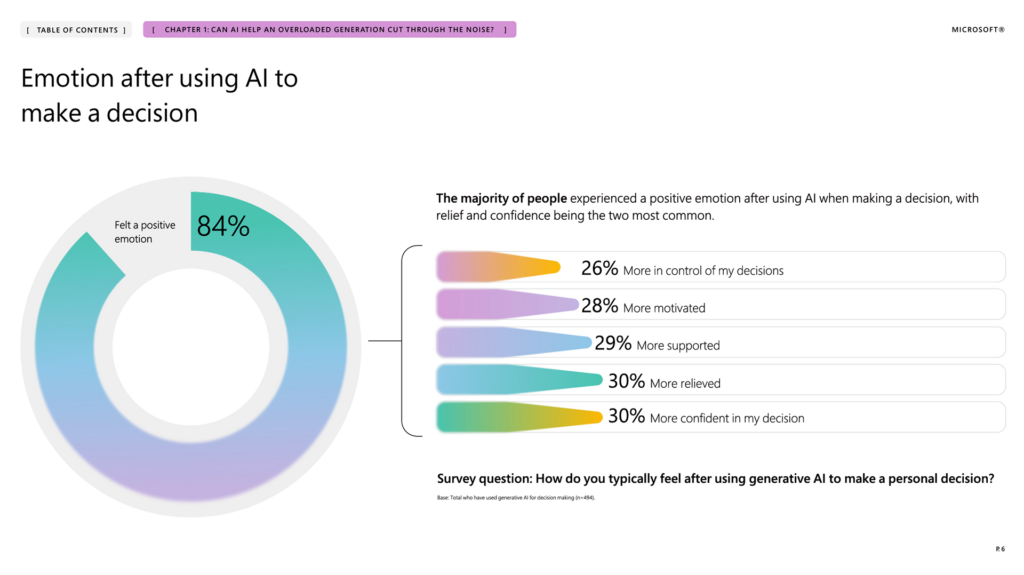
Majority experience a positive emotion after using AI to make a decision: Eighty-four percent of people felt a positive emotion after using AI when making a decision, with relief and confidence being the two most common.
Introducing Generation AI
Leading the way is Generation AI, born between 1995 and 2012. Raised on increasingly intuitive digital tools, they’ve learned how to embrace emerging technologies as a support system rather than merely a shortcut—from PCs and mobile devices, to the internet, and now AI. This generation is 16% more likely to use AI tools than those who are older, and when they do, they’re finding more than answers. They’re unlocking a greater sense of relief and confidence, a result that users of all ages can learn from.AI interrupts overthinking, before the spiral starts
AI’s mainstream moment comes at a critical time for this generation’s mental health.Generation AI is carrying a compound burden made up of the ambient weight of everyday social pressures, persistent economic uncertainty, digital isolation, and the long tail of a global pandemic. Seventy-two percent of those aged 18-34 rate mental health as a significant stressor, the highest among all age cohorts.
With estimates suggesting that the average person can face thousands of choices each day, this mental load is unrelenting. It’s the kind of weight that turns indecision into inaction, leading people to abandon choices that once felt important.
Even once we are finally able to make up our minds, it rarely feels like closure. Sixty-eight percent of Generation AI would describe themselves as an “overthinker,” someone who spends a lot of time worrying about their decisions, even after making them. Would-be relief is clouded by doubt, a lingering sense that maybe we missed something better, smarter, or more optimized.
But data shows that AI offers overthinkers a different outcome. Across all age groups, respondents were more than twice as likely to feel relieved (30%) or confident (30%) compared to anxious (14%) or frustrated (14%) after using generative AI to make a personal decision.
This confidence boost applies to a range of relatable scenarios. Many find support for things they are passionate about, involving AI in decisions around entertainment (34%) or travel (25%). For others, AI proves helpful in moving through more emotionally fraught territory, such as money decisions (35%), health and wellness (35%), and career or job considerations (34%).

AI helps make decisions in diverse scenarios: Generative AI helps users make decisions in the following areas: money (35%), health and wellness (35%), career or job (34%), entertainment (34%), and travel (25%).
Instead of dwelling on these decisions interminably, every prompt becomes a quiet practice in turning uncertainty into action.
Creating a safe space for deeper, more helpful answers
We are now getting a glimpse into a tech-powered future that is more intuitive, personal, and judgment-free. AI reflects consumers’ curiosity back to them in a way few tools have before. When they need help making a decision, a third of respondents (33%) say they appreciate that AI gives them a clear, personalized response.Getting the right advice has always depended on the gatekeepers of the moment. In the past, information was limited by which experts or institutions one had access to. Even the internet, once seen as the great equalizer, has its limits. The search engines that Generation AI grew up using may have put pages and pages of web results at their fingertips, but they stopped short at turning that data into something truly actionable. This has left 67% of this age group feeling like it is still “hard to find guidance or suggestions that fit my exact situation” when gathering information to answer a question or make a decision.
Now, they have somewhere else to turn; a conversational advisor that can match their thirst for knowledge with specificity, flexibility, and patience. When asked about using generative AI for advice, all respondents cite a sense of emotional delicacy, noting how “I can ask as many follow-up questions as I want without feeling bad” (81%) and “AI doesn’t judge me like a person would” (78%).
This change in our relationship with information also changes how we learn. Recent research on AI usage found that students aged 18 and older used it more than any other employment group, with 85% reporting usage. Generation AI students are now more likely to rank AI as a helpful study aid (45%) than books (36%) or a one-on-one tutor (27%).
The way AI users describe themselves tells us more about their mindset. Those who use AI to make decisions are more likely to say they are “ambitious” (+20ppts), “decisive” (+15ppts), and “problem solvers” (+10 ppts) compared to those who don’t use it. These labels signal how AI might intersect with a generation’s sense of self.

AI users describe themselves differently: People who use AI to make decisions are more likely to describe themselves as a problem solver (+10ppts), ambitious (+20ppts), and decisive (+16ppts).
While each individual interaction might feel small, these micro-moments of support can foster trust in both the technology itself and in the user’s own ability to choose.
Hopeful but not naïve, Generation AI brings discernment to AI asks
This isn’t the first time Generation AI has lived through a major technological shift, and it won’t be the last. As true digital natives, they approach any new tool with nuance, carefully weighing the promised benefits against potential tradeoffs.When it comes to AI, 66% of this generation is optimistic that it will improve our lives and the world we live in. While only 15% of all consumers say they fully trust AI when making important decisions, 95% have still used a generative AI tool in the past month—suggesting that people are finding meaningful, appropriate ways to engage with these tools. Rather than blind trust, this is thoughtful adoption: users are integrating AI into their broader decision-making process in ways that feel supportive and safe.
Also in the mix? Friends, family, experts, and professionals. But most of all, their own judgment: 59% of consumers trust their gut when making a decision.

Trust varies across sources when making important decisions: When making an important decision, 15% trust AI—less than their own gut (59%), advice from friends or family (44%), or web search results (37%), the same as teachers (15%), and more than social media influencers (11%) or political leaders (7%).
Call it curiosity, caution, or a carefully balanced blend of both. While 59% of all respondents used generative AI for work and business purposes in the past year, even more have explored how it might fit into their personal lives. Sixty-four percent report using AI for hobbies and personal interests, such as art music, or DIY projects.
AI can help sort through today’s information overload until one’s instincts take over. It summarizes information so that it is easier to understand (34% of use cases), shows different options that users hadn’t thought about (31%), and compares choices by showing pros and cons (30%).
Turning to AI in these everyday moments builds a rhythm of trust—measured, useful, and often accompanied by a sense of relief. With just enough structure to help people make sense of pressing considerations, these tools make confident decision-making possible.
In a world that often feels like too much, AI offers something rare: relief
Our research shows that American consumers are taking the emotional edge off decision-making by bolstering their own judgement with AI-powered tools that offer clarity, curiosity, and calm.AI reshapes what it feels like to choose. The “before”—that data-gathering phase—is shorter, more streamlined. Information is delivered clearly, without overload or judgment. The “after” feels different too, marked by reassurance instead of regret. Instead of spiraling over making the right call, individuals experience a sturdy sense of confidence.
The proof is in the practice: using these tools as Generation AI does, for everyday decisions both big and small, changes what’s possible. Over time, it builds the kind of momentum that moves people through uncertainty, not just around it. And when faced with the daily thrum of decisions, it helps them trust themselves enough to move forward.
Source:

Understanding what AI means to consumers
When we talk about new AI-powered devices and experiences, the focus often lands on the pace of technological progress. But just as quickly, the way people are using these tools—and how they feel about them—is evolving
 blogs.windows.com