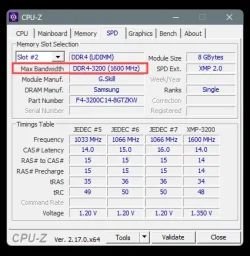
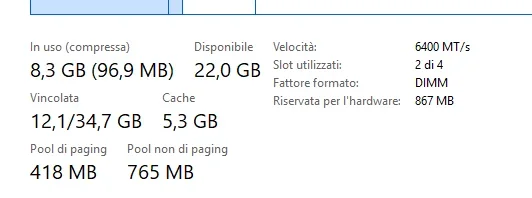
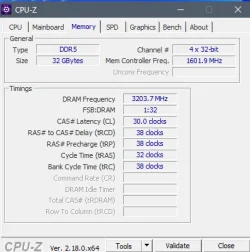
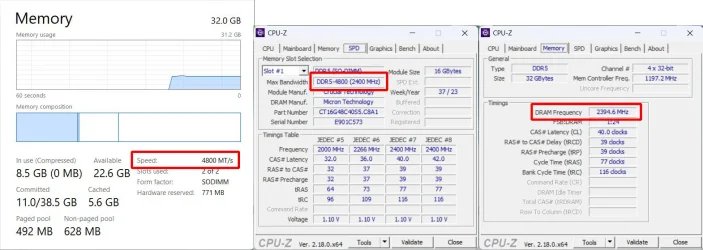
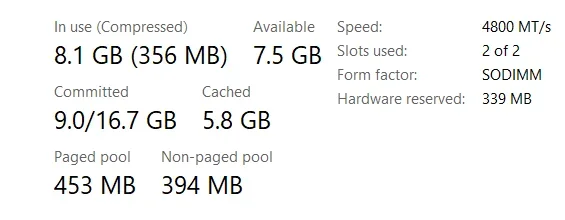
This Task Manager (Windows 10) shows 800 MHz, not MT/s. I have DDR3 at "1600 MHz" in this computer (the RAM itself can do 1866 w/ XMP but the mobo cannot w/ 4x8 GB modules, pre-Ryzen AMDs are poor in memory bandwidth anyway -14 GB/s I've heard for the FX8350, Intel was superior in this age specially in memory bandwidth, bear in mind double channel-). It follows the same rule as CPU-Z, that I consider "half the speed". 800 MHz is the RAM timers frecuency ("CL9" means 9 cycles of a 800 MHz clock), 1600 MHz is the data frequency. To get the PC3-12800 (or PC3-14933/14900 if @1866) you multiply the timers frequency times 16 or the data frequency times 8 (the data bus has 64 bits = 8 bytes), and you get MB/s (and per channel).
My first DDR RAM had 100 and 133 MHz. The 100 MHz modules for a 500 MHz Katmai (first Pentium 3) were weak and I upgraded them to 133. Before or after I upgraded the Katmai to a 650 MHz Coppermine (evolved Pentium 3) that could do 866 as if it were an 866 MHz part, with "133 MHz RAM" of course. I'm sure it was so in the commerce and in the users minds. Maybe DDR 200/400 started with the shift to name the data frequency.
I still have a DDR2 system, all my DDR2 RAM is/has been "800 MHz". The same for DDR3 (1333, 1600 or 1866 here) and DDR4 (I believe my miniPC uses 2133 MHz, soldered anyway).











 Apple 13" Macbook Pro 2020 (m1)