Network and Internet Turn On or Off Network Discovery in Windows 11

  • Thread starter Thread starter Brink
  • Start date Published: Start date Updated Updated:

Network_and_Internet_banner.webp

This tutorial will show you how to turn on or off network discovery for private and public networks on your Windows 11 PC.

Network Discovery is a network setting that affects whether your computer can see (find) other computers and devices on the same network and whether other computers and devices on the same network can see your computer.

When network discovery is turned on, the device sends out signals over the network to search for other discoverable devices. This makes it convenient for you to share network resources among the devices connected to the network.

There are three network discovery states:

Discovery StateDescription
OnThis state allows your computer to see other network computers and devices and allows people on other network computers to see your computer. This makes it easier to share files and printers.
OffThis state prevents your computer from seeing other network computers and devices and prevents people on other network computers from seeing your computer.
CustomThis is a mixed state in which some settings related to network discovery are enabled, but not all of them. For example, network discovery could be turned on, but you or your system administrator might have changed firewall settings that affect network discovery.

Windows creates a separate network profile for each network you use. You can turn on or off network discovery separately for each Private and Public network profile type.

Reference:


You must be signed in as an administrator to turn on or off network discovery.

If you can't turn on Network Discovery, check to make sure the services below are enabled, set to automatic (startup type), and running (status).

DNS Client
Function Discovery Provider Host
Function Discovery Resource Publication
SSDP Discovery
UPnP Device Host


Contents

  • Option One: Turn On or Off Network Discovery in Settings
  • Option Two: Turn On or Off Network Discovery in PowerShell


EXAMPLE: Computer with network discovery turned on showing up in File Explorer > Network

File_Explorer_Network.png


Option One

Turn On or Off Network Discovery in Settings


1 Open Settings (Win+I).

2 Click/tap on Network & internet on the left side, and click/tap on Advanced network settings on the right side. (see screenshot below)

Network_Discovery_Settings-1.png

3 Click/tap on Advanced sharing settings on the right side. (see screenshot below)


Network_Discovery_Settings-2.png

4 Click/tap on Private networks and/or Public networks to expand open. (see screenshot below step 5)

5 Turn On or Off Network discovery for what you want for private and public networks.

Network discovery is turned off by default for public networks.

Network discovery is turned on by default for private networks. You can also check (default) or uncheck Set up network connected devices automatically for private networks.


Network_Discovery_Settings-3.png

6 You can now close Settings if you like.


Option Two

Turn On or Off Network Discovery in PowerShell


1 Open Windows Terminal (Admin), and select Windows PowerShell.

2 Do step 3 (on) or step 4 (off) below for what you want.


 3. Turn On Network Discovery

A) Copy and paste the command below you want to use into the elevated PowerShell, press Enter, and go to step 5 below.

(Apply to all network profiles)
Set-NetFirewallRule -Group '*-32752*' -Enabled 'True'

OR​

(Apply to "Domain" network profile)
Get-NetFirewallRule -Group '*-32752*' | Where-Object 'Profile' -Match 'Domain' | Set-NetFirewallRule -Enabled 'True'

OR​

(Apply to "Private" network profile)
Get-NetFirewallRule -Group '*-32752*' | Where-Object 'Profile' -Match 'Private' | Set-NetFirewallRule -Enabled 'True'

OR​

(Apply to "Public" network profile)
Get-NetFirewallRule -Group '*-32752*' | Where-Object 'Profile' -Match 'Public' | Set-NetFirewallRule -Enabled 'True'


 4. Turn Off Network Discovery

A) Copy and paste the command below into the elevated PowerShell, press Enter, and go to step 5 below. (see screenshot below)

(Apply to all network profiles)
Set-NetFirewallRule -Group '*-32752*' -Enabled 'False'

OR​

(Apply to "Domain" network profile)
Get-NetFirewallRule -Group '*-32752*' | Where-Object 'Profile' -Match 'Domain' | Set-NetFirewallRule -Enabled 'False'

OR​

(Apply to "Private" network profile)
Get-NetFirewallRule -Group '*-32752*' | Where-Object 'Profile' -Match 'Private' | Set-NetFirewallRule -Enabled 'False'

OR​

(Apply to "Public" network profile)
Get-NetFirewallRule -Group '*-32752*' | Where-Object 'Profile' -Match 'Public' | Set-NetFirewallRule -Enabled 'False'

5 You can now close the elevated PowerShell if you like.


That's it,
Shawn Brink


Last edited:

Shawn, Option Three and Fourn don't work for me. Admin account running in a Powershell Admin window.

1689784290080.png


Windows PowerShell
Copyright (C) Microsoft Corporation. All rights reserved.

Install the latest PowerShell for new features and improvements! Migrating from Windows PowerShell 5.1 to PowerShell 7 - PowerShell

PS C:\Users\ASCTh> netsh advfirewall firewall set rule group="Network Discovery" new enable=Yes

A specified value is not valid.


Windows PowerShell
Copyright (C) Microsoft Corporation. All rights reserved.

Install the latest PowerShell for new features and improvements! Migrating from Windows PowerShell 5.1 to PowerShell 7 - PowerShell

PS C:\Users\ASCTh> Set-NetFirewallRule -DisplayGroup "Network Discovery" -Enabled False -Profile Any
Set-NetFirewallRule : Access is denied.

At line:1 char:1
  • Set-NetFirewallRule -DisplayGroup "Network Discovery" -Enabled False ...
  • ~~~~~~~~~~~~~~~~~~~~~~~~~~~~~~~~~~~~~~~~~~~~~~~~~~~~~~~~~~~~~~~~~~~~~
+ CategoryInfo : PermissionDenied: (MSFT_NetFirewal...ystemName = ""):root/standardcimv2/MSFT_NetFirewall
Rule) [Set-NetFirewallRule], CimException
+ FullyQualifiedErrorId : Windows System Error 5,Set-NetFirewallRule
 

My Computer

System One

  • OS
    Windows 11 Pro X64 25H2 Build 26200.7019
    Computer type
    PC/Desktop
    Manufacturer/Model
    Dell Vostro 3910
    CPU
    12th Gen Intel Core i7-12700, 2.1Ghz
    Memory
    32.0GB PC3-12800 DDR3 SDRAM
    Graphics Card(s)
    EVGA GeForce GTX 780
    Sound Card
    Realtek HD Audio
    Monitor(s) Displays
    Visio 32" TV
    Screen Resolution
    1920x1080
    Hard Drives
    2TB Samsung NVME SSD 990 PRO with Heatsink
    4TB Fanxiang 2.5" SATA III SSD S101Q
    PSU
    ?
    Keyboard
    Dell USB SK-8115
    Mouse
    Microsoft Sculpt Mobile Mouse 1569
    Internet Speed
    374.10MB Down, 11.75MB Up
    Browser
    Edge - eM Client Pro for E-Mail
    Antivirus
    Windows Security
    Other Info
    Purchased December 2013, many upgrades since then
Shawn, Option Three and Fourn don't work for me. Admin account running in a Powershell Admin window.

Hello Rich, :alien:

Just to confirm, did you open an elevated PowerShell like below?


My Computers

System One System Two

  • OS
    Windows 11 Pro for Workstations
    Computer type
    PC/Desktop
    Manufacturer/Model
    Custom self build
    CPU
    Intel i7-8700K 5 GHz
    Motherboard
    ASUS ROG Maximus XI Formula Z390
    Memory
    64 GB (4x16GB) G.SKILL TridentZ RGB DDR4 3600 MHz (F4-3600C18D-32GTZR)
    Graphics Card(s)
    ASUS ROG-STRIX-GTX1080TI-O11G-GAMING (11GB GDDR5X)
    Sound Card
    Integrated Digital Audio (S/PDIF)
    Monitor(s) Displays
    2 x Samsung Odyssey G75 27"
    Screen Resolution
    2560x1440
    Hard Drives
    1TB Samsung 990 PRO M.2,
    4TB Samsung 990 PRO M.2,
    TerraMaster F8 SSD Plus NAS
    PSU
    Seasonic Prime Titanium 850W
    Case
    Thermaltake Core P3 wall mounted
    Cooling
    Corsair Hydro H115i
    Keyboard
    Amazon Basics Wired Full Keyboard MD005
    Mouse
    Logitech MX Master 4
    Internet Speed
    2 Gbps Download and 100 Mbps Upload
    Browser
    Chrome and Edge
    Antivirus
    Microsoft Defender
    Other Info
    Logitech Z625 speaker system,
    Logitech BRIO 4K Pro webcam,
    HP Color LaserJet Pro MFP M477fdn,
    CyberPower CP1500PFCLCD
    Galaxy S23 Plus phone
  • Operating System
    Windows 11 Pro
    Computer type
    Laptop
    Manufacturer/Model
    Surface Laptop 7 Copilot+ PC
    CPU
    Snapdragon X Elite (12 core) 3.42 GHz
    Memory
    16 GB LPDDR5x-7467 MHz
    Monitor(s) Displays
    15" HDR
    Screen Resolution
    2496 x 1664
    Hard Drives
    1 TB SSD
    Internet Speed
    Wi-Fi 7 and Bluetooth 5.4
    Browser
    Chrome and Edge
    Antivirus
    Microsoft Defender
Hi Shawn, sorry for the late reply. I believe I did but I check tomorrow when I get tot work.
 

My Computer

System One

  • OS
    Windows 11 Pro X64 25H2 Build 26200.7019
    Computer type
    PC/Desktop
    Manufacturer/Model
    Dell Vostro 3910
    CPU
    12th Gen Intel Core i7-12700, 2.1Ghz
    Memory
    32.0GB PC3-12800 DDR3 SDRAM
    Graphics Card(s)
    EVGA GeForce GTX 780
    Sound Card
    Realtek HD Audio
    Monitor(s) Displays
    Visio 32" TV
    Screen Resolution
    1920x1080
    Hard Drives
    2TB Samsung NVME SSD 990 PRO with Heatsink
    4TB Fanxiang 2.5" SATA III SSD S101Q
    PSU
    ?
    Keyboard
    Dell USB SK-8115
    Mouse
    Microsoft Sculpt Mobile Mouse 1569
    Internet Speed
    374.10MB Down, 11.75MB Up
    Browser
    Edge - eM Client Pro for E-Mail
    Antivirus
    Windows Security
    Other Info
    Purchased December 2013, many upgrades since then

My Computers

System One System Two

  • OS
    Windows 11 Pro for Workstations
    Computer type
    PC/Desktop
    Manufacturer/Model
    Custom self build
    CPU
    Intel i7-8700K 5 GHz
    Motherboard
    ASUS ROG Maximus XI Formula Z390
    Memory
    64 GB (4x16GB) G.SKILL TridentZ RGB DDR4 3600 MHz (F4-3600C18D-32GTZR)
    Graphics Card(s)
    ASUS ROG-STRIX-GTX1080TI-O11G-GAMING (11GB GDDR5X)
    Sound Card
    Integrated Digital Audio (S/PDIF)
    Monitor(s) Displays
    2 x Samsung Odyssey G75 27"
    Screen Resolution
    2560x1440
    Hard Drives
    1TB Samsung 990 PRO M.2,
    4TB Samsung 990 PRO M.2,
    TerraMaster F8 SSD Plus NAS
    PSU
    Seasonic Prime Titanium 850W
    Case
    Thermaltake Core P3 wall mounted
    Cooling
    Corsair Hydro H115i
    Keyboard
    Amazon Basics Wired Full Keyboard MD005
    Mouse
    Logitech MX Master 4
    Internet Speed
    2 Gbps Download and 100 Mbps Upload
    Browser
    Chrome and Edge
    Antivirus
    Microsoft Defender
    Other Info
    Logitech Z625 speaker system,
    Logitech BRIO 4K Pro webcam,
    HP Color LaserJet Pro MFP M477fdn,
    CyberPower CP1500PFCLCD
    Galaxy S23 Plus phone
  • Operating System
    Windows 11 Pro
    Computer type
    Laptop
    Manufacturer/Model
    Surface Laptop 7 Copilot+ PC
    CPU
    Snapdragon X Elite (12 core) 3.42 GHz
    Memory
    16 GB LPDDR5x-7467 MHz
    Monitor(s) Displays
    15" HDR
    Screen Resolution
    2496 x 1664
    Hard Drives
    1 TB SSD
    Internet Speed
    Wi-Fi 7 and Bluetooth 5.4
    Browser
    Chrome and Edge
    Antivirus
    Microsoft Defender
Forgot to check. Will do it next week if my memory improves :(
 

My Computer

System One

  • OS
    Windows 11 Pro X64 25H2 Build 26200.7019
    Computer type
    PC/Desktop
    Manufacturer/Model
    Dell Vostro 3910
    CPU
    12th Gen Intel Core i7-12700, 2.1Ghz
    Memory
    32.0GB PC3-12800 DDR3 SDRAM
    Graphics Card(s)
    EVGA GeForce GTX 780
    Sound Card
    Realtek HD Audio
    Monitor(s) Displays
    Visio 32" TV
    Screen Resolution
    1920x1080
    Hard Drives
    2TB Samsung NVME SSD 990 PRO with Heatsink
    4TB Fanxiang 2.5" SATA III SSD S101Q
    PSU
    ?
    Keyboard
    Dell USB SK-8115
    Mouse
    Microsoft Sculpt Mobile Mouse 1569
    Internet Speed
    374.10MB Down, 11.75MB Up
    Browser
    Edge - eM Client Pro for E-Mail
    Antivirus
    Windows Security
    Other Info
    Purchased December 2013, many upgrades since then

My Computers

System One System Two

  • OS
    Windows 11 Pro for Workstations
    Computer type
    PC/Desktop
    Manufacturer/Model
    Custom self build
    CPU
    Intel i7-8700K 5 GHz
    Motherboard
    ASUS ROG Maximus XI Formula Z390
    Memory
    64 GB (4x16GB) G.SKILL TridentZ RGB DDR4 3600 MHz (F4-3600C18D-32GTZR)
    Graphics Card(s)
    ASUS ROG-STRIX-GTX1080TI-O11G-GAMING (11GB GDDR5X)
    Sound Card
    Integrated Digital Audio (S/PDIF)
    Monitor(s) Displays
    2 x Samsung Odyssey G75 27"
    Screen Resolution
    2560x1440
    Hard Drives
    1TB Samsung 990 PRO M.2,
    4TB Samsung 990 PRO M.2,
    TerraMaster F8 SSD Plus NAS
    PSU
    Seasonic Prime Titanium 850W
    Case
    Thermaltake Core P3 wall mounted
    Cooling
    Corsair Hydro H115i
    Keyboard
    Amazon Basics Wired Full Keyboard MD005
    Mouse
    Logitech MX Master 4
    Internet Speed
    2 Gbps Download and 100 Mbps Upload
    Browser
    Chrome and Edge
    Antivirus
    Microsoft Defender
    Other Info
    Logitech Z625 speaker system,
    Logitech BRIO 4K Pro webcam,
    HP Color LaserJet Pro MFP M477fdn,
    CyberPower CP1500PFCLCD
    Galaxy S23 Plus phone
  • Operating System
    Windows 11 Pro
    Computer type
    Laptop
    Manufacturer/Model
    Surface Laptop 7 Copilot+ PC
    CPU
    Snapdragon X Elite (12 core) 3.42 GHz
    Memory
    16 GB LPDDR5x-7467 MHz
    Monitor(s) Displays
    15" HDR
    Screen Resolution
    2496 x 1664
    Hard Drives
    1 TB SSD
    Internet Speed
    Wi-Fi 7 and Bluetooth 5.4
    Browser
    Chrome and Edge
    Antivirus
    Microsoft Defender
Hi.

The Powershell commands are wrong.

By default, there are 3 rules for each protocol.
e.g. "Network Discovery (LLMNR-UDP-In)" has 3 rules. One for each profile (Public, Private, Domain).

When you run:
Code:
Set-NetFirewallRule -DisplayGroup "Network Discovery" -Enabled True -Profile Private

It will set every rules of the "Network Discovery" group to the choosen profile.

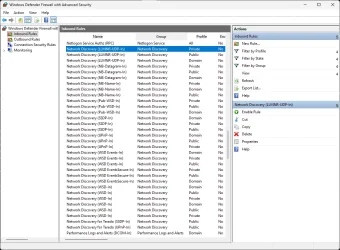
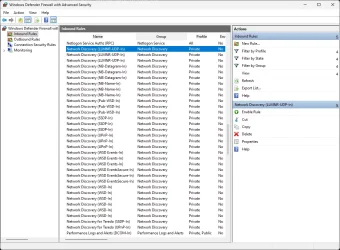
In this example, it will set everything to the "Private" profile (see screenshoots).
i.e. "Network Discovery (LLMNR-UDP-In)" has still 3 rules, but all defined to the "Private" profile.

Screenshot 2025-09-13 125542.webpScreenshot 2025-09-13 130024.webp

Therefore, after the command execution, you cannot enable "Network Discovery" for the "Public" profile via the Windows settings app.

If you use "Public", you cannot enable the "Private" profile via the GUI.
If you use "Domain", you cannot enable the "Public" or "Private" profile via the GUI.
If you use "Any", the GUI settings still work despite adding some duplicate firewall rules.

The Powershell command should be:
Code:
Get-NetFirewallRule -DisplayGroup 'Network Discovery' |
    Where-Object -Property 'Profile' -Match -Value 'Private' |
    Set-NetFirewallRule -Enabled 'True'

-Match is used instead of -EQ because a rule could contains several profiles.
e.g. Profile : Domain, Public

This is the case when your restore the default firewall rules.
But it's not the case anymore when you toggle on/off the 2 "Network Discovery" settings via the GUI.

For the netsh command, it would be nice to emphasize that the "Network Discovery" will be enable on the "Public" network and could raise security issues if you are connected to untrusted networks like public Wi-Fi (e.g. airports or restaurant).
Or even better, put a warning to not use this comand and to prefer the GUI or powershell methods for more control over the setting.
 

My Computer

System One

  • OS
    .
Thank you @agadiffe. That is a much better option. Tutorial updated for this. :shawn:
 

My Computers

System One System Two

  • OS
    Windows 11 Pro for Workstations
    Computer type
    PC/Desktop
    Manufacturer/Model
    Custom self build
    CPU
    Intel i7-8700K 5 GHz
    Motherboard
    ASUS ROG Maximus XI Formula Z390
    Memory
    64 GB (4x16GB) G.SKILL TridentZ RGB DDR4 3600 MHz (F4-3600C18D-32GTZR)
    Graphics Card(s)
    ASUS ROG-STRIX-GTX1080TI-O11G-GAMING (11GB GDDR5X)
    Sound Card
    Integrated Digital Audio (S/PDIF)
    Monitor(s) Displays
    2 x Samsung Odyssey G75 27"
    Screen Resolution
    2560x1440
    Hard Drives
    1TB Samsung 990 PRO M.2,
    4TB Samsung 990 PRO M.2,
    TerraMaster F8 SSD Plus NAS
    PSU
    Seasonic Prime Titanium 850W
    Case
    Thermaltake Core P3 wall mounted
    Cooling
    Corsair Hydro H115i
    Keyboard
    Amazon Basics Wired Full Keyboard MD005
    Mouse
    Logitech MX Master 4
    Internet Speed
    2 Gbps Download and 100 Mbps Upload
    Browser
    Chrome and Edge
    Antivirus
    Microsoft Defender
    Other Info
    Logitech Z625 speaker system,
    Logitech BRIO 4K Pro webcam,
    HP Color LaserJet Pro MFP M477fdn,
    CyberPower CP1500PFCLCD
    Galaxy S23 Plus phone
  • Operating System
    Windows 11 Pro
    Computer type
    Laptop
    Manufacturer/Model
    Surface Laptop 7 Copilot+ PC
    CPU
    Snapdragon X Elite (12 core) 3.42 GHz
    Memory
    16 GB LPDDR5x-7467 MHz
    Monitor(s) Displays
    15" HDR
    Screen Resolution
    2496 x 1664
    Hard Drives
    1 TB SSD
    Internet Speed
    Wi-Fi 7 and Bluetooth 5.4
    Browser
    Chrome and Edge
    Antivirus
    Microsoft Defender
One last thing.
The command for the "(Apply to all network profiles)" does nothing as there is no firewall rules with the "All" profile.
You can just use Set-NetFirewallRule without the -Profile parameter:
Code:
Set-NetFirewallRule -DisplayGroup 'Network Discovery' -Enabled 'True'

Option Two: urn On or Off Network Discovery in PowerShell
Also a small typo: Missing the "T". :-)
 

My Computer

System One

  • OS
    .
One last thing.
The command for the "(Apply to all network profiles)" does nothing as there is no firewall rules with the "All" profile.
You can just use Set-NetFirewallRule without the -Profile parameter:
Code:
Set-NetFirewallRule -DisplayGroup 'Network Discovery' -Enabled 'True'


Also a small typo: Missing the "T". :-)

:shawn:
 

My Computers

System One System Two

  • OS
    Windows 11 Pro for Workstations
    Computer type
    PC/Desktop
    Manufacturer/Model
    Custom self build
    CPU
    Intel i7-8700K 5 GHz
    Motherboard
    ASUS ROG Maximus XI Formula Z390
    Memory
    64 GB (4x16GB) G.SKILL TridentZ RGB DDR4 3600 MHz (F4-3600C18D-32GTZR)
    Graphics Card(s)
    ASUS ROG-STRIX-GTX1080TI-O11G-GAMING (11GB GDDR5X)
    Sound Card
    Integrated Digital Audio (S/PDIF)
    Monitor(s) Displays
    2 x Samsung Odyssey G75 27"
    Screen Resolution
    2560x1440
    Hard Drives
    1TB Samsung 990 PRO M.2,
    4TB Samsung 990 PRO M.2,
    TerraMaster F8 SSD Plus NAS
    PSU
    Seasonic Prime Titanium 850W
    Case
    Thermaltake Core P3 wall mounted
    Cooling
    Corsair Hydro H115i
    Keyboard
    Amazon Basics Wired Full Keyboard MD005
    Mouse
    Logitech MX Master 4
    Internet Speed
    2 Gbps Download and 100 Mbps Upload
    Browser
    Chrome and Edge
    Antivirus
    Microsoft Defender
    Other Info
    Logitech Z625 speaker system,
    Logitech BRIO 4K Pro webcam,
    HP Color LaserJet Pro MFP M477fdn,
    CyberPower CP1500PFCLCD
    Galaxy S23 Plus phone
  • Operating System
    Windows 11 Pro
    Computer type
    Laptop
    Manufacturer/Model
    Surface Laptop 7 Copilot+ PC
    CPU
    Snapdragon X Elite (12 core) 3.42 GHz
    Memory
    16 GB LPDDR5x-7467 MHz
    Monitor(s) Displays
    15" HDR
    Screen Resolution
    2496 x 1664
    Hard Drives
    1 TB SSD
    Internet Speed
    Wi-Fi 7 and Bluetooth 5.4
    Browser
    Chrome and Edge
    Antivirus
    Microsoft Defender
@Brink

The words for "Network Discovery" are written differently in other languages, if you're using a localized edition of Windows.
For example, it's called "Recherche du réseau" in the French edition.

en-US:
Code:
Get-NetFirewallRule | where { $_.Group -match '-32752|-28752' } | select -Unique DisplayGroup,Group

DisplayGroup      Group              
------------      -----              
Network Discovery @FirewallAPI.dll,-32752
Remote Desktop    @FirewallAPI.dll,-28752

fr-FR:
Code:
Get-NetFirewallRule | where { $_.Group -match '-32752|-28752' } | select -Unique DisplayGroup,Group

DisplayGroup        Group              
------------        -----              
Recherche du réseau @FirewallAPI.dll,-32752
Bureau à distance   @FirewallAPI.dll,-28752

If you want a command that works for all Windows languages, it's important to use the firewall rule Group's unique ID.
Code:
Get-NetFirewallRule | Where-Object { $_.Group -Match '-32752' -and $_.Profile -Match 'Public' } | Set-NetFirewallRule -Enabled 'False'
 

My Computer

System One

  • OS
    Windows 7
@Brink

The words for "Network Discovery" are written differently in other languages, if you're using a localized edition of Windows.
For example, it's called "Recherche du réseau" in the French edition.

en-US:
Code:
Get-NetFirewallRule | where { $_.Group -match '-32752|-28752' } | select -Unique DisplayGroup,Group

DisplayGroup      Group             
------------      -----             
Network Discovery @FirewallAPI.dll,-32752
Remote Desktop    @FirewallAPI.dll,-28752

fr-FR:
Code:
Get-NetFirewallRule | where { $_.Group -match '-32752|-28752' } | select -Unique DisplayGroup,Group

DisplayGroup        Group             
------------        -----             
Recherche du réseau @FirewallAPI.dll,-32752
Bureau à distance   @FirewallAPI.dll,-28752

If you want a command that works for all Windows languages, it's important to use the firewall rule Group's unique ID.
Code:
Get-NetFirewallRule | Where-Object { $_.Group -Match '-32752' -and $_.Profile -Match 'Public' } | Set-NetFirewallRule -Enabled 'False'

Of course. Using the same "group" name in all languages would be too easy. :doh:
 

My Computers

System One System Two

  • OS
    Windows 11 Pro for Workstations
    Computer type
    PC/Desktop
    Manufacturer/Model
    Custom self build
    CPU
    Intel i7-8700K 5 GHz
    Motherboard
    ASUS ROG Maximus XI Formula Z390
    Memory
    64 GB (4x16GB) G.SKILL TridentZ RGB DDR4 3600 MHz (F4-3600C18D-32GTZR)
    Graphics Card(s)
    ASUS ROG-STRIX-GTX1080TI-O11G-GAMING (11GB GDDR5X)
    Sound Card
    Integrated Digital Audio (S/PDIF)
    Monitor(s) Displays
    2 x Samsung Odyssey G75 27"
    Screen Resolution
    2560x1440
    Hard Drives
    1TB Samsung 990 PRO M.2,
    4TB Samsung 990 PRO M.2,
    TerraMaster F8 SSD Plus NAS
    PSU
    Seasonic Prime Titanium 850W
    Case
    Thermaltake Core P3 wall mounted
    Cooling
    Corsair Hydro H115i
    Keyboard
    Amazon Basics Wired Full Keyboard MD005
    Mouse
    Logitech MX Master 4
    Internet Speed
    2 Gbps Download and 100 Mbps Upload
    Browser
    Chrome and Edge
    Antivirus
    Microsoft Defender
    Other Info
    Logitech Z625 speaker system,
    Logitech BRIO 4K Pro webcam,
    HP Color LaserJet Pro MFP M477fdn,
    CyberPower CP1500PFCLCD
    Galaxy S23 Plus phone
  • Operating System
    Windows 11 Pro
    Computer type
    Laptop
    Manufacturer/Model
    Surface Laptop 7 Copilot+ PC
    CPU
    Snapdragon X Elite (12 core) 3.42 GHz
    Memory
    16 GB LPDDR5x-7467 MHz
    Monitor(s) Displays
    15" HDR
    Screen Resolution
    2496 x 1664
    Hard Drives
    1 TB SSD
    Internet Speed
    Wi-Fi 7 and Bluetooth 5.4
    Browser
    Chrome and Edge
    Antivirus
    Microsoft Defender
If you want a command that works for all Windows languages, it's important to use the firewall rule Group's unique ID.
Get-NetFirewallRule | Where-Object { $_.Group -Match '-32752' -and $_.Profile -Match 'Public' } | Set-NetFirewallRule -Enabled 'False'
Nice catch, I overlooked that.

Slightly shorter version (especially for the all networks command):
Code:
Set-NetFirewallRule -Group '*-32752*' -Enabled 'True'
Get-NetFirewallRule -Group '*-32752*' | Where-Object 'Profile' -Match 'Public' | Set-NetFirewallRule -Enabled 'True'
I like to be verbose and add -Property and -Value but that's a personal preference.
 

My Computer

System One

  • OS
    .

My Computers

System One System Two

  • OS
    Windows 11 Pro for Workstations
    Computer type
    PC/Desktop
    Manufacturer/Model
    Custom self build
    CPU
    Intel i7-8700K 5 GHz
    Motherboard
    ASUS ROG Maximus XI Formula Z390
    Memory
    64 GB (4x16GB) G.SKILL TridentZ RGB DDR4 3600 MHz (F4-3600C18D-32GTZR)
    Graphics Card(s)
    ASUS ROG-STRIX-GTX1080TI-O11G-GAMING (11GB GDDR5X)
    Sound Card
    Integrated Digital Audio (S/PDIF)
    Monitor(s) Displays
    2 x Samsung Odyssey G75 27"
    Screen Resolution
    2560x1440
    Hard Drives
    1TB Samsung 990 PRO M.2,
    4TB Samsung 990 PRO M.2,
    TerraMaster F8 SSD Plus NAS
    PSU
    Seasonic Prime Titanium 850W
    Case
    Thermaltake Core P3 wall mounted
    Cooling
    Corsair Hydro H115i
    Keyboard
    Amazon Basics Wired Full Keyboard MD005
    Mouse
    Logitech MX Master 4
    Internet Speed
    2 Gbps Download and 100 Mbps Upload
    Browser
    Chrome and Edge
    Antivirus
    Microsoft Defender
    Other Info
    Logitech Z625 speaker system,
    Logitech BRIO 4K Pro webcam,
    HP Color LaserJet Pro MFP M477fdn,
    CyberPower CP1500PFCLCD
    Galaxy S23 Plus phone
  • Operating System
    Windows 11 Pro
    Computer type
    Laptop
    Manufacturer/Model
    Surface Laptop 7 Copilot+ PC
    CPU
    Snapdragon X Elite (12 core) 3.42 GHz
    Memory
    16 GB LPDDR5x-7467 MHz
    Monitor(s) Displays
    15" HDR
    Screen Resolution
    2496 x 1664
    Hard Drives
    1 TB SSD
    Internet Speed
    Wi-Fi 7 and Bluetooth 5.4
    Browser
    Chrome and Edge
    Antivirus
    Microsoft Defender
Back
Top Bottom