Backup and Restore Change Restore Point Frequency for Point-in-time Restore in Windows 11

  • Thread starter Thread starter Brink
  • Start date Published: Start date Updated Updated:

Point-in_time_header.webp

This tutorial will show you how to change how frequently restore points are created for point-in-time restore in Windows 11.

Starting with Windows 11 build 26220.7271 (Dev and Beta 25H2), and build 29576.1000 (Experimental Future Platforms), build 26100.8728 (RP 24H2), and build 26200.8728 (RP 25H2), Microsoft introduced point-in-time restore for Windows. This flexible recovery feature empowers you to quickly roll your device back to a previous state—helping minimize downtime and simplify troubleshooting when disruptions strike. Whether you’re dealing with a widespread outage or a one-off issue, point-in-time restore helps recover your system (including apps, settings, and user files) to get you back to productivity faster.

Point-in-time restore enables users to restore a Windows PC to the exact state it was at an earlier point in time in minutes, using restore points. Restore points are stored locally on the machine and are captured using Volume Shadow Copy Service (VSS). Point-in-time restore focuses on fast recovery from recent issues by restoring the full system state captured within the last 72 hours. This feature is designed to help minimize downtime and simplify remediation, without the need for technical expertise or lengthy troubleshooting.

Restore points are captured automatically at a frequency (default: 24 hours) which is configurable by administrators. Restore points are comprehensive and include the OS, apps, settings, and local files (no user data is scoped out of the restore point). All restore points are stored locally on the system and are captured in the background.
  • Creation window: When point-in-time restore is enabled or settings change, the scheduler plans the next restore point based on boot timing and the most recent restore point. If there’s no recent restore point, one is scheduled promptly after enablement.
  • Retention: Each restore point is retained for a maximum of 72 hours; after that, it’s automatically deleted.
  • Deletions: Restore points are deleted, starting from the oldest restore point under the following conditions:
    • The max VSS storage configured for restore points is exceeded.
    • The device reports low free space conditions that cause VSS to limit or evict restore points.
    • If VSS encounters a condition that will prevent it from preserving data that is about to be overwritten all restore points are deleted. For example, the disk full, fails to allocate memory, inability to expand diff area in time, write errors.
While both point-in-time restore and System Restore use Volume Shadow Copy Service (VSS) to revert a device to a previous state, point-in-time restore introduces a modern approach and focuses on reliability and a broad range of issues.

Criteria​
Point-in-time restore​
System Restore​
ConfigurationSystem settingsControl panel
Restore point triggerScheduled frequency (automatic only)Event-triggered or manual
RetentionMax 72 hours per restore pointIndefinite (subject to disk usage/cleanup)
Target scopeFull system stateSystem files and settings; app/user data coverage varies
ManagementWill support remote management*No modern management
* Remote management isn't supported in preview version

Administrators can configure the feature. The configuration options consist of:
  • Feature On/Off, if feature is ON, restore points are automatically captured.
  • Restore point frequency controls how frequently restore points are created.
  • Restore point retention defines how long restore points can exist on the system before they are automatically deleted (earlier deletion can occur under storage pressure).
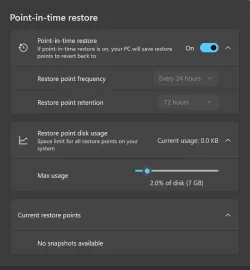
  • Maximum usage limit sets an upper bound for the total space consumed by all restore points captured by VSS on the device. Space isn't pre-allocated for restore points; any remaining space within the maximum usage limit not used by restore points is available to be used by the system.
Configuration details for preview are outlined:

Configuration​
Defaults​
Options​
Feature On/OffOnOn, Off
Restore point frequencyEvery 24 hours4, 16, 12, 24 hours
Restore point retention72 hours6, 12, 16, 24, 72 hours
Maximum usage limit2% of diskPercent of disk (min 2GB, max 50GB equivalent)

Risks

Data loss: point-in-time restore is a comprehensive recovery solution that reverts the entire system—including user files, applications, settings, passwords, secrets, certificates, and keys—to the selected restore point. Any local changes made after the restore point will be lost. Data stored in cloud services such as OneDrive isn't affected.

  • The capture of a restore point can fail due to insufficient disk space, system experiencing heavy I/O load, or unstable VSS writer.
  • The restoration of a system can fail due to insufficient free disk space, EFS-encrypted files changing, sudden power during restoration, or a corrupted file system.
  • Certain configurations, data corruption, or powering off the PC can prevent a successful boot after rollback as that could leave the device in a corrupt state.
  • Restoring the system can revert recent security updates or policies; validate and remediate post-restore.
Limitations
  • A restore can only be initiated locally in WinRE.
  • BitLocker recovery key is required for local restore on encrypted volumes.
  • There's no guarantee a restore point is captured at the exact frequency configured due to conditions such as: the device is powered off, in sleep or modern standby mode, recent reboot, or disk is full.
  • If the PC’s edition change, for example, from Home to Pro or Enterprise, point-in-time restore shouldn't be used. Restoring across different editions/SKUs can lead to system instability or unsupported configurations.
  • Usage of EFS encrypted files may affect reliability of point-in-time restore.
  • For devices that have multiple volumes, only the MainOS volume is restored.
  • Export/mount of restore points as independent images isn't supported.
  • Point-in-time restore is not a substitute for a system image.
Starting with Windows 11 build 26220.8062 (Beta 25H2) and build 26300.8068 (Dev 25H2), when you launch point-in-time restore, local admins will see a settings dialog (behind a User Account Control (UAC) prompt) where they can view or change the default restore settings. This experience also now shows a list of restore points available on the device.

References:

You must be signed in as an administrators to change how frequently restore points are created for point-in-time restore when turned on.


Settings for point-in-time restore are reset to the defaults after a feature update. Current solution is to reconfigure the feature if settings were changed from the defaults.


If you do not have the point-in-time restore feature available in the builds above yet and would like to try it now, then you can use the ViVeTool command below to enable it.

vivetool.exe /enable /id:55324166,59673297



Contents

  • Option One: Change Restore Point Frequency for Point-in-time Restore in Settings
  • Option Two: Change Restore Point Frequency for Point-in-time Restore using REG file


Option One

Change Restore Point Frequency for Point-in-time Restore in Settings


1 Open Settings (WIn+I).

2 Click/tap on System on the left side, and click/tap on Recovery on the right side. (see screenshot below)


Point-in-time_restore_Settings-1.webp

3 Perform an available step below: (see screenshots below)
  • Under "Recovery options", click/tap on Point-in-time restore.
  • Under "Recovery options", click/tap on the View or edit button for Point-in-time restore.
Point-in-time_restore_Settings-2.webp
Point_in_time_restore-1.webp

4 If prompted by UAC. click/tap on Yes to allow.

5 Select Every 4 hours, Every 6 hours, Every 12 hours, Every 16 hours, or Every 24 hours (default) for the Restore point frequency you want in the drop menu. (see screenshots below)

Point-in-time_restore_Settings-5.webp
Point_in_time_restore-2.webp

6 You can now close Settings if you like.


Option Two

Change Restore Point Frequency for Point-in-time Restore using REG file


1 Do step 2 (4 hours), step 3 (6 hours), step 4 (12 hours), step 5 (16 hours), or step 6 (24 hours) below for what you want.

2 Every 4 hours Restore Point Frequency for Point-in-time Restore

A) Click/tap on the Download button below to download the file below, and go to step 7 below.​

every_4_hours_restore_point_frequency.reg


(Contents of REG file for reference)
Code:
Windows Registry Editor Version 5.00

[HKEY_LOCAL_MACHINE\SOFTWARE\Microsoft\Windows\CurrentVersion\Setup\Recovery\PITR\Settings]
"SnapshotInterval_UX"=dword:000000f0

3 Every 6 hours Restore Point Frequency for Point-in-time Restore

A) Click/tap on the Download button below to download the file below, and go to step 7 below.​

every_6_hours_restore_point_frequency.reg


(Contents of REG file for reference)
Code:
Windows Registry Editor Version 5.00

[HKEY_LOCAL_MACHINE\SOFTWARE\Microsoft\Windows\CurrentVersion\Setup\Recovery\PITR\Settings]
"SnapshotInterval_UX"=dword:00000168

4 Every 12 hours Restore Point Frequency for Point-in-time Restore

A) Click/tap on the Download button below to download the file below, and go to step 7 below.​

every_12_hours_restore_point_frequency.reg


(Contents of REG file for reference)
Code:
Windows Registry Editor Version 5.00

[HKEY_LOCAL_MACHINE\SOFTWARE\Microsoft\Windows\CurrentVersion\Setup\Recovery\PITR\Settings]
"SnapshotInterval_UX"=dword:000002d0

5 Every 16 hours Restore Point Frequency for Point-in-time Restore

A) Click/tap on the Download button below to download the file below, and go to step 7 below.​

every_16_hours_restore_point_frequency.reg


(Contents of REG file for reference)
Code:
Windows Registry Editor Version 5.00

[HKEY_LOCAL_MACHINE\SOFTWARE\Microsoft\Windows\CurrentVersion\Setup\Recovery\PITR\Settings]
"SnapshotInterval_UX"=dword:000003c0

6 Every 24 hours Restore Point Frequency for Point-in-time Restore

This is the default setting.


A) Click/tap on the Download button below to download the file below, and go to step 7 below.​

every_24_hours_restore_point_frequency.reg


(Contents of REG file for reference)
Code:
Windows Registry Editor Version 5.00

[HKEY_LOCAL_MACHINE\SOFTWARE\Microsoft\Windows\CurrentVersion\Setup\Recovery\PITR\Settings]
"SnapshotInterval_UX"=dword:000005a0

7 Save the .reg file to your desktop.

8 If you have Smart App Control turned on, you will need to unblock the downloaded REG file.

9 Double click/tap on the downloaded .reg file to merge it.

10 When prompted, click/tap on Run, Yes (UAC), Yes, and OK to approve the merge.

11 You can now delete the downloaded .reg file if you like.


That's it,
Shawn Brink


Attachments

Last edited:
I can enable or disable but the option to change frequency and rollback time is greyed out

Also @Brink do you know where the restore points are saved? I'm guessing $SystemVolumeInformation?

I already use Macrium for full image backups - I'm just experimenting with PIT feature
 

Attachments

  • Screenshot 2026-06-21 160848.webp
    Screenshot 2026-06-21 160848.webp
    23.6 KB · Views: 1
Last edited:

My Computer My Computer

At a glance

Windows 11 Pro 25H2 (RP channel)AMD Ryzen 7 9800X3D 8-core64GB Corsair Titanium 6000/CL30MSI Suprim 5080 SOC
OS
Windows 11 Pro 25H2 (RP channel)
Computer type
PC/Desktop
Manufacturer/Model
MSI
CPU
AMD Ryzen 7 9800X3D 8-core
Motherboard
MEG X870E Godlike
Memory
64GB Corsair Titanium 6000/CL30
Graphics Card(s)
MSI Suprim 5080 SOC
Sound Card
Soundblaster AE-9
Monitor(s) Displays
ASUS TUF Gaming VG289Q
Screen Resolution
3840x2160
Hard Drives
Samsung 9100 Pro 4TB (gen 5 x4, system drive/games)
Samsung 990 Pro 2TB
Samsung 980 Pro 2TB
Samsung 870 Evo 4TB
Samsung 870 Evo 2TB
Samsung T9 4TB
PSU
Seasonic PX-2200
Case
Bequiet! Dark Base Pro 901
Cooling
Noctua NH-D15S Chromax black
Keyboard
Logitech G915 X (wired)
Mouse
Logitech G903 with PowerPlay charger
Internet Speed
900Mb/sec
Browser
Microsoft Edge
Antivirus
Windows Defender
I can enable or disable but the option to change frequency and rollback time is greyed out

Hey Brian, :alien:

It looks like it's a bug in the new flyout menu.

You can still manually change frequency and retention in the registry though.
 

My Computers My Computers

  • At a glance

    Windows 11 Pro for WorkstationsIntel i7-8700K 5 GHz64 GB (4x16GB) G.SKILL TridentZ RGB DDR4 3600...ASUS ROG-STRIX-GTX1080TI-O11G-GAMING (11GB GD...
    OS
    Windows 11 Pro for Workstations
    Computer type
    PC/Desktop
    Manufacturer/Model
    Custom self build
    CPU
    Intel i7-8700K 5 GHz
    Motherboard
    ASUS ROG Maximus XI Formula Z390
    Memory
    64 GB (4x16GB) G.SKILL TridentZ RGB DDR4 3600 MHz (F4-3600C18D-32GTZR)
    Graphics Card(s)
    ASUS ROG-STRIX-GTX1080TI-O11G-GAMING (11GB GDDR5X)
    Sound Card
    Integrated Digital Audio (S/PDIF)
    Monitor(s) Displays
    2 x Samsung Odyssey G75 27"
    Screen Resolution
    2560x1440
    Hard Drives
    1TB Samsung 990 PRO M.2,
    4TB Samsung 990 PRO M.2,
    TerraMaster F8 SSD Plus NAS
    PSU
    Seasonic Prime Titanium 850W
    Case
    Thermaltake Core P3 wall mounted
    Cooling
    Corsair Hydro H115i
    Keyboard
    Amazon Basics Wired Full Keyboard MD005
    Mouse
    Logitech MX Master 4
    Internet Speed
    2 Gbps Download and 100 Mbps Upload
    Browser
    Chrome and Edge
    Antivirus
    Microsoft Defender
    Other Info
    Logitech Z625 speaker system,
    Logitech BRIO 4K Pro webcam,
    HP Color LaserJet Pro MFP M477fdn,
    CyberPower CP1500PFCLCD
    Galaxy S23 Plus phone
  • At a glance

    Windows 11 ProSnapdragon X Elite (12 core) 3.42 GHz16 GB LPDDR5x-7467 MHz
    Operating System
    Windows 11 Pro
    Computer type
    Laptop
    Manufacturer/Model
    Surface Laptop 7 Copilot+ PC
    CPU
    Snapdragon X Elite (12 core) 3.42 GHz
    Memory
    16 GB LPDDR5x-7467 MHz
    Monitor(s) Displays
    15" HDR
    Screen Resolution
    2496 x 1664
    Hard Drives
    1 TB SSD
    Internet Speed
    Wi-Fi 7 and Bluetooth 5.4
    Browser
    Chrome and Edge
    Antivirus
    Microsoft Defender
Hey Brian, :alien:

It looks like it's a bug in the new flyout menu.

You can still manually change frequency and retention in the registry though.
OK thanks, it does work with the registry changes.
ANother quick question: The space set for PIT is also the same space set for System restore in the control panel (moving the slider on one changes the other) - does System restore need to be On for PIT to work?
 

My Computer My Computer

At a glance

Windows 11 Pro 25H2 (RP channel)AMD Ryzen 7 9800X3D 8-core64GB Corsair Titanium 6000/CL30MSI Suprim 5080 SOC
OS
Windows 11 Pro 25H2 (RP channel)
Computer type
PC/Desktop
Manufacturer/Model
MSI
CPU
AMD Ryzen 7 9800X3D 8-core
Motherboard
MEG X870E Godlike
Memory
64GB Corsair Titanium 6000/CL30
Graphics Card(s)
MSI Suprim 5080 SOC
Sound Card
Soundblaster AE-9
Monitor(s) Displays
ASUS TUF Gaming VG289Q
Screen Resolution
3840x2160
Hard Drives
Samsung 9100 Pro 4TB (gen 5 x4, system drive/games)
Samsung 990 Pro 2TB
Samsung 980 Pro 2TB
Samsung 870 Evo 4TB
Samsung 870 Evo 2TB
Samsung T9 4TB
PSU
Seasonic PX-2200
Case
Bequiet! Dark Base Pro 901
Cooling
Noctua NH-D15S Chromax black
Keyboard
Logitech G915 X (wired)
Mouse
Logitech G903 with PowerPlay charger
Internet Speed
900Mb/sec
Browser
Microsoft Edge
Antivirus
Windows Defender
OK thanks, it does work with the registry changes.
ANother quick question: The space set for PIT is also the same space set for System restore in the control panel (moving the slider on one changes the other) - does System restore need to be On for PIT to work?

Both point-in-time restore and System Restore use the Volume Shadow Copy Service (VSS), but they are separate. You don't need System Restore turned on to use point-in-time restore, or vice versa.
 

My Computers My Computers

  • At a glance

    Windows 11 Pro for WorkstationsIntel i7-8700K 5 GHz64 GB (4x16GB) G.SKILL TridentZ RGB DDR4 3600...ASUS ROG-STRIX-GTX1080TI-O11G-GAMING (11GB GD...
    OS
    Windows 11 Pro for Workstations
    Computer type
    PC/Desktop
    Manufacturer/Model
    Custom self build
    CPU
    Intel i7-8700K 5 GHz
    Motherboard
    ASUS ROG Maximus XI Formula Z390
    Memory
    64 GB (4x16GB) G.SKILL TridentZ RGB DDR4 3600 MHz (F4-3600C18D-32GTZR)
    Graphics Card(s)
    ASUS ROG-STRIX-GTX1080TI-O11G-GAMING (11GB GDDR5X)
    Sound Card
    Integrated Digital Audio (S/PDIF)
    Monitor(s) Displays
    2 x Samsung Odyssey G75 27"
    Screen Resolution
    2560x1440
    Hard Drives
    1TB Samsung 990 PRO M.2,
    4TB Samsung 990 PRO M.2,
    TerraMaster F8 SSD Plus NAS
    PSU
    Seasonic Prime Titanium 850W
    Case
    Thermaltake Core P3 wall mounted
    Cooling
    Corsair Hydro H115i
    Keyboard
    Amazon Basics Wired Full Keyboard MD005
    Mouse
    Logitech MX Master 4
    Internet Speed
    2 Gbps Download and 100 Mbps Upload
    Browser
    Chrome and Edge
    Antivirus
    Microsoft Defender
    Other Info
    Logitech Z625 speaker system,
    Logitech BRIO 4K Pro webcam,
    HP Color LaserJet Pro MFP M477fdn,
    CyberPower CP1500PFCLCD
    Galaxy S23 Plus phone
  • At a glance

    Windows 11 ProSnapdragon X Elite (12 core) 3.42 GHz16 GB LPDDR5x-7467 MHz
    Operating System
    Windows 11 Pro
    Computer type
    Laptop
    Manufacturer/Model
    Surface Laptop 7 Copilot+ PC
    CPU
    Snapdragon X Elite (12 core) 3.42 GHz
    Memory
    16 GB LPDDR5x-7467 MHz
    Monitor(s) Displays
    15" HDR
    Screen Resolution
    2496 x 1664
    Hard Drives
    1 TB SSD
    Internet Speed
    Wi-Fi 7 and Bluetooth 5.4
    Browser
    Chrome and Edge
    Antivirus
    Microsoft Defender
Both point-in-time restore and System Restore use the Volume Shadow Copy Service (VSS), but they are separate. You don't need System Restore turned on to use point-in-time restore, or vice versa.
OK cool thanks. I'm gonna assume the PIT points are in the system volume information folder like the regular restore points.

Thanks again
 

My Computer My Computer

At a glance

Windows 11 Pro 25H2 (RP channel)AMD Ryzen 7 9800X3D 8-core64GB Corsair Titanium 6000/CL30MSI Suprim 5080 SOC
OS
Windows 11 Pro 25H2 (RP channel)
Computer type
PC/Desktop
Manufacturer/Model
MSI
CPU
AMD Ryzen 7 9800X3D 8-core
Motherboard
MEG X870E Godlike
Memory
64GB Corsair Titanium 6000/CL30
Graphics Card(s)
MSI Suprim 5080 SOC
Sound Card
Soundblaster AE-9
Monitor(s) Displays
ASUS TUF Gaming VG289Q
Screen Resolution
3840x2160
Hard Drives
Samsung 9100 Pro 4TB (gen 5 x4, system drive/games)
Samsung 990 Pro 2TB
Samsung 980 Pro 2TB
Samsung 870 Evo 4TB
Samsung 870 Evo 2TB
Samsung T9 4TB
PSU
Seasonic PX-2200
Case
Bequiet! Dark Base Pro 901
Cooling
Noctua NH-D15S Chromax black
Keyboard
Logitech G915 X (wired)
Mouse
Logitech G903 with PowerPlay charger
Internet Speed
900Mb/sec
Browser
Microsoft Edge
Antivirus
Windows Defender
OK cool thanks. I'm gonna assume the PIT points are in the system volume information folder like the regular restore points.

Thanks again

Correct assumption. :shawn:
 

My Computers My Computers

  • At a glance

    Windows 11 Pro for WorkstationsIntel i7-8700K 5 GHz64 GB (4x16GB) G.SKILL TridentZ RGB DDR4 3600...ASUS ROG-STRIX-GTX1080TI-O11G-GAMING (11GB GD...
    OS
    Windows 11 Pro for Workstations
    Computer type
    PC/Desktop
    Manufacturer/Model
    Custom self build
    CPU
    Intel i7-8700K 5 GHz
    Motherboard
    ASUS ROG Maximus XI Formula Z390
    Memory
    64 GB (4x16GB) G.SKILL TridentZ RGB DDR4 3600 MHz (F4-3600C18D-32GTZR)
    Graphics Card(s)
    ASUS ROG-STRIX-GTX1080TI-O11G-GAMING (11GB GDDR5X)
    Sound Card
    Integrated Digital Audio (S/PDIF)
    Monitor(s) Displays
    2 x Samsung Odyssey G75 27"
    Screen Resolution
    2560x1440
    Hard Drives
    1TB Samsung 990 PRO M.2,
    4TB Samsung 990 PRO M.2,
    TerraMaster F8 SSD Plus NAS
    PSU
    Seasonic Prime Titanium 850W
    Case
    Thermaltake Core P3 wall mounted
    Cooling
    Corsair Hydro H115i
    Keyboard
    Amazon Basics Wired Full Keyboard MD005
    Mouse
    Logitech MX Master 4
    Internet Speed
    2 Gbps Download and 100 Mbps Upload
    Browser
    Chrome and Edge
    Antivirus
    Microsoft Defender
    Other Info
    Logitech Z625 speaker system,
    Logitech BRIO 4K Pro webcam,
    HP Color LaserJet Pro MFP M477fdn,
    CyberPower CP1500PFCLCD
    Galaxy S23 Plus phone
  • At a glance

    Windows 11 ProSnapdragon X Elite (12 core) 3.42 GHz16 GB LPDDR5x-7467 MHz
    Operating System
    Windows 11 Pro
    Computer type
    Laptop
    Manufacturer/Model
    Surface Laptop 7 Copilot+ PC
    CPU
    Snapdragon X Elite (12 core) 3.42 GHz
    Memory
    16 GB LPDDR5x-7467 MHz
    Monitor(s) Displays
    15" HDR
    Screen Resolution
    2496 x 1664
    Hard Drives
    1 TB SSD
    Internet Speed
    Wi-Fi 7 and Bluetooth 5.4
    Browser
    Chrome and Edge
    Antivirus
    Microsoft Defender

Latest Support Threads

Back
Top Bottom