GPU Preemption


shoober420

Well-known member
Member
VIP
Local time
1:07 AM
Posts
231
OS
Windows 11 27965
Ive read conflicting results as to whether GPU Premption increases or decrease latency / FPS. i decided to make scripts to enable or disable GPU Preemption. There is this one script from AlchemyTweaks.


This only includes one registry key out of numerous others ive found pertaining to GPU Preemption. the script ive put together includes many more.


i also need to add other mentions of GPU Preemption from the main GPUTweaks script.


my question is, does anyone know if these registry keys involve GPU Preemption and should they also be added to enable and disable GPU Preemption?

Code:
reg add "HKLM\SYSTEM\CurrentControlSet\Control\GraphicsDrivers\Power" /v "ComputePreemption" /t REG_DWORD /d "0" /f
reg add "HKLM\SYSTEM\CurrentControlSet\Control\GraphicsDrivers\Power" /v "DisableCudaContextPreemption" /t REG_DWORD /d "1" /f
reg add "HKLM\SYSTEM\CurrentControlSet\Control\GraphicsDrivers\Power" /v "EnableAsyncMidBufferPreemption" /t REG_DWORD /d "0" /f
reg add "HKLM\SYSTEM\CurrentControlSet\Control\GraphicsDrivers\Power" /v "EnableCEPreemption" /t REG_DWORD /d "0" /f
reg add "HKLM\SYSTEM\CurrentControlSet\Control\GraphicsDrivers\Power" /v "EnableMidBufferPreemption" /t REG_DWORD /d "0" /f
reg add "HKLM\SYSTEM\CurrentControlSet\Control\GraphicsDrivers\Power" /v "EnableMidBufferPreemptionForHighTdrTimeout" /t REG_DWORD /d "0" /f
reg add "HKLM\SYSTEM\CurrentControlSet\Control\GraphicsDrivers\Power" /v "EnableMidGfxPreemption" /t REG_DWORD /d "0" /f
reg add "HKLM\SYSTEM\CurrentControlSet\Control\GraphicsDrivers\Power" /v "EnableMidGfxPreemptionVGPU" /t REG_DWORD /d "0" /f
reg add "HKLM\SYSTEM\CurrentControlSet\Control\GraphicsDrivers\Power" /v "EnableSCGMidBufferPreemption" /t REG_DWORD /d "0" /f
reg add "HKLM\SYSTEM\CurrentControlSet\Control\GraphicsDrivers\Power" /v "PerfAnalyzeMidBufferPreemption" /t REG_DWORD /d "0" /f

they are under the "GraphicsDrivers" string, so they should naturally effect GPU Preemption, meaning it could possibly effect GPU Preemption. are those keys types of GPU Preemption? does anyone happen to know if those are needed to be enabled as well for GPU Preemption to work?

is there also a way to test if GPU Premption is on or off?
 
Last edited:

My Computer My Computer

At a glance

Windows 11 27965Intel i7 7700 @4.0ghz64gb DDR4Radeon RX 5500 XT
OS
Windows 11 27965
Computer type
PC/Desktop
CPU
Intel i7 7700 @4.0ghz
Memory
64gb DDR4
Graphics Card(s)
Radeon RX 5500 XT
Sound Card
Topping D50s
Hard Drives
NVMe
PSU
Corsair
Keyboard
Stelseries G6v2
Mouse
Zowie EC2
Other Info
https://www.youtube.com/shoober420
Google says GPU Preemption improves responsiveness while multitasking. I don't see how this would improve performance when playing a single game at the time, unless you render some HD videos in the background while playing the game. But this would interrupt the game processing to pay attention to the rendering, so it would actually reduce performance, not boost it!

From Google AI:

GPU preemption is a technique that allows the operating system to interrupt a currently running graphics processing unit (GPU) task and switch to another task, similar to how CPU multitasking works. This capability is crucial for enabling features like improved responsiveness, fairness, and quality of service in multi-application and multi-user GPU environments.

Here's a breakdown of GPU preemption:
What it is:
  • Preemption is the act of temporarily suspending a currently running task to execute a higher-priority task.

  • In the context of GPUs, this means interrupting a GPU kernel or workload to switch to another one.

  • This is typically managed by the GPU scheduler, which decides when and how to preempt tasks.
Why it's important:

  • Improved Responsiveness:
    Preemption allows high-priority tasks to be executed more quickly, reducing latency and improving the user experience.
  • Resource Sharing:
    It enables efficient sharing of the GPU among multiple applications, preventing one application from monopolizing the resource.
  • Fairness and Quality of Service:
    Preemption helps ensure that all applications get a fair share of GPU resources and that critical tasks are prioritized.
How it works:
  • Context Switching:
    Preemption involves saving the state of the current GPU task (its context) and loading the context of the new task.

  • Timeslicing:
    Some preemption mechanisms use timeslicing, where each task gets a fixed amount of GPU time before being preempted.

  • Wait-based vs. Reset-based:
    Some strategies wait for the current task to finish before switching, while others can interrupt and reset the task, requiring it to be idempotent (meaning it can be restarted without issues).

  • Hardware and Software Support:
    Preemption requires both hardware support (e.g., mechanisms for context switching) and software support (e.g., GPU drivers and scheduling algorithms).
Examples:
  • Windows WDDM 1.2:
    Introduced a more robust GPU preemption model, ensuring that preemption requests are handled before a Timeout Detection and Recovery (TDR) process.

  • Real-time Scheduling:
    Research focuses on enabling preemptive scheduling for real-time tasks on GPUs, allowing for predictable and timely execution of critical workloads.

  • Multiprogrammed Workloads:
    Work is being done to extend GPU architectures to support efficient preemption in environments where multiple applications are running concurrently.
Challenges:
  • Overhead: Preemption can introduce overhead due to the context switching process.

  • Complexity: Implementing preemption can be complex, requiring careful design of scheduling algorithms and synchronization mechanisms.

  • Idempotency: Reset-based preemption requires tasks to be idempotent, which may not always be the case.
In summary, GPU preemption is a critical feature for modern GPU systems, enabling efficient resource sharing, improved responsiveness, and better support for diverse workloads.
 

My Computers My Computers

  • At a glance

    Windows 11 Pro 23H2 (5699), 25H2 (8655)Mobile DualCore Intel Core 2 Duo T7250, 2000 MHz4GBMobile Intel(R) GMA 4500M (Mobile 4 series)
    OS
    Windows 11 Pro 23H2 (5699), 25H2 (8655)
    Computer type
    Laptop
    Manufacturer/Model
    Acer Extensa 5630EZ
    CPU
    Mobile DualCore Intel Core 2 Duo T7250, 2000 MHz
    Motherboard
    Acer Extensa 5630
    Memory
    4GB
    Graphics Card(s)
    Mobile Intel(R) GMA 4500M (Mobile 4 series)
    Sound Card
    Realtek ALC268 @ Intel 82801IB ICH9 - High Definition Audio Controller
    Monitor(s) Displays
    1
    Screen Resolution
    1280x800
    Hard Drives
    Samsung SSD 850 EVO 250GB SATA Device (250 GB, SATA-III)
    Internet Speed
    VDSL 50 Mbps
    Browser
    MICROSOFT EDGE
    Antivirus
    WINDOWS DEFENDER
    Other Info
    Legacy MBR installation, no TPM, no Secure Boot, no WDDM 2.0 graphics drivers, no SSE4.2, cannot get more unsupported ;) This is only my test laptop. I had installed Windows 11 here before upgrading my main PC. For my main PC I use everyday see my 2nd system specs.
  • At a glance

    Windows 11 Pro v25H2 (build 26200.8655)Intel Core-i7 3770 3.40GHz s1155 (3rd generat...2x Kingston Hyper-X Blu 8GB DDR3-1600GIGABYTE GeForce RTX 3050 WINDFORCE OC V2 6GB...
    Operating System
    Windows 11 Pro v25H2 (build 26200.8655)
    Computer type
    PC/Desktop
    Manufacturer/Model
    Custom-built PC
    CPU
    Intel Core-i7 3770 3.40GHz s1155 (3rd generation)
    Motherboard
    Asus P8H61 s1155 ATX
    Memory
    2x Kingston Hyper-X Blu 8GB DDR3-1600
    Graphics card(s)
    GIGABYTE GeForce RTX 3050 WINDFORCE OC V2 6GB (GV-N3050WF2OCV2-6GD)
    Sound Card
    Realtek HD audio (ALC887)
    Monitor(s) Displays
    Sony Bravia KDL-19L4000 19" LCD TV via VGA
    Screen Resolution
    1440x900 32-bit 60Hz
    Hard Drives
    WD Blue SA510 2.5 1000GB SSD as system disk, Western Digital Caviar Purple 4TB SATA III (WD40PURZ) as second
    PSU
    Thermaltake Litepower RGB 550W Full Wired
    Case
    SUPERCASE MIDI-TOWER
    Cooling
    Deepcool Gamma Archer CPU cooler, 1x 8cm fan at the back
    Keyboard
    Mitsumi 101-key PS/2
    Mouse
    Sunnyline OptiEye PS/2
    Internet Speed
    100Mbps
    Browser
    Microsoft Edge, Mozilla Firefox
    Antivirus
    Microsoft Windows Defender
    Other Info
    Legacy BIOS (MBR) installation, no TPM, no Secure Boot, WDDM 3.0 graphics drivers, WEI score 7.4
For some reason I thought it depended on

1.webp

but I was probably wrong.
 

My Computer My Computer

At a glance

Microsoft Windows 11 HomeIntel Core i5-13490F2 x 16 Patriot Memory (PDP Systems) PSD516G56...GIGABYTE GeForce RTX 4070 WINDFORCE OC 12G (G...
OS
Microsoft Windows 11 Home
Computer type
PC/Desktop
Manufacturer/Model
MSI MS-7D98
CPU
Intel Core i5-13490F
Motherboard
MSI B760 GAMING PLUS WIFI
Memory
2 x 16 Patriot Memory (PDP Systems) PSD516G560081 6400MT (32-37-37-74); 1.35V)
Graphics Card(s)
GIGABYTE GeForce RTX 4070 WINDFORCE OC 12G (GV-N4070WF3OC-12GD)
Sound Card
Bluetooth Аудио
Monitor(s) Displays
INNOCN 15K1F
Screen Resolution
1920 x 1080
Hard Drives
WD_BLACK SN770 250GB
KINGSTON SNV2S1000G (ELFK0S.6)
PSU
Thermaltake Toughpower GF3 1000W
Case
CG560 - DeepCool
Cooling
ID-COOLING SE-224-XTS / 2 x 140Mm Fan - rear and top; 3 x 120Mm - front
Keyboard
Corsair K70 RGB TKL
Mouse
Corsair KATAR PRO XT
Internet Speed
100 Mbps
Browser
Firefox
Antivirus
Microsoft Defender Antivirus
Other Info
https://www.userbenchmark.com/UserRun/66553205
I would enable to show FPS on screen, then play a game with preemptive off. Then play the same game with preemptive on and compare results. Repeat test with 2-3 games to conclude if off or on is better.
 

My Computers My Computers

  • At a glance

    Windows 11 Pro 23H2 (5699), 25H2 (8655)Mobile DualCore Intel Core 2 Duo T7250, 2000 MHz4GBMobile Intel(R) GMA 4500M (Mobile 4 series)
    OS
    Windows 11 Pro 23H2 (5699), 25H2 (8655)
    Computer type
    Laptop
    Manufacturer/Model
    Acer Extensa 5630EZ
    CPU
    Mobile DualCore Intel Core 2 Duo T7250, 2000 MHz
    Motherboard
    Acer Extensa 5630
    Memory
    4GB
    Graphics Card(s)
    Mobile Intel(R) GMA 4500M (Mobile 4 series)
    Sound Card
    Realtek ALC268 @ Intel 82801IB ICH9 - High Definition Audio Controller
    Monitor(s) Displays
    1
    Screen Resolution
    1280x800
    Hard Drives
    Samsung SSD 850 EVO 250GB SATA Device (250 GB, SATA-III)
    Internet Speed
    VDSL 50 Mbps
    Browser
    MICROSOFT EDGE
    Antivirus
    WINDOWS DEFENDER
    Other Info
    Legacy MBR installation, no TPM, no Secure Boot, no WDDM 2.0 graphics drivers, no SSE4.2, cannot get more unsupported ;) This is only my test laptop. I had installed Windows 11 here before upgrading my main PC. For my main PC I use everyday see my 2nd system specs.
  • At a glance

    Windows 11 Pro v25H2 (build 26200.8655)Intel Core-i7 3770 3.40GHz s1155 (3rd generat...2x Kingston Hyper-X Blu 8GB DDR3-1600GIGABYTE GeForce RTX 3050 WINDFORCE OC V2 6GB...
    Operating System
    Windows 11 Pro v25H2 (build 26200.8655)
    Computer type
    PC/Desktop
    Manufacturer/Model
    Custom-built PC
    CPU
    Intel Core-i7 3770 3.40GHz s1155 (3rd generation)
    Motherboard
    Asus P8H61 s1155 ATX
    Memory
    2x Kingston Hyper-X Blu 8GB DDR3-1600
    Graphics card(s)
    GIGABYTE GeForce RTX 3050 WINDFORCE OC V2 6GB (GV-N3050WF2OCV2-6GD)
    Sound Card
    Realtek HD audio (ALC887)
    Monitor(s) Displays
    Sony Bravia KDL-19L4000 19" LCD TV via VGA
    Screen Resolution
    1440x900 32-bit 60Hz
    Hard Drives
    WD Blue SA510 2.5 1000GB SSD as system disk, Western Digital Caviar Purple 4TB SATA III (WD40PURZ) as second
    PSU
    Thermaltake Litepower RGB 550W Full Wired
    Case
    SUPERCASE MIDI-TOWER
    Cooling
    Deepcool Gamma Archer CPU cooler, 1x 8cm fan at the back
    Keyboard
    Mitsumi 101-key PS/2
    Mouse
    Sunnyline OptiEye PS/2
    Internet Speed
    100Mbps
    Browser
    Microsoft Edge, Mozilla Firefox
    Antivirus
    Microsoft Windows Defender
    Other Info
    Legacy BIOS (MBR) installation, no TPM, no Secure Boot, WDDM 3.0 graphics drivers, WEI score 7.4
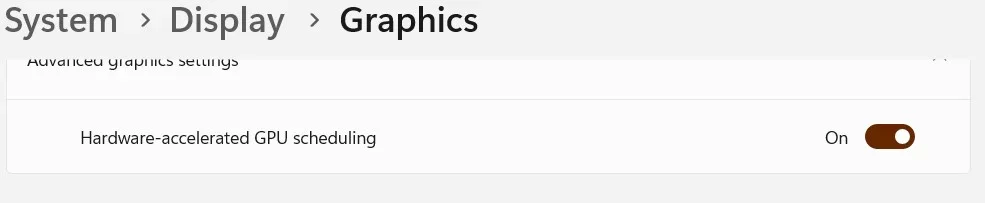
For some reason I thought it depended on

View attachment 141461

but I was probably wrong.
it appears when googling that GPU scheduling does depend on GPU premption. thanks for the info

ive updated the GPU Preemption scripts and will test in CS2 shortly. ill also test with HAGS on and off as well
 

My Computer My Computer

At a glance

Windows 11 27965Intel i7 7700 @4.0ghz64gb DDR4Radeon RX 5500 XT
OS
Windows 11 27965
Computer type
PC/Desktop
CPU
Intel i7 7700 @4.0ghz
Memory
64gb DDR4
Graphics Card(s)
Radeon RX 5500 XT
Sound Card
Topping D50s
Hard Drives
NVMe
PSU
Corsair
Keyboard
Stelseries G6v2
Mouse
Zowie EC2
Other Info
https://www.youtube.com/shoober420
i had no FPS increase when enabling GPU scheduling and GPU Preemption. i do have a Radeon 5500 XT card so having a new Radeon or Geforce card might see benefits. i still decided to leave it on since its supposed to increase perferormance and lower latency

i did find this though. according to this thread, the GraphicsPerfSvc is required for GPU Scheduling. does anyone know of this is true or a troll post?


My Computer My Computer

At a glance

Windows 11 27965Intel i7 7700 @4.0ghz64gb DDR4Radeon RX 5500 XT
OS
Windows 11 27965
Computer type
PC/Desktop
CPU
Intel i7 7700 @4.0ghz
Memory
64gb DDR4
Graphics Card(s)
Radeon RX 5500 XT
Sound Card
Topping D50s
Hard Drives
NVMe
PSU
Corsair
Keyboard
Stelseries G6v2
Mouse
Zowie EC2
Other Info
https://www.youtube.com/shoober420
If you cannot currently afford a faster card you might be able to slightly overclock it (with caution, don't overdo it) to boost performance. I recently upgraded from nVidia GTX 1050 Ti 4GB GDDR5 to nVidia RTX 3050 6GB GDDR6 and it has a huge difference, even if it is not working at maximum speed due to my PCIe 3.0 version (the card is PCIe 4.0).
 

My Computers My Computers

  • At a glance

    Windows 11 Pro 23H2 (5699), 25H2 (8655)Mobile DualCore Intel Core 2 Duo T7250, 2000 MHz4GBMobile Intel(R) GMA 4500M (Mobile 4 series)
    OS
    Windows 11 Pro 23H2 (5699), 25H2 (8655)
    Computer type
    Laptop
    Manufacturer/Model
    Acer Extensa 5630EZ
    CPU
    Mobile DualCore Intel Core 2 Duo T7250, 2000 MHz
    Motherboard
    Acer Extensa 5630
    Memory
    4GB
    Graphics Card(s)
    Mobile Intel(R) GMA 4500M (Mobile 4 series)
    Sound Card
    Realtek ALC268 @ Intel 82801IB ICH9 - High Definition Audio Controller
    Monitor(s) Displays
    1
    Screen Resolution
    1280x800
    Hard Drives
    Samsung SSD 850 EVO 250GB SATA Device (250 GB, SATA-III)
    Internet Speed
    VDSL 50 Mbps
    Browser
    MICROSOFT EDGE
    Antivirus
    WINDOWS DEFENDER
    Other Info
    Legacy MBR installation, no TPM, no Secure Boot, no WDDM 2.0 graphics drivers, no SSE4.2, cannot get more unsupported ;) This is only my test laptop. I had installed Windows 11 here before upgrading my main PC. For my main PC I use everyday see my 2nd system specs.
  • At a glance

    Windows 11 Pro v25H2 (build 26200.8655)Intel Core-i7 3770 3.40GHz s1155 (3rd generat...2x Kingston Hyper-X Blu 8GB DDR3-1600GIGABYTE GeForce RTX 3050 WINDFORCE OC V2 6GB...
    Operating System
    Windows 11 Pro v25H2 (build 26200.8655)
    Computer type
    PC/Desktop
    Manufacturer/Model
    Custom-built PC
    CPU
    Intel Core-i7 3770 3.40GHz s1155 (3rd generation)
    Motherboard
    Asus P8H61 s1155 ATX
    Memory
    2x Kingston Hyper-X Blu 8GB DDR3-1600
    Graphics card(s)
    GIGABYTE GeForce RTX 3050 WINDFORCE OC V2 6GB (GV-N3050WF2OCV2-6GD)
    Sound Card
    Realtek HD audio (ALC887)
    Monitor(s) Displays
    Sony Bravia KDL-19L4000 19" LCD TV via VGA
    Screen Resolution
    1440x900 32-bit 60Hz
    Hard Drives
    WD Blue SA510 2.5 1000GB SSD as system disk, Western Digital Caviar Purple 4TB SATA III (WD40PURZ) as second
    PSU
    Thermaltake Litepower RGB 550W Full Wired
    Case
    SUPERCASE MIDI-TOWER
    Cooling
    Deepcool Gamma Archer CPU cooler, 1x 8cm fan at the back
    Keyboard
    Mitsumi 101-key PS/2
    Mouse
    Sunnyline OptiEye PS/2
    Internet Speed
    100Mbps
    Browser
    Microsoft Edge, Mozilla Firefox
    Antivirus
    Microsoft Windows Defender
    Other Info
    Legacy BIOS (MBR) installation, no TPM, no Secure Boot, WDDM 3.0 graphics drivers, WEI score 7.4
Ive read conflicting results as to whether GPU Premption increases or decrease latency / FPS. i decided to make scripts to enable or disable GPU Preemption. There is this one script from AlchemyTweaks.


This only includes one registry key out of numerous others ive found pertaining to GPU Preemption. the script ive put together includes many more.


i also need to add other mentions of GPU Preemption from the main GPUTweaks script.


my question is, does anyone know if these registry keys involve GPU Preemption and should they also be added to enable and disable GPU Preemption?

Code:
reg add "HKLM\SYSTEM\CurrentControlSet\Control\GraphicsDrivers\Power" /v "ComputePreemption" /t REG_DWORD /d "0" /f
reg add "HKLM\SYSTEM\CurrentControlSet\Control\GraphicsDrivers\Power" /v "DisableCudaContextPreemption" /t REG_DWORD /d "1" /f
reg add "HKLM\SYSTEM\CurrentControlSet\Control\GraphicsDrivers\Power" /v "EnableAsyncMidBufferPreemption" /t REG_DWORD /d "0" /f
reg add "HKLM\SYSTEM\CurrentControlSet\Control\GraphicsDrivers\Power" /v "EnableCEPreemption" /t REG_DWORD /d "0" /f
reg add "HKLM\SYSTEM\CurrentControlSet\Control\GraphicsDrivers\Power" /v "EnableMidBufferPreemption" /t REG_DWORD /d "0" /f
reg add "HKLM\SYSTEM\CurrentControlSet\Control\GraphicsDrivers\Power" /v "EnableMidBufferPreemptionForHighTdrTimeout" /t REG_DWORD /d "0" /f
reg add "HKLM\SYSTEM\CurrentControlSet\Control\GraphicsDrivers\Power" /v "EnableMidGfxPreemption" /t REG_DWORD /d "0" /f
reg add "HKLM\SYSTEM\CurrentControlSet\Control\GraphicsDrivers\Power" /v "EnableMidGfxPreemptionVGPU" /t REG_DWORD /d "0" /f
reg add "HKLM\SYSTEM\CurrentControlSet\Control\GraphicsDrivers\Power" /v "EnableSCGMidBufferPreemption" /t REG_DWORD /d "0" /f
reg add "HKLM\SYSTEM\CurrentControlSet\Control\GraphicsDrivers\Power" /v "PerfAnalyzeMidBufferPreemption" /t REG_DWORD /d "0" /f

they are under the "GraphicsDrivers" string, so they should naturally effect GPU Preemption, meaning it could possibly effect GPU Preemption. are those keys types of GPU Preemption? does anyone happen to know if those are needed to be enabled as well for GPU Preemption to work?

is there also a way to test if GPU Premption is on or off?
 

My Computer My Computer

At a glance

Windows 11 ProIntel i5 10400f ( Frequency: 3.98GHz )G.Skill Ripjaws V 16GB DDR4 RAM ( Frequency 3...Gigabyte RX 5700 XTX OC EDITION
OS
Windows 11 Pro
Computer type
PC/Desktop
Manufacturer/Model
Gigabyte
CPU
Intel i5 10400f ( Frequency: 3.98GHz )
Motherboard
Gigabyte Z590M UD
Memory
G.Skill Ripjaws V 16GB DDR4 RAM ( Frequency 3200MHz with XMP )
Graphics Card(s)
Gigabyte RX 5700 XTX OC EDITION
Sound Card
Motherboard's
Monitor(s) Displays
LG 27GN600-B IPS HDR Gaming Monitor 27" FHD 1920x1080 144Hz
Screen Resolution
1920x1080
Hard Drives
Samsung 980 Pro SSD 500GB M.2 NVMe PCI Express 4.0

Seagate Barracuda 1TB HDD
PSU
Be Quiet System Power 10 750W
Case
Cougar MX410 Mesh-G RGB Gaming Midi Tower
Cooling
6 ARGB FANS ( NO WATER COOLING )
Keyboard
Hyperx Alloy fps pro
Mouse
Logitech g402
Internet Speed
Router with sim card (80down - 15 up)
Browser
Microsoft Edge
Antivirus
Symantec Endpoint Protection
I tested
Code:
reg add "HKLM\SYSTEM\CurrentControlSet\Control\GraphicsDrivers\Power" /v "ComputePreemption" /t REG_DWORD /d "0" /f<br>reg add "HKLM\SYSTEM\CurrentControlSet\Control\GraphicsDrivers\Power" /v "DisableCudaContextPreemption" /t REG_DWORD /d "1" /f<br>reg add "HKLM\SYSTEM\CurrentControlSet\Control\GraphicsDrivers\Power" /v "EnableAsyncMidBufferPreemption" /t REG_DWORD /d "0" /f<br>reg add "HKLM\SYSTEM\CurrentControlSet\Control\GraphicsDrivers\Power" /v "EnableCEPreemption" /t REG_DWORD /d "0" /f<br>reg add "HKLM\SYSTEM\CurrentControlSet\Control\GraphicsDrivers\Power" /v "EnableMidBufferPreemption" /t REG_DWORD /d "0" /f<br>reg add "HKLM\SYSTEM\CurrentControlSet\Control\GraphicsDrivers\Power" /v "EnableMidBufferPreemptionForHighTdrTimeout" /t REG_DWORD /d "0" /f<br>reg add "HKLM\SYSTEM\CurrentControlSet\Control\GraphicsDrivers\Power" /v "EnableMidGfxPreemption" /t REG_DWORD /d "0" /f<br>reg add "HKLM\SYSTEM\CurrentControlSet\Control\GraphicsDrivers\Power" /v "EnableMidGfxPreemptionVGPU" /t REG_DWORD /d "0" /f<br>reg add "HKLM\SYSTEM\CurrentControlSet\Control\GraphicsDrivers\Power" /v "EnableSCGMidBufferPreemption" /t REG_DWORD /d "0" /f<br>reg add "HKLM\SYSTEM\CurrentControlSet\Control\GraphicsDrivers\Power" /v "PerfAnalyzeMidBufferPreemption" /t REG_DWORD /d "0" /f`
From my perspective, I observed no measurable difference in FPS, latency, or related metrics. There may be internal GPU-level changes detectable through a deeper analysis (e.g., GPUView or similar tooling), but in my assessment, these do not deliver the performance improvements one might expect. The root cause is likely elsewhere. Υou may want to test ForcePreemptionAware. Based on my own experimentation with this set of settings ultimately keeping preemption enabled this DWORD showed some positive effect.
 

Attachments

My Computer My Computer

At a glance

Windows 11 ProIntel i5 10400f ( Frequency: 3.98GHz )G.Skill Ripjaws V 16GB DDR4 RAM ( Frequency 3...Gigabyte RX 5700 XTX OC EDITION
OS
Windows 11 Pro
Computer type
PC/Desktop
Manufacturer/Model
Gigabyte
CPU
Intel i5 10400f ( Frequency: 3.98GHz )
Motherboard
Gigabyte Z590M UD
Memory
G.Skill Ripjaws V 16GB DDR4 RAM ( Frequency 3200MHz with XMP )
Graphics Card(s)
Gigabyte RX 5700 XTX OC EDITION
Sound Card
Motherboard's
Monitor(s) Displays
LG 27GN600-B IPS HDR Gaming Monitor 27" FHD 1920x1080 144Hz
Screen Resolution
1920x1080
Hard Drives
Samsung 980 Pro SSD 500GB M.2 NVMe PCI Express 4.0

Seagate Barracuda 1TB HDD
PSU
Be Quiet System Power 10 750W
Case
Cougar MX410 Mesh-G RGB Gaming Midi Tower
Cooling
6 ARGB FANS ( NO WATER COOLING )
Keyboard
Hyperx Alloy fps pro
Mouse
Logitech g402
Internet Speed
Router with sim card (80down - 15 up)
Browser
Microsoft Edge
Antivirus
Symantec Endpoint Protection
I tested
Code:
reg add "HKLM\SYSTEM\CurrentControlSet\Control\GraphicsDrivers\Power" /v "ComputePreemption" /t REG_DWORD /d "0" /f<br>reg add "HKLM\SYSTEM\CurrentControlSet\Control\GraphicsDrivers\Power" /v "DisableCudaContextPreemption" /t REG_DWORD /d "1" /f<br>reg add "HKLM\SYSTEM\CurrentControlSet\Control\GraphicsDrivers\Power" /v "EnableAsyncMidBufferPreemption" /t REG_DWORD /d "0" /f<br>reg add "HKLM\SYSTEM\CurrentControlSet\Control\GraphicsDrivers\Power" /v "EnableCEPreemption" /t REG_DWORD /d "0" /f<br>reg add "HKLM\SYSTEM\CurrentControlSet\Control\GraphicsDrivers\Power" /v "EnableMidBufferPreemption" /t REG_DWORD /d "0" /f<br>reg add "HKLM\SYSTEM\CurrentControlSet\Control\GraphicsDrivers\Power" /v "EnableMidBufferPreemptionForHighTdrTimeout" /t REG_DWORD /d "0" /f<br>reg add "HKLM\SYSTEM\CurrentControlSet\Control\GraphicsDrivers\Power" /v "EnableMidGfxPreemption" /t REG_DWORD /d "0" /f<br>reg add "HKLM\SYSTEM\CurrentControlSet\Control\GraphicsDrivers\Power" /v "EnableMidGfxPreemptionVGPU" /t REG_DWORD /d "0" /f<br>reg add "HKLM\SYSTEM\CurrentControlSet\Control\GraphicsDrivers\Power" /v "EnableSCGMidBufferPreemption" /t REG_DWORD /d "0" /f<br>reg add "HKLM\SYSTEM\CurrentControlSet\Control\GraphicsDrivers\Power" /v "PerfAnalyzeMidBufferPreemption" /t REG_DWORD /d "0" /f`
From my perspective, I observed no measurable difference in FPS, latency, or related metrics. There may be internal GPU-level changes detectable through a deeper analysis (e.g., GPUView or similar tooling), but in my assessment, these do not deliver the performance improvements one might expect. The root cause is likely elsewhere. Υou may want to test ForcePreemptionAware. Based on my own experimentation with this set of settings ultimately keeping preemption enabled this DWORD showed some positive effect.
In my PC, the only entry where Preemtion appears in the registry is at "Computer\HKEY_LOCAL_MACHINE\SYSTEM\ControlSet001\Control\GraphicsDrivers\Scheduler" REG_DWORD EnablePreemtion 0x00000001(1) or 0x00000000(0)

Running Windows 11 Pro 25h2
 

My Computer My Computer

At a glance

Windows 11 IoT Enterprise LTSC Evaluation + A...AMD Ryzen 5 5600G with Radeon GraphicsG.Skill SK Hynix F4-2400C15-16GFXR DDR4 (UDIM...GIGABYTE RTX 3060 GAMING OC Rev. 2.0 / AMD Ra...
OS
Windows 11 IoT Enterprise LTSC Evaluation + Atlas Playbook + Custom Tweaks
Computer type
PC/Desktop
Manufacturer/Model
Custom
CPU
AMD Ryzen 5 5600G with Radeon Graphics
Motherboard
Asus Prime 5600M-K
Memory
G.Skill SK Hynix F4-2400C15-16GFXR DDR4 (UDIMM) 2400 (1200MHz) 2x16Gb
Graphics Card(s)
GIGABYTE RTX 3060 GAMING OC Rev. 2.0 / AMD Radeon Graphics 448SP
Monitor(s) Displays
LG 32GN500B-AEU - Monitor Gaming LG UltraGear (Panel VA: 1920x1080p, 16:9, 300 cd/m², 3000:1, 165Hz, 5ms (MBR 1ms)); diag. 80,1cm; entradas: DP x1, HDMI x2; AMD Freesync Premium & G-Sync, HDR10, 165Hz / BenQ Zowie eSports XL2430 144Hz AMD Freesync
Screen Resolution
1920x1080p
Hard Drives
WD Blue SN570 500GB
Samsung SSD 850 EVO 500GB
ST1000DM003-1ER162
Case
Nfortec Azir Black PC Case
Cooling
Mars Gaming ML-PRO120 Liquid Cooler
Keyboard
Epomaker SKYLOONG GK61 SK61 RGB Gateron Optical Red 1000 Hz -1ms Latency / Razer BlackWidow Chroma Mechanical Razer Green
Mouse
Razer Naga Trinity -2.9 Latency (https://www.rtings.com/mouse/reviews/razer/naga-trinity)
Internet Speed
1Gb fiber optic ethernet
Browser
Edge Debloated
Other Info
Razer Kraken V3 Hypersense THX 7.1
Mars Gaming MWPRO Black Webcam Full HD Light Ring
Mars Gaming MSDUOW RGB Speakers/Soundbar
Razer Gigantus V2 Large

Latest Support Threads

Back
Top Bottom