What's the full procedure to turn BitLocker off?


mck

Well-known member
Member
VIP
Local time
12:19 PM
Posts
83
OS
Windows 11
A friend bought a HP PC running Windows 11 Home. I discovered that the system C SSD and the data D HDD have BitLocker turned on.

QUESTION-1: Does Macrium Reflect Free Version 8 do image backup and restore of BitLocked drives successfully? (We backed up both drives using Macrium Reflect Free Version 8 image backups successfully. But I've not tested if Macrium's restore will restore BitLocker encrypted drives to their original BitLocked state.)

QUESTION-2: I want to turn BitLocker off on both drives. Googling, I see how to turn BitLocker off to decrypt the drives. My question is what to do to insure that BitLocker is never turned back on. Is just turning BitLocker off and decrypting the drives all that's needed? Or is there an additional step to insure that BitLocker is never turned back on?

Thanks.
 

My Computer

System One

  • OS
    Windows 11
    Computer type
    PC/Desktop
    Manufacturer/Model
    Self Built
    CPU
    Intel Core Ultra 7, 265K
    Motherboard
    MSI Pro Z890-P WiFi
    Memory
    32GB
    Graphics Card(s)
    Using integrated graphics
    Monitor(s) Displays
    LG
    Screen Resolution
    4K
    Hard Drives
    512 GB SSD, 2TB M.2 SSD and 2TB SATA SSD
    PSU
    Seasonic Modular 550 watt Focus Plus
    Case
    Corsair 4000D
    Cooling
    ThermalRight Phantom Sprit
1/ I use Macrium 8 (paid for version) on my main PC and Macrium Free on my older one. As far as I remember the free version was fine with Bitlocker when I had Bitlocker encryption enabled on the old one. Its seamless, you don't have to even think about it as its all taken care of automatically. Restores work with Bitlocker re-enabled when completed. Nothing to think about.

2/ I'm not sure tbh. Bitlocker is enabled via the BIOS on my main PC and so any clean installs etc that I do automatically have Bitlocker applied. Other PC is older and runs W11 as unsupported hardware. I have to enable Bitlocker via other means on that one when I wanted it. So it might be worth looking in the BIOS for a Bitlocker setting as well as turning it off. If you turn it off it takes quite a while to decrypt a drive.

Fwiw I really like Bitlocker and provided you back the keys up (to your MS account which is offered as an option) and also keep a hard copy somewhere you should never have an issue.
 

My Computer

System One

  • OS
    W11 Pro x64 ongoing Canary 29500 latest builds
    Computer type
    Laptop
    Manufacturer/Model
    Dell 7760 Mobile Precision 17"
    CPU
    Intel i5
    Motherboard
    Unknown
    Memory
    8Gb
    Graphics Card(s)
    Intel HD Graphics
    Sound Card
    Realtek
    Monitor(s) Displays
    Internal
    Hard Drives
    2 x 256Gb SSD
    PSU
    Dell 240 watt
    Mouse
    Dell Premier Bluetooth
    Internet Speed
    50Mbps
    Browser
    Edge
    Antivirus
    Default Microsoft Security
  • Like
Reactions: mck
1/ I use Macrium 8 (paid for version) on my main PC and Macrium Free on my older one. As far as I remember the free version was fine with Bitlocker when I had Bitlocker encryption enabled on the old one. Its seamless, you don't have to even think about it as its all taken care of automatically. Restores work with Bitlocker re-enabled when completed. Nothing to think about.

2/ I'm not sure tbh. Bitlocker is enabled via the BIOS on my main PC and so any clean installs etc that I do automatically have Bitlocker applied. Other PC is older and runs W11 as unsupported hardware. I have to enable Bitlocker via other means on that one when I wanted it. So it might be worth looking in the BIOS for a Bitlocker setting as well as turning it off. If you turn it off it takes quite a while to decrypt a drive.

Fwiw I really like Bitlocker and provided you back the keys up (to your MS account which is offered as an option) and also keep a hard copy somewhere you should never have an issue.
@Mooly, thanks for your responses.

1/ Thanks for the confirmation that MRF does image backups and restores of Bitlocked drives, with no issures.

2/ If anyone knows whether an additional step is required to insure that BitLocker is never turned back on, after it is turned off, the info will be greatly appreciated.
 

My Computer

System One

  • OS
    Windows 11
    Computer type
    PC/Desktop
    Manufacturer/Model
    Self Built
    CPU
    Intel Core Ultra 7, 265K
    Motherboard
    MSI Pro Z890-P WiFi
    Memory
    32GB
    Graphics Card(s)
    Using integrated graphics
    Monitor(s) Displays
    LG
    Screen Resolution
    4K
    Hard Drives
    512 GB SSD, 2TB M.2 SSD and 2TB SATA SSD
    PSU
    Seasonic Modular 550 watt Focus Plus
    Case
    Corsair 4000D
    Cooling
    ThermalRight Phantom Sprit
BitLocker doesn't randomly turn itself back on, even in an upgrade scenario. At least not yet.
 

My Computer

System One

  • OS
    Windows 11 Pro 25H2
    Computer type
    PC/Desktop
    Manufacturer/Model
    Intel NUC12WSHi7
    CPU
    12th Gen Core i7-1260P
    Motherboard
    NUC12WSBi7
    Memory
    64 GB Micron PC4-25600
    Graphics Card(s)
    Intel Iris Xe Graphics
    Sound Card
    on-board Realtek HD Audio
    Monitor(s) Displays
    Dell U3219Q
    Screen Resolution
    3840 x 2160
    Hard Drives
    Samsung SSD 990 PRO 1TB
    Crucial MX500 2 TB
    Antivirus
    Microsoft Defender
BitLocker doesn't randomly turn itself back on, even in an upgrade scenario. At least not yet.
Thanks for that important info!
 

My Computer

System One

  • OS
    Windows 11
    Computer type
    PC/Desktop
    Manufacturer/Model
    Self Built
    CPU
    Intel Core Ultra 7, 265K
    Motherboard
    MSI Pro Z890-P WiFi
    Memory
    32GB
    Graphics Card(s)
    Using integrated graphics
    Monitor(s) Displays
    LG
    Screen Resolution
    4K
    Hard Drives
    512 GB SSD, 2TB M.2 SSD and 2TB SATA SSD
    PSU
    Seasonic Modular 550 watt Focus Plus
    Case
    Corsair 4000D
    Cooling
    ThermalRight Phantom Sprit
QUESTION-2: I want to turn BitLocker off on both drives. Googling, I see how to turn BitLocker off to decrypt the drives. My question is what to do to insure that BitLocker is never turned back on. Is just turning BitLocker off and decrypting the drives all that's needed? Or is there an additional step to insure that BitLocker is never turned back on?
Maybe this ( at the bottom ) :


My Computer

System One

  • OS
    Windows 11 Pro
    Computer type
    PC/Desktop
    Manufacturer/Model
    Homemade by me
    CPU
    Intel i5 12600K
    Motherboard
    MSI PRO Z690-A DDR4
    Memory
    G.Skill Ripjaws V DDR4 3600 MHz / PC4-28800 CL16 2x8 GB
    Graphics Card(s)
    Intel® UHD Graphics 770 (iGPU)
    Sound Card
    8-Channel (7.1) HD Audio
    Monitor(s) Displays
    Legion/Lenovo Y25-25
    Screen Resolution
    Full HD 1920 x 1080
    Hard Drives
    WD Black NVMe M.2 500 GB (system drive)
    Case
    Lian-Li
    Keyboard
    Old solid and heavy IBM🙂
    Mouse
    Logitech
    Internet Speed
    1000 mbit
    Antivirus
    Avast free
Depends on if the user has device encryption (Home)or Bitlocker (Pro)


My Computers

System One System Two

  • OS
    Windows 11 Pro 25H2 26200.8655
    Computer type
    PC/Desktop
    Manufacturer/Model
    Dell Optiplex 7080
    CPU
    i9-10900 10 core 20 threads
    Motherboard
    DELL 0J37VM
    Memory
    32 gb
    Graphics Card(s)
    none-Intel UHD Graphics 630
    Sound Card
    Integrated Realtek
    Monitor(s) Displays
    Benq 27
    Screen Resolution
    2560x1440
    Hard Drives
    2x1tb Solidigm m.2 nvme /External drives 512gb Samsung m.2 sata+2tb Kingston m2.nvme
    PSU
    500w
    Case
    MT
    Cooling
    Dell Premium
    Keyboard
    Logitech wired
    Mouse
    Logitech wireless
    Internet Speed
    so slow I'm too embarrassed to tell
    Browser
    #1 Edge #2 Firefox
    Antivirus
    Defender+MWB Premium
  • Operating System
    Windows 11 Pro 24H2 26200.8457
    Computer type
    PC/Desktop
    Manufacturer/Model
    Beelink Mini PC SER5
    CPU
    AMD Ryzen 7 6800U
    Memory
    32 gb
    Graphics card(s)
    integrated
    Sound Card
    integrated
    Monitor(s) Displays
    Benq 27
    Screen Resolution
    2560x1440
    Hard Drives
    1TB Crucial nvme
    Keyboard
    Logitech wired
    Mouse
    Logitech wireless
    Internet Speed
    still too embarrassed to tell
    Browser
    Firefox
    Antivirus
    Defender
    Other Info
    System 3 is non compliant Dell 9020 i7-4770/24gb ram Win11 PRO 26200.8457
The same reg key is used to prevent automatic BitLocker and Device Encryption.
Code:
Windows Registry Editor Version 5.00

[HKEY_LOCAL_MACHINE\SYSTEM\CurrentControlSet\Control\BitLocker]
"PreventDeviceEncryption"=dword:00000001

DE is a simplified version of BitLocker. Same technology, but Home users don't get to fiddle with all the advanced settings.
 

My Computer

System One

  • OS
    Windows 7
And jus a bit more info.

I actually save the disk images to a Bitlocker encrypted drive and there are no issues doing so.

I forget the exact wording but Macrium does give a 'warning' message that such an image is not in itself 'protected' and that you can use Macrium's own encryption to make the image itself 'safe'. None of this makes any difference to making and restoring images though. Also the image file on the Bitlocker drive can be moved as desired to another drive for archiving etc (and that drive can be Bitlocker protected or not).

So I image the C drive and put the image onto the 'Macrium' drive (pc has two internal drives). I also move backup when needed to a 1Tb USB drive that is 'Bitlocker to Go' protected.

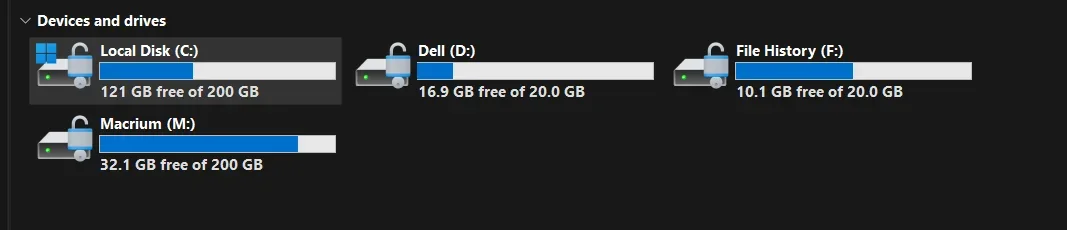
C and D are one 256Gb drive and F and M the other 256Gb drive. All Bitlocker protected. All keys stored on MS account and also printed and squirrelled away safe should they be needed.

Screenshot 2025-09-24 194344.webp
 

My Computer

System One

  • OS
    W11 Pro x64 ongoing Canary 29500 latest builds
    Computer type
    Laptop
    Manufacturer/Model
    Dell 7760 Mobile Precision 17"
    CPU
    Intel i5
    Motherboard
    Unknown
    Memory
    8Gb
    Graphics Card(s)
    Intel HD Graphics
    Sound Card
    Realtek
    Monitor(s) Displays
    Internal
    Hard Drives
    2 x 256Gb SSD
    PSU
    Dell 240 watt
    Mouse
    Dell Premier Bluetooth
    Internet Speed
    50Mbps
    Browser
    Edge
    Antivirus
    Default Microsoft Security
I have two systems running W11 Home, and both came with device encryption turned on, which I immediately turned off. Today I noticed my MS account has "BitLocker Keys" saved for both of them. Is there any reason to keep the keys or to delete them? I have no desire to use encryption of any kind.
 

My Computers

System One System Two

  • OS
    Windows 11 25H2
    Computer type
    PC/Desktop
    Manufacturer/Model
    Dell Tower Plus EBT2250
    CPU
    Intel Core Ultra 7 265
    Memory
    32GB
    Graphics Card(s)
    NVIDIA GeForce RTX 3050 6GB
    Monitor(s) Displays
    2x Dell U2419H
    Hard Drives
    NVMe Phison 521GB SSD
    Seagate 2TB HDD
    (Dell installed them RAID enabled using Intel VMD)
  • Operating System
    Windows 11 25H2
    Computer type
    Laptop
    Manufacturer/Model
    HP
    CPU
    Intel Core i5-1334U
    Motherboard
    HP 8DD7 - Intel Alder Lake-P PCH
    Memory
    8 GB
    Graphics card(s)
    Intel Raptor Lake-U - Integrated Graphics
    Hard Drives
    512 GB
Maybe this ( at the bottom ) :

I see at the following at the bottom of the link you provided:

1) "Note: If device encryption is turned off, it will no longer automatically enable itself in the future. The user must enable it manually in Settings."

And Googling:
2) "Windows 11 Device Encryption is an automatically enabled, consumer-focused version of BitLocker designed for Windows Home editions that uses a Microsoft account to back up the recovery key. In contrast, BitLocker is the more robust, feature-rich encryption tool available on Windows Pro, Enterprise, and Education editions, offering greater control over which drives are encrypted, the ability to require pre-boot authentication, and more flexible management of recovery keys."

Since my friend's PC is running Win11 Home, it appears that the drives are locked via "Device Encryption". And thus item-1 above applies.

Thanks!
 

My Computer

System One

  • OS
    Windows 11
    Computer type
    PC/Desktop
    Manufacturer/Model
    Self Built
    CPU
    Intel Core Ultra 7, 265K
    Motherboard
    MSI Pro Z890-P WiFi
    Memory
    32GB
    Graphics Card(s)
    Using integrated graphics
    Monitor(s) Displays
    LG
    Screen Resolution
    4K
    Hard Drives
    512 GB SSD, 2TB M.2 SSD and 2TB SATA SSD
    PSU
    Seasonic Modular 550 watt Focus Plus
    Case
    Corsair 4000D
    Cooling
    ThermalRight Phantom Sprit
Depends on if the user has device encryption (Home)or Bitlocker (Pro)

Very informative links. Will refer to them when I turn off Device Encryption on the two drives in my friend's PC.

Thanks much!
 

My Computer

System One

  • OS
    Windows 11
    Computer type
    PC/Desktop
    Manufacturer/Model
    Self Built
    CPU
    Intel Core Ultra 7, 265K
    Motherboard
    MSI Pro Z890-P WiFi
    Memory
    32GB
    Graphics Card(s)
    Using integrated graphics
    Monitor(s) Displays
    LG
    Screen Resolution
    4K
    Hard Drives
    512 GB SSD, 2TB M.2 SSD and 2TB SATA SSD
    PSU
    Seasonic Modular 550 watt Focus Plus
    Case
    Corsair 4000D
    Cooling
    ThermalRight Phantom Sprit
Duplicate post so deleted this one.
 
Last edited:

My Computer

System One

  • OS
    Windows 11
    Computer type
    PC/Desktop
    Manufacturer/Model
    Self Built
    CPU
    Intel Core Ultra 7, 265K
    Motherboard
    MSI Pro Z890-P WiFi
    Memory
    32GB
    Graphics Card(s)
    Using integrated graphics
    Monitor(s) Displays
    LG
    Screen Resolution
    4K
    Hard Drives
    512 GB SSD, 2TB M.2 SSD and 2TB SATA SSD
    PSU
    Seasonic Modular 550 watt Focus Plus
    Case
    Corsair 4000D
    Cooling
    ThermalRight Phantom Sprit
The same reg key is used to prevent automatic BitLocker and Device Encryption.
Code:
Windows Registry Editor Version 5.00

[HKEY_LOCAL_MACHINE\SYSTEM\CurrentControlSet\Control\BitLocker]
"PreventDeviceEncryption"=dword:00000001

DE is a simplified version of BitLocker. Same technology, but Home users don't get to fiddle with all the advanced settings.
Thanks for the additional clarification.
 

My Computer

System One

  • OS
    Windows 11
    Computer type
    PC/Desktop
    Manufacturer/Model
    Self Built
    CPU
    Intel Core Ultra 7, 265K
    Motherboard
    MSI Pro Z890-P WiFi
    Memory
    32GB
    Graphics Card(s)
    Using integrated graphics
    Monitor(s) Displays
    LG
    Screen Resolution
    4K
    Hard Drives
    512 GB SSD, 2TB M.2 SSD and 2TB SATA SSD
    PSU
    Seasonic Modular 550 watt Focus Plus
    Case
    Corsair 4000D
    Cooling
    ThermalRight Phantom Sprit
And jus a bit more info.

I actually save the disk images to a Bitlocker encrypted drive and there are no issues doing so.

I forget the exact wording but Macrium does give a 'warning' message that such an image is not in itself 'protected' and that you can use Macrium's own encryption to make the image itself 'safe'. None of this makes any difference to making and restoring images though. Also the image file on the Bitlocker drive can be moved as desired to another drive for archiving etc (and that drive can be Bitlocker protected or not).

So I image the C drive and put the image onto the 'Macrium' drive (pc has two internal drives). I also move backup when needed to a 1Tb USB drive that is 'Bitlocker to Go' protected.

C and D are one 256Gb drive and F and M the other 256Gb drive. All Bitlocker protected. All keys stored on MS account and also printed and squirrelled away safe should they be needed.

View attachment 146420
Thanks for the confirmation that Macrium will backup and restore Win11 encrypted drives successfully.
Actually, the backups will be done just as a safety measure in case decryption of my friend's drives is unsuccessful for whatever reason.
Thanks.
 

My Computer

System One

  • OS
    Windows 11
    Computer type
    PC/Desktop
    Manufacturer/Model
    Self Built
    CPU
    Intel Core Ultra 7, 265K
    Motherboard
    MSI Pro Z890-P WiFi
    Memory
    32GB
    Graphics Card(s)
    Using integrated graphics
    Monitor(s) Displays
    LG
    Screen Resolution
    4K
    Hard Drives
    512 GB SSD, 2TB M.2 SSD and 2TB SATA SSD
    PSU
    Seasonic Modular 550 watt Focus Plus
    Case
    Corsair 4000D
    Cooling
    ThermalRight Phantom Sprit
I have two systems running W11 Home, and both came with device encryption turned on, which I immediately turned off. Today I noticed my MS account has "BitLocker Keys" saved for both of them. Is there any reason to keep the keys or to delete them? I have no desire to use encryption of any kind.

If you are not using Bitlocker then you can forget about the keys and delete them if you wish. Remember the keys for the C drive change anyway if you reinstall W11 and I think also if you decrypt and re-encrypt.
 

My Computer

System One

  • OS
    W11 Pro x64 ongoing Canary 29500 latest builds
    Computer type
    Laptop
    Manufacturer/Model
    Dell 7760 Mobile Precision 17"
    CPU
    Intel i5
    Motherboard
    Unknown
    Memory
    8Gb
    Graphics Card(s)
    Intel HD Graphics
    Sound Card
    Realtek
    Monitor(s) Displays
    Internal
    Hard Drives
    2 x 256Gb SSD
    PSU
    Dell 240 watt
    Mouse
    Dell Premier Bluetooth
    Internet Speed
    50Mbps
    Browser
    Edge
    Antivirus
    Default Microsoft Security
BitLocker doesn't randomly turn itself back on, even in an upgrade scenario. At least not yet.
Well I sure would like to know what happened here then because I sure didn't select anything that said BitLocker. All I did was upgrade to 25H2. :mad:

bitlockerencrptnoconsent.webp
 

My Computer

System One

  • OS
    WIN 11, WIN 10, WIN 8.1, WIN 7 U, WIN 7 PRO, WIN 7 HOME (32 Bit), LINUX MINT
    Computer type
    PC/Desktop
    Manufacturer/Model
    DIY, ASUS, and DELL
    CPU
    Intel i7 6900K and i9-7960X / AMD 3800X (8 core)
    Motherboard
    ASUS X99E-WS USB 3.1 and ASUS X299 SAGE
    Memory
    128 GB CORSAIR DOMINATOR PLATINUM (B DIE)
    Graphics Card(s)
    NVIDIA 1070 and RTX 3070
    Sound Card
    Crystal Sound (onboard)
    Monitor(s) Displays
    single Samsung 30" 4K and 8" aux monitor
    Screen Resolution
    4K and something equally attrocious. I'll be working on this.
    Hard Drives
    A, B, C, D, E, F, G, H, I, J, K, L, M, N, O, P, Q, R, S, T, U, V, W

    Ports X, Y, and Z are reserved for USB access and removable drives.

    Drive types consist of the following: Various mechanical hard drives bearing the brand names, Seagate, Toshiba, and Western Digital. Various NVMe drives bearing the brand names Kingston, Intel, Silicon Power, Crucial, Western Digital, and Team Group. Various SATA SSDs bearing various different brand names.

    RAID arrays included:

    LSI RAID 10 (WD Velociraptors) 1115.72 GB
    LSI RAID 10 (WD SSDS) 463.80 GB

    INTEL RAID 0 (KINGSTON HYPER X) System 447.14 GB
    INTEL RAID 1 TOSHIBA ENTERPRIZE class Data 2794.52 GB
    INTEL RAID 1 SEAGATE HYBRID 931.51 GB
    PSU
    SEVERAL. I prefer my Corsair Platinum HX1000i but I also like EVGA power supplies
    Case
    ThermalTake Level 10 GT (among others)
    Cooling
    Noctua is my favorite and I use it in my main. I also own various other coolers.
    Keyboard
    all kinds.
    Mouse
    all kinds
    Internet Speed
    360 mbps - 1 gbps (depending)
    Browser
    FIREFOX
    Antivirus
    KASPERSKY (no apologies)
    Other Info
    Gave Dell touch screen with Windows 11 to daughter and got me an OTVOC. Being a PC builder I own many desktop PCs as well. I am a father of five providing PCs, laptops, and tablets for all my family, most of which I have modified, rebuilt, or simply built from scratch. I do not own a cell phone, never have, never will.
Let me tell ya'll a story about a friend of mine. (And yes, he really was a friend of mine and still is. In fact the guy could run circles around me when it comes to both software and hardware. He's only a little younger than me and he was building computers back in the 70's.) Well, to make a long story short he thought he would enable BitLocker. He thought it was a great idea at the time but I was reluctant about the idea of letting some other party encrypt my physical data on my PC. About a month later my friend got ransomwared. That was enough reason for me NOT to enable BitLocker on my PC. Ya'll can do what you like. Personal preference prevails. All I know is I never enabled BitLocker and I never got ransomware. Looks like Mr. Braxman was correct about Win 11 after all.
 

My Computer

System One

  • OS
    WIN 11, WIN 10, WIN 8.1, WIN 7 U, WIN 7 PRO, WIN 7 HOME (32 Bit), LINUX MINT
    Computer type
    PC/Desktop
    Manufacturer/Model
    DIY, ASUS, and DELL
    CPU
    Intel i7 6900K and i9-7960X / AMD 3800X (8 core)
    Motherboard
    ASUS X99E-WS USB 3.1 and ASUS X299 SAGE
    Memory
    128 GB CORSAIR DOMINATOR PLATINUM (B DIE)
    Graphics Card(s)
    NVIDIA 1070 and RTX 3070
    Sound Card
    Crystal Sound (onboard)
    Monitor(s) Displays
    single Samsung 30" 4K and 8" aux monitor
    Screen Resolution
    4K and something equally attrocious. I'll be working on this.
    Hard Drives
    A, B, C, D, E, F, G, H, I, J, K, L, M, N, O, P, Q, R, S, T, U, V, W

    Ports X, Y, and Z are reserved for USB access and removable drives.

    Drive types consist of the following: Various mechanical hard drives bearing the brand names, Seagate, Toshiba, and Western Digital. Various NVMe drives bearing the brand names Kingston, Intel, Silicon Power, Crucial, Western Digital, and Team Group. Various SATA SSDs bearing various different brand names.

    RAID arrays included:

    LSI RAID 10 (WD Velociraptors) 1115.72 GB
    LSI RAID 10 (WD SSDS) 463.80 GB

    INTEL RAID 0 (KINGSTON HYPER X) System 447.14 GB
    INTEL RAID 1 TOSHIBA ENTERPRIZE class Data 2794.52 GB
    INTEL RAID 1 SEAGATE HYBRID 931.51 GB
    PSU
    SEVERAL. I prefer my Corsair Platinum HX1000i but I also like EVGA power supplies
    Case
    ThermalTake Level 10 GT (among others)
    Cooling
    Noctua is my favorite and I use it in my main. I also own various other coolers.
    Keyboard
    all kinds.
    Mouse
    all kinds
    Internet Speed
    360 mbps - 1 gbps (depending)
    Browser
    FIREFOX
    Antivirus
    KASPERSKY (no apologies)
    Other Info
    Gave Dell touch screen with Windows 11 to daughter and got me an OTVOC. Being a PC builder I own many desktop PCs as well. I am a father of five providing PCs, laptops, and tablets for all my family, most of which I have modified, rebuilt, or simply built from scratch. I do not own a cell phone, never have, never will.
Well I sure would like to know what happened here then because I sure didn't select anything that said BitLocker. All I did was upgrade to 25H2. :mad:
Maybe because Microsoft does not like you. ;-)
Seriously though, I've not seen that happen during an upgrade. But when using a MS account things are getting stranger and stranger about what we, as users, can expect during any given scenario when it comes to stuff Microsoft wants us to have. Bitlocker/device encryption and Onedrive are at the top of MS list and they can force it down our throat at will.

When I'm going to go through the roof and stroke out is when they force me to use secure boot. I want no part of the secure boot key crap just like I want no part of bitlocker. But I know it's a comin' right along with some other stuff that's going to prevent us from changing a lot of stuff we can currently change..... especially in Home. All mine are Pro, but even in Pro, I'm not sure we will be spared from some things MS has in their plan.
 

My Computers

System One System Two

  • OS
    Windows 11 Pro 25H2 26200.8655
    Computer type
    PC/Desktop
    Manufacturer/Model
    Dell Optiplex 7080
    CPU
    i9-10900 10 core 20 threads
    Motherboard
    DELL 0J37VM
    Memory
    32 gb
    Graphics Card(s)
    none-Intel UHD Graphics 630
    Sound Card
    Integrated Realtek
    Monitor(s) Displays
    Benq 27
    Screen Resolution
    2560x1440
    Hard Drives
    2x1tb Solidigm m.2 nvme /External drives 512gb Samsung m.2 sata+2tb Kingston m2.nvme
    PSU
    500w
    Case
    MT
    Cooling
    Dell Premium
    Keyboard
    Logitech wired
    Mouse
    Logitech wireless
    Internet Speed
    so slow I'm too embarrassed to tell
    Browser
    #1 Edge #2 Firefox
    Antivirus
    Defender+MWB Premium
  • Operating System
    Windows 11 Pro 24H2 26200.8457
    Computer type
    PC/Desktop
    Manufacturer/Model
    Beelink Mini PC SER5
    CPU
    AMD Ryzen 7 6800U
    Memory
    32 gb
    Graphics card(s)
    integrated
    Sound Card
    integrated
    Monitor(s) Displays
    Benq 27
    Screen Resolution
    2560x1440
    Hard Drives
    1TB Crucial nvme
    Keyboard
    Logitech wired
    Mouse
    Logitech wireless
    Internet Speed
    still too embarrassed to tell
    Browser
    Firefox
    Antivirus
    Defender
    Other Info
    System 3 is non compliant Dell 9020 i7-4770/24gb ram Win11 PRO 26200.8457
Maybe because Microsoft does not like you. ;-)
Seriously though, I've not seen that happen during an upgrade. But when using a MS account things are getting stranger and stranger about what we, as users, can expect during any given scenario when it comes to stuff Microsoft wants us to have. Bitlocker/device encryption and Onedrive are at the top of MS list and they can force it down our throat at will.

When I'm going to go through the roof and stroke out is when they force me to use secure boot. I want no part of the secure boot key crap just like I want no part of bitlocker. But I know it's a comin' right along with some other stuff that's going to prevent us from changing a lot of stuff we can currently change..... especially in Home. All mine are Pro, but even in Pro, I'm not sure we will be spared from some things MS has in their plan.
That happened on a local account. I managed to decrypt but that's not the point. I should not have to decrypt my drives simply because I upgraded my OS to 25H2. The only Home edition of Win 11 I own is in my gaming rig which is slated for disassembly. I have a hunch this is a TPM thing. Linux couldn't ask for a better friend.
 

My Computer

System One

  • OS
    WIN 11, WIN 10, WIN 8.1, WIN 7 U, WIN 7 PRO, WIN 7 HOME (32 Bit), LINUX MINT
    Computer type
    PC/Desktop
    Manufacturer/Model
    DIY, ASUS, and DELL
    CPU
    Intel i7 6900K and i9-7960X / AMD 3800X (8 core)
    Motherboard
    ASUS X99E-WS USB 3.1 and ASUS X299 SAGE
    Memory
    128 GB CORSAIR DOMINATOR PLATINUM (B DIE)
    Graphics Card(s)
    NVIDIA 1070 and RTX 3070
    Sound Card
    Crystal Sound (onboard)
    Monitor(s) Displays
    single Samsung 30" 4K and 8" aux monitor
    Screen Resolution
    4K and something equally attrocious. I'll be working on this.
    Hard Drives
    A, B, C, D, E, F, G, H, I, J, K, L, M, N, O, P, Q, R, S, T, U, V, W

    Ports X, Y, and Z are reserved for USB access and removable drives.

    Drive types consist of the following: Various mechanical hard drives bearing the brand names, Seagate, Toshiba, and Western Digital. Various NVMe drives bearing the brand names Kingston, Intel, Silicon Power, Crucial, Western Digital, and Team Group. Various SATA SSDs bearing various different brand names.

    RAID arrays included:

    LSI RAID 10 (WD Velociraptors) 1115.72 GB
    LSI RAID 10 (WD SSDS) 463.80 GB

    INTEL RAID 0 (KINGSTON HYPER X) System 447.14 GB
    INTEL RAID 1 TOSHIBA ENTERPRIZE class Data 2794.52 GB
    INTEL RAID 1 SEAGATE HYBRID 931.51 GB
    PSU
    SEVERAL. I prefer my Corsair Platinum HX1000i but I also like EVGA power supplies
    Case
    ThermalTake Level 10 GT (among others)
    Cooling
    Noctua is my favorite and I use it in my main. I also own various other coolers.
    Keyboard
    all kinds.
    Mouse
    all kinds
    Internet Speed
    360 mbps - 1 gbps (depending)
    Browser
    FIREFOX
    Antivirus
    KASPERSKY (no apologies)
    Other Info
    Gave Dell touch screen with Windows 11 to daughter and got me an OTVOC. Being a PC builder I own many desktop PCs as well. I am a father of five providing PCs, laptops, and tablets for all my family, most of which I have modified, rebuilt, or simply built from scratch. I do not own a cell phone, never have, never will.
Back
Top Bottom