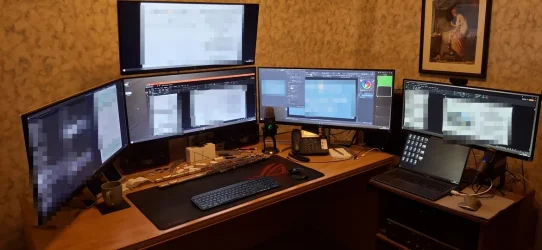
My workflow has me accessing the desktop itself frequently, so I do need to minimize stuff to get it out of the way. I could use Win + D to minimize everything, then Win + D again to restore BUT if you switch to another virtual desktop and then back again, Win + D seems to lose track of what it minimized before and so pressing Win + D to restore does not work.
This is yet another reason why I don't use virtual desktops. Alt+Tab will always restore a minimized window automatically anyway in the first place. ExplorerPatcher's Simple Window Switcher not only does the same when I press Alt +
key above Tab to switch to a minimized window of the same app as the currently active window, but also has an option to "Show the desktop as the last window in the interaction list".
As a result, I always have one virtual desktop that is a desktop with no open windows.
Once I had all the keyboard shortcuts committed to memory, I found that I could zip along at lightning speed. I've actually had people who see me working note how rapidly I navigate many open tasks.
My take from the comments in this thread is this: We all have different workflows. What works for one person may not work for another person. Plus, we all have our preferences. What may be technically more efficient may still not be how some people prefer to work. Some may actually prefer a less efficient way of navigating simply because they are used to their procedures or they don't want to learn a new way because their methods work well enough for them. So, there is no one "right" answer, just what is right for you personally.
The simple fact that all its shortcomings make the virtual desktops feature less efficient also is why I don't use virtual desktops. I already outlined several of these shortcomings, but the list still goes on, as is evidenced by your own observation above, i.e., it breaks Win+D. Granted, I don't know specific details like exactly how your workflow is structured so, I can't (nor feel the need to) comment on whether these shortcomings have any significant impact on the efficiency of your workflow.
What I can say, though, is that my own personal workflow revolves heavily around things like automated taskbar toolbars and various other automation tweaks that I wrote over the years, but UI automation is only one (fairly small) part of all that. It relies on AutoHotKey, PowerShell, C#, etc., and some of it also relies on scripts, tools, and utilities that someone else wrote. A lot of these are hosted on GitHub, as GitHub really is a treasure trove, even though there are other places.
That said, just because I don't use virtual desktops doesn't also mean that I don't know all of its keyboard shortcuts by heart. I do, and, I know all of Task View's keyboard actions, also by heart. Memorizing them was easy enough that I can still perfectly remember them all, which is a bit odd I guess.
As an Enterprise Java developer, none of my work related activities ever rely on (or come in contact with) the Windows OS in any way. Ever. The entire hardware setup and infrastructure is completely separate, fully isolated, due to company policy. I am not even allowed to further discuss it publicly, but I can't sit here cooking Enterprise Java Beans all day long (and most of the night) and still be able to futz around in Windows without also remembering to save my eyes. That in fact is why I am in front of a 55 inch TV. It's because the 10 feet viewing distance makes a ton of difference in that regard.
What's more, I am lying on my back because just looking at your setup already hurts my rear end plus everything that is attached to it. Sitting on a chair frequently for prolonged periods of time is very bad for health, whereas taking frequent (and long enough) breaks is recommended, BUT... research has shown that, by the time you can fully concentrate again after you took another break, you're almost always already halfway (or threabout) to needing your next break.
So yes, of course I can relate to "different folks, different strokes", or "to each their own". It's considered rather trivial in my line of work and in some other areas. I am naturally attracted to the kind of environments where people don't very often waste time trying to state the obvious, where the general consensus is that making strong logical sense must take strong precedence over unnecessary politeness.
I've heard some people complain about how many different ways the same task can sometimes be performed in Windows. To me that is a strong point of Windows for precisely that reason - what works best for one person may not be best for another.
Oftentimes it's not just about one person versus another IMO. There's pros and there's cons to everything, and personal preference or the force of habit is only one part of that equation.



 My setup works for me.