This tutorial will show you how to add or remove the All apps section on the Start menu for your account, specific users, or all users in Windows 11.
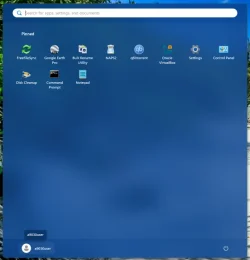
The Start menu in Windows 11 is comprised of three sections: Pinned, Recent, and All apps.
The All apps section on the Start menu shows all your installed apps in either a Category, Grid, or List view. With All now on the top-level, apps are easily accessible without having to navigate to a secondary page. The new default Category view automatically groups your apps by category for quick access to your most used categories and apps. So, if your most used apps are Outlook and Solitaire, you can expect those apps to bubble up to the top in their respective categories. Categories are formed when there are at least 3 apps in each respective category. Otherwise, they will remain in the “Other” category. Grid view is ordered alphabetically like List view but allows for better scanning of all your installed apps with more horizontal real estate. The Start menu will remember your last used view so you can reliably launch your apps with the view you prefer most.
Starting with Windows 11 build 26100.9278 (24H2), build 26200.9278 (25H2), and build 2800.3086 (26H1), Microsoft has added section-level toggles to independently show or hide Pinned, Recommended, and All.
Removing the All Apps list can be handy if you prefer to only see pinned apps on Start instead.
- Option One: Add or Remove All Apps Section on Start Menu for Current User in Settings
- Option Two: Add or Remove All Apps Section on Start Menu for Current User using REG file
- Option Three: Add or Remove All apps section on Start Menu for All or Specific Users in Local Group Policy Editor
- Option Four: Add or Remove All apps section on Start Menu for All Users using REG file
EXAMPLE: Add or Remove All apps section on Start Menu
This option is only available starting with Windows 11 build 26300.8553 (Experimental 25H2) for Insiders.
1 Open Settings (Win+I).
2 Click/tap on Personalization on the left side, and click/tap on Start on the right side. (see screenshot below)
3 Under Layout options, turn On (add) or Off (remove - default) All for what you want. (see screenshot below)
4 You can now close Settings if you like.
This option is only available starting with Windows 11 build 26300.8553 (Experimental 25H2) for Insiders.
1 Do step 2] (add) or step 3 (remove) below for what you want.
This is the default setting.
(Contents of REG file for reference)
Windows Registry Editor Version 5.00

[HKEY_CURRENT_USER\Software\Microsoft\Windows\CurrentVersion\Start]
"ShowAllAppsSection"=dword:00000001(Contents of REG file for reference)
Windows Registry Editor Version 5.00

[HKEY_CURRENT_USER\Software\Microsoft\Windows\CurrentVersion\Start]
"ShowAllAppsSection"=dword:00000000
4 Save the .reg file to your desktop.
5 If you have Smart App Control turned on, you will need to unblock the downloaded REG file.
6 Double click/tap on the downloaded .reg file to merge it.
7 When prompted, click/tap on Run, Yes (UAC), Yes, and OK to approve the merge.
8 You can now delete the downloaded .reg file if you like.
Add or Remove All apps section on Start Menu for All or Specific Users in Local Group Policy Editor
You must be signed in as an administrator to use this option.
The Local Group Policy Editor is only available in the Windows 11 Pro, Enterprise, and Education editions.
All editions can use Option Four to configure the same policy.
1 Open the all users, specific users or groups, or all users except administrators Local Group Policy Editor for how you want this policy applied.
2 Navigate to the policy location below you want in the left pane of the Local Group Policy Editor. (see screenshot below)
3 In the right pane of Start Menu and Taskbar in the Local Group Policy Editor, double click/tap on the Remove All Programs list from the Start menu policy to edit it. (see screenshot above)
4 Do step 5 (add) or step 6 (remove) below for what you want.
This is the default setting to allow using Option One and Option Two.
This will prevent using Option One and Option Two.
7 If the policy doesn't get applied immediately, then either restart the explorer process, sign out and sign in, or restart the computer to apply.
8 You can now close the Local Group Policy Editor if you like.
You must be signed in as an administrator to use this option.
1 Do step 2 (add) or step 3 (remove) below for what you would like to do.
This is the default setting to allow using Option One and Option Two.
(Contents of REG file for reference)
Windows Registry Editor Version 5.00

[HKEY_CURRENT_USER\Software\Microsoft\Windows\CurrentVersion\Policies\Explorer]
"NoStartMenuMorePrograms"=-

[HKEY_LOCAL_MACHINE\SOFTWARE\Microsoft\Windows\CurrentVersion\Policies\Explorer]
"NoStartMenuMorePrograms"=-This will prevent using Option One and Option Two.
(Contents of REG file for reference)
Windows Registry Editor Version 5.00

[HKEY_CURRENT_USER\Software\Microsoft\Windows\CurrentVersion\Policies\Explorer]
"NoStartMenuMorePrograms"=-

[HKEY_LOCAL_MACHINE\SOFTWARE\Microsoft\Windows\CurrentVersion\Policies\Explorer]
"NoStartMenuMorePrograms"=dword:00000001
4 Save the REG file to your desktop.
5 If you have Smart App Control turned on, you will need to unblock the downloaded REG file.
6 Double click/tap on the downloaded REG file to merge it.
7 When prompted, click/tap on Run, Yes (UAC), Yes, and OK to approve the merge.
8 Either restart the explorer process, sign out and sign in, or restart the computer to apply.
9 You can now delete the downloaded REG file if you like.
That's it,
Shawn Brink
- Open Start Menu in Windows 11
- Change Start Menu All apps View in Windows 11
- Add or Remove Category View in All Apps Section on Start Menu in Windows 11
- Hide or Show Most Used apps list on Start Menu in Windows 11
- Add or Remove Pinned Section on Start Menu in Windows 11
- Remove Recommended Section from Start Menu in Windows 11
- Add or Remove Items in All apps in Windows 11 Start menu
- Add or Remove Common Program Groups from Start Menu in Windows 11
- Add or Remove User Program Groups from Start Menu in Windows 11