Advice on options to Dual Boot Windows 10 and Windows 11 on Separate SSDs


Fozzie Bear

Active member
Local time
1:38 PM
Posts
32
OS
Windows 10 Home 22H2 (Build 19045.4291)
I am seeking advice on the best method to dual boot windows 10 (22h2) and windows 11 (23H2) each on separate SSD's
Despite a considerable amount of help from colleagues on this forum to get win 11 installed on unsupported hardware I eventually caved in and did a clean install of Win 11 on another ssd on the basis this will be my default OS with access to Win10 when I want to use software which I no longer have the installation media.

At the moment I can choose which OS to boot using the bios F12 boot menu option but would prefer an easier method. Initially I could not see the windows 10 partitions in windows 11 even in disk manager so I mistakenly installed EasyBCD on Windows 10 but in doing so screwed up the boot loader on the win10 drive.
I have recovered the situation using Macrium Reflect boot ISO and can now again boot into Windows 10.

Is there an alternative to EasyBCD as it throws up a warning about reduced functionality with GPT disks. It seems a bit more complicated with two disks than with the OS on separate partitions on the same disk with presumably only one efi partition? Am I safe installing EasyBCD on Win 11 drive and creating an entry for Win 10 assuming I make the Win 11 SSD the priority boot media. Or is there a better or easier way.
Also once EasyBCD has found to correct partition and created the boot entry can you safely hide the partitions of the other drive by removing the drive letters?
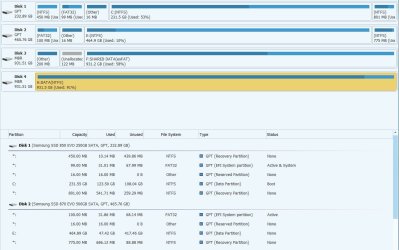
I have included a snip of the drives from Minitool. Disk1 is Win 10 on 256Gb SSD and Disk2 is Win 11 on a 512Gb SSD. The other two disks are my data volumes
Many thanks
Disk Partitions.JPG
 

My Computer My Computer

At a glance

Windows 10 Home 22H2 (Build 19045.4291)Intel(R) Core(TM) i7-4770K CPU @ 3.50GHz (8 C...16.0 GbIntegrated Intel(R) HD Graphics 4600
OS
Windows 10 Home 22H2 (Build 19045.4291)
Computer type
PC/Desktop
Manufacturer/Model
Gigabyte B85M-D3H
CPU
Intel(R) Core(TM) i7-4770K CPU @ 3.50GHz (8 CPUs)
Motherboard
Gigabyte B85M-D3H
Memory
16.0 Gb
Graphics Card(s)
Integrated Intel(R) HD Graphics 4600
Sound Card
Intel Digital Audio (S/PDIF) (High Definition Audio Device)
Monitor(s) Displays
BenQ G2420HD
Screen Resolution
1920x1080
Hard Drives
Primary: Samsung SSD 840 EVO 250GB Secondary 1: Seagate ST31000524AS (NTFS) Secondary 2: Seagate ST1000DM005 HD103SJ(exFat)
PSU
OCZ 550w
Case
LianLi
Cooling
ThermoLab Trinity
Keyboard
Dell (Logitech) Wireless keyboard
Mouse
Dell (Logitech) Wireless Mouse
Internet Speed
100mb FTTP
My personal preferred method for dual-booting two Windows OSes is to install the secondary OS as a Natively Bootable VHD.

Brief Overview

A natively Bootable VHD is a Virtual Hard Disk file that the PC can boot directly. In brief, the procedure involves creating a VHD (Virtual Hard Disk) and deploying Windows to it, then marking that VHD bootable.

Advantages

Booting from a VHD has multiple advantages:

1) Super simple to setup.

2) Unlike a VM, the installation of Windows in a VHD has direct access to your hardware, so you would install all the same drivers as for your physical machine. This is a great way to test that an OS will work on your specific hardware with all the drivers that you have available. If the OS works in the VHD, then it should also work flawlessly on your hardware outside of a VHD.

3) Ridiculously easy to cleanup when done. Because you are deploying Windows to a single VHD file, it is crazy easy to cleanup when done testing. Simply remove that OS from the BCD and delete the VHD. It is literally that simple.

4) If you are installing this instance of Windows using the same edition (Pro, Home, etc.) that you already have activated on your machine, then the instance in the VHD can also be activated without the need for any additional license key. This will allow you to fully utilize all Windows features since you will have a fully activated copy of Windows.

If this sounds like something that you are interested in, please let me know. I will send to you links to tutorials on how to accomplish this, along with some additional notes.
 

My Computers My Computers

  • At a glance

    Win11 Pro 25H2 (RTM+)Intel i7-14650HX32 GBNo GPU - Built-in Intel Graphics
    OS
    Win11 Pro 25H2 (RTM+)
    Computer type
    PC/Desktop
    Manufacturer/Model
    Acemagic
    CPU
    Intel i7-14650HX
    Memory
    32 GB
    Graphics Card(s)
    No GPU - Built-in Intel Graphics
    Sound Card
    Integrated
    Monitor(s) Displays
    Varies as machine will often be moved to locations with different monitors
    Screen Resolution
    Varies
    Hard Drives
    1 x 1TB Gen 4 NVMe SSD
    PSU
    120W Power Brick
    Keyboard
    Corsair K70 Max RGB Magnetic Keyboard
    Mouse
    Logitech MX Master 3
    Internet Speed
    1Gb Up / 1 Gb Down
    Browser
    Edge
    Antivirus
    Windows Defender
  • At a glance

    Win11 Pro 25H2 (RTM+)Intel i7-1255U16 GBIntel Iris Xe Graphics
    Operating System
    Win11 Pro 25H2 (RTM+)
    Computer type
    Laptop
    Manufacturer/Model
    Lenovo ThinkBook 13x Gen 2
    CPU
    Intel i7-1255U
    Memory
    16 GB
    Graphics card(s)
    Intel Iris Xe Graphics
    Sound Card
    Realtek® ALC3306-CG codec
    Monitor(s) Displays
    13.3-inch IPS Display
    Screen Resolution
    WQXGA (2560 x 1600)
    Hard Drives
    2 TB 4 x 4 NVMe SSD
    PSU
    USB-C / Thunderbolt 4 Power / Charging
    Keyboard
    Backlit, spill resistant keyboard
    Mouse
    Buttonless Glass Precision Touchpad
    Internet Speed
    1Gb Up / 1Gb Down
    Browser
    Edge
    Antivirus
    Windows Defender
    Other Info
    WiFi 6e / Bluetooth 5.1 / Facial Recognition / Fingerprint Sensor / ToF (Time of Flight) Human Presence Sensor
My personal preferred method for dual-booting two Windows OSes is to install the secondary OS as a Natively Bootable VHD.

Brief Overview

A natively Bootable VHD is a Virtual Hard Disk file that the PC can boot directly. In brief, the procedure involves creating a VHD (Virtual Hard Disk) and deploying Windows to it, then marking that VHD bootable.

Advantages

Booting from a VHD has multiple advantages:

1) Super simple to setup.

2) Unlike a VM, the installation of Windows in a VHD has direct access to your hardware, so you would install all the same drivers as for your physical machine. This is a great way to test that an OS will work on your specific hardware with all the drivers that you have available. If the OS works in the VHD, then it should also work flawlessly on your hardware outside of a VHD.

3) Ridiculously easy to cleanup when done. Because you are deploying Windows to a single VHD file, it is crazy easy to cleanup when done testing. Simply remove that OS from the BCD and delete the VHD. It is literally that simple.

4) If you are installing this instance of Windows using the same edition (Pro, Home, etc.) that you already have activated on your machine, then the instance in the VHD can also be activated without the need for any additional license key. This will allow you to fully utilize all Windows features since you will have a fully activated copy of Windows.

If this sounds like something that you are interested in, please let me know. I will send to you links to tutorials on how to accomplish this, along with some additional notes.
Many thanks @hsehestedt. If I were starting from scratch then I would certainly consider your suggestion. However the OS I want to retain is Windows 10 which is going out of support and the OS has installations of certain software that is no longer available due to the company going out of business. I have the software but as the activation servers are gone it will not activate. I therefore need to keep the existing Win10 image.
I tried to upgrade it to Win11 with help from others on this forum, but it keeps failing. I therefore did a clean install of Win11 on a new SSD which will now be my default OS going forward. Hence the dual boot and asking for a easier way to achieve this. There are other boot managers such as EasyUEFI and rEFInd - Boot Manager but perhaps there is a straightforward option using windows tools.
Many thanks for suggestion.
 

My Computer My Computer

At a glance

Windows 10 Home 22H2 (Build 19045.4291)Intel(R) Core(TM) i7-4770K CPU @ 3.50GHz (8 C...16.0 GbIntegrated Intel(R) HD Graphics 4600
OS
Windows 10 Home 22H2 (Build 19045.4291)
Computer type
PC/Desktop
Manufacturer/Model
Gigabyte B85M-D3H
CPU
Intel(R) Core(TM) i7-4770K CPU @ 3.50GHz (8 CPUs)
Motherboard
Gigabyte B85M-D3H
Memory
16.0 Gb
Graphics Card(s)
Integrated Intel(R) HD Graphics 4600
Sound Card
Intel Digital Audio (S/PDIF) (High Definition Audio Device)
Monitor(s) Displays
BenQ G2420HD
Screen Resolution
1920x1080
Hard Drives
Primary: Samsung SSD 840 EVO 250GB Secondary 1: Seagate ST31000524AS (NTFS) Secondary 2: Seagate ST1000DM005 HD103SJ(exFat)
PSU
OCZ 550w
Case
LianLi
Cooling
ThermoLab Trinity
Keyboard
Dell (Logitech) Wireless keyboard
Mouse
Dell (Logitech) Wireless Mouse
Internet Speed
100mb FTTP
Many thanks @hsehestedt. If I were starting from scratch then I would certainly consider your suggestion. However the OS I want to retain is Windows 10 which is going out of support and the OS has installations of certain software that is no longer available due to the company going out of business. I have the software but as the activation servers are gone it will not activate. I therefore need to keep the existing Win10 image.
I tried to upgrade it to Win11 with help from others on this forum, but it keeps failing. I therefore did a clean install of Win11 on a new SSD which will now be my default OS going forward. Hence the dual boot and asking for a easier way to achieve this. There are other boot managers such as EasyUEFI and rEFInd - Boot Manager but perhaps there is a straightforward option using windows tools.
Many thanks for suggestion.
Even then it is simple - you could clone the W10 installation to a vhd. Easybcd is the easiest to add/remove bcd entries.
 

My Computer My Computer

At a glance

Windows 11 Pro + Win11 Canary VM.I9 13th gen i9-13900H 2.60 GHZ16 GB solderedIntegrated Intel Iris XE
OS
Windows 11 Pro + Win11 Canary VM.
Computer type
Laptop
Manufacturer/Model
ASUS Zenbook 14
CPU
I9 13th gen i9-13900H 2.60 GHZ
Motherboard
Yep, Laptop has one.
Memory
16 GB soldered
Graphics Card(s)
Integrated Intel Iris XE
Sound Card
Realtek built in
Monitor(s) Displays
laptop OLED screen
Screen Resolution
2880x1800 touchscreen
Hard Drives
1 TB NVME SSD (only weakness is only one slot)
PSU
Internal + 65W thunderbolt USB4 charger
Case
Yep, got one
Cooling
Stella Artois (UK pint cans - 568 ml) - extra cost.
Keyboard
Built in UK keybd
Mouse
Bluetooth , wireless dongled, wired
Internet Speed
900 mbs (ethernet), wifi 6 typical 350-450 mb/s both up and down
Browser
Edge
Antivirus
Defender
Other Info
TPM 2.0, 2xUSB4 thunderbolt, 1xUsb3 (usb a), 1xUsb-c, hdmi out, 3.5 mm audio out/in combo, ASUS backlit trackpad (inc. switchable number pad)

Macrium Reflect Home V8
Office 365 Family (6 users each 1TB onedrive space)
Hyper-V (a vm runs almost as fast as my older laptop)
Thanks @cereberus Should I set up Win11 SSD as the first boot device in the bios and then install EasyBCD on Win 11 and add Win10 there?
 

My Computer My Computer

At a glance

Windows 10 Home 22H2 (Build 19045.4291)Intel(R) Core(TM) i7-4770K CPU @ 3.50GHz (8 C...16.0 GbIntegrated Intel(R) HD Graphics 4600
OS
Windows 10 Home 22H2 (Build 19045.4291)
Computer type
PC/Desktop
Manufacturer/Model
Gigabyte B85M-D3H
CPU
Intel(R) Core(TM) i7-4770K CPU @ 3.50GHz (8 CPUs)
Motherboard
Gigabyte B85M-D3H
Memory
16.0 Gb
Graphics Card(s)
Integrated Intel(R) HD Graphics 4600
Sound Card
Intel Digital Audio (S/PDIF) (High Definition Audio Device)
Monitor(s) Displays
BenQ G2420HD
Screen Resolution
1920x1080
Hard Drives
Primary: Samsung SSD 840 EVO 250GB Secondary 1: Seagate ST31000524AS (NTFS) Secondary 2: Seagate ST1000DM005 HD103SJ(exFat)
PSU
OCZ 550w
Case
LianLi
Cooling
ThermoLab Trinity
Keyboard
Dell (Logitech) Wireless keyboard
Mouse
Dell (Logitech) Wireless Mouse
Internet Speed
100mb FTTP
For me the way it is is perfect. Totally independent
You can add Win 10 to the win 11 boot manager (or vice versa). When you boot you will see the two options (win 10 and Win 11) and a count down to load Win 11 (or Win 10).
The downside is that at every boot you will have to choose witch OS to boot or wait for the count down.
I can give you the commands to add the second OS to the boot loader.
 
Last edited:

My Computers My Computers

  • At a glance

    Windows 11 Pro - Windows 7 HP 64 - Lubuntui5 6600K - 800MHz to 4400MHz4+4G GSkill DDR4 3000IG - Intel 530
    OS
    Windows 11 Pro - Windows 7 HP 64 - Lubuntu
    Computer type
    PC/Desktop
    Manufacturer/Model
    custom build
    CPU
    i5 6600K - 800MHz to 4400MHz
    Motherboard
    GA-Z170-HD3P
    Memory
    4+4G GSkill DDR4 3000
    Graphics Card(s)
    IG - Intel 530
    Monitor(s) Displays
    Samsung 226BW
    Screen Resolution
    1680x1050
    Hard Drives
    (1) -1 SM951 – 128GB M.2 AHCI PCIe SSD drive for Win 11
    (2) -1 WD SATA 3 - 1T for Data
    (3) -1 WD SATA 3 - 1T for backup
    (4) -1 BX500 SSD - 256G for Windows 7 and Lubuntu
    PSU
    Thermaltake 450W TR2 gold
    Keyboard
    Old and good Chicony mechanical keyboard
    Mouse
    Logitech mX performance - 9 buttons (had to disable some)
    Internet Speed
    500 Mb/s
    Browser
    Firefox 64
  • At a glance

    Windows 11 Proi7-4500U 800- 3000MHz(4+4)G DDR3 1600IG intel 4400 + NVIDIA GeForce GT 745M
    Operating System
    Windows 11 Pro
    Computer type
    Laptop
    Manufacturer/Model
    Asus Q550LF
    CPU
    i7-4500U 800- 3000MHz
    Motherboard
    Asus Q550LF
    Memory
    (4+4)G DDR3 1600
    Graphics card(s)
    IG intel 4400 + NVIDIA GeForce GT 745M
    Sound Card
    Realtek
    Monitor(s) Displays
    LG Display LP156WF4-SPH1
    Screen Resolution
    1920 x 1080
    Hard Drives
    BX500 120G SSD for Windows and programs
    & 1T HDD for data
    Internet Speed
    500 Mb/s
    Browser
    Firefox 64
For me the way it is is perfect. Totally independent
You can add Win 10 to the win 11 boot manager (or vice versa). When you boot you will see the two options (win 10 an Win 11) and a count down to load Win 11 (or Win 10).
The downside is that at every boot you will have to choose witch OS to boot or wait for the count down.
I can give you the commands to add the second OS to the boot loader.
Hi @Megahertz I am assuming you are not using EasyBCD to add the other OS to the boot manager. If you could show me what to do that would be great. Many thanks
 

My Computer My Computer

At a glance

Windows 10 Home 22H2 (Build 19045.4291)Intel(R) Core(TM) i7-4770K CPU @ 3.50GHz (8 C...16.0 GbIntegrated Intel(R) HD Graphics 4600
OS
Windows 10 Home 22H2 (Build 19045.4291)
Computer type
PC/Desktop
Manufacturer/Model
Gigabyte B85M-D3H
CPU
Intel(R) Core(TM) i7-4770K CPU @ 3.50GHz (8 CPUs)
Motherboard
Gigabyte B85M-D3H
Memory
16.0 Gb
Graphics Card(s)
Integrated Intel(R) HD Graphics 4600
Sound Card
Intel Digital Audio (S/PDIF) (High Definition Audio Device)
Monitor(s) Displays
BenQ G2420HD
Screen Resolution
1920x1080
Hard Drives
Primary: Samsung SSD 840 EVO 250GB Secondary 1: Seagate ST31000524AS (NTFS) Secondary 2: Seagate ST1000DM005 HD103SJ(exFat)
PSU
OCZ 550w
Case
LianLi
Cooling
ThermoLab Trinity
Keyboard
Dell (Logitech) Wireless keyboard
Mouse
Dell (Logitech) Wireless Mouse
Internet Speed
100mb FTTP
What windows you want to be the default, win 10 or Win 11?

If Win 10, boot from it, open a CMD window as administrator and type:
bcdboot E:\Windows /d /addlast

If Win 11, boot from it, open a CMD window as administrator and type:
bcdboot X:\Windows /d /addlast (replace X with win 10 partition letter - It won't be C:)

Set the default Windows boot drive to be the first boot option on BIOS
 
Last edited:

My Computers My Computers

  • At a glance

    Windows 11 Pro - Windows 7 HP 64 - Lubuntui5 6600K - 800MHz to 4400MHz4+4G GSkill DDR4 3000IG - Intel 530
    OS
    Windows 11 Pro - Windows 7 HP 64 - Lubuntu
    Computer type
    PC/Desktop
    Manufacturer/Model
    custom build
    CPU
    i5 6600K - 800MHz to 4400MHz
    Motherboard
    GA-Z170-HD3P
    Memory
    4+4G GSkill DDR4 3000
    Graphics Card(s)
    IG - Intel 530
    Monitor(s) Displays
    Samsung 226BW
    Screen Resolution
    1680x1050
    Hard Drives
    (1) -1 SM951 – 128GB M.2 AHCI PCIe SSD drive for Win 11
    (2) -1 WD SATA 3 - 1T for Data
    (3) -1 WD SATA 3 - 1T for backup
    (4) -1 BX500 SSD - 256G for Windows 7 and Lubuntu
    PSU
    Thermaltake 450W TR2 gold
    Keyboard
    Old and good Chicony mechanical keyboard
    Mouse
    Logitech mX performance - 9 buttons (had to disable some)
    Internet Speed
    500 Mb/s
    Browser
    Firefox 64
  • At a glance

    Windows 11 Proi7-4500U 800- 3000MHz(4+4)G DDR3 1600IG intel 4400 + NVIDIA GeForce GT 745M
    Operating System
    Windows 11 Pro
    Computer type
    Laptop
    Manufacturer/Model
    Asus Q550LF
    CPU
    i7-4500U 800- 3000MHz
    Motherboard
    Asus Q550LF
    Memory
    (4+4)G DDR3 1600
    Graphics card(s)
    IG intel 4400 + NVIDIA GeForce GT 745M
    Sound Card
    Realtek
    Monitor(s) Displays
    LG Display LP156WF4-SPH1
    Screen Resolution
    1920 x 1080
    Hard Drives
    BX500 120G SSD for Windows and programs
    & 1T HDD for data
    Internet Speed
    500 Mb/s
    Browser
    Firefox 64
Disk1 is Win 10 on 256Gb SSD and Disk2 is Win 11 on a 512Gb SSD.

You should label each as such to easily identify them.

1714585230368.png

I dual boot Windows 11/10 from separate drives. I used EasyBCD to set it up.

1714585314157.png
 

My Computers My Computers

  • At a glance

    Win 11 Pro 25H2 26200.8894Intel® Core™ i7-14700KG.SKILL Ripjaws S5 Series 64GB (2 x 32GB) DDR5ASUS GeForce RTX 4070 Super 12GB
    OS
    Win 11 Pro 25H2 26200.8894
    Computer type
    PC/Desktop
    Manufacturer/Model
    Self Built
    CPU
    Intel® Core™ i7-14700K
    Motherboard
    ASUS TUF Z690-PLUS WIFI (BIOS 4505)
    Memory
    G.SKILL Ripjaws S5 Series 64GB (2 x 32GB) DDR5
    Graphics Card(s)
    ASUS GeForce RTX 4070 Super 12GB
    Sound Card
    Sound Blaster AE-5 Plus
    Monitor(s) Displays
    ASUS TUF Gaming 27" 2K HDR Gaming
    Screen Resolution
    2560 x 1440
    Hard Drives
    Samsung 990 Pro 1TB NVMe (Win 11 25H2)
    SK hynix P41 500GB NVMe
    SK hynix P41 2TB NVMe (x3)
    Crucial P3 Plus 4TB
    PSU
    Corsair RM850x Shift
    Case
    Antec Dark Phantom DP502 FLUX
    Cooling
    Corsair Nautilus 360 RS AIO
    Keyboard
    Logitech MK 320
    Mouse
    Razer Basilisk V3
    Internet Speed
    750Mbs
    Browser
    Firefox
    Antivirus
    Winows Security
    Other Info
    MR 8.1 Home
  • At a glance

    Win 11 Pro 25H2 26200.8894Intel Core i5-1140064 GB DDR4MSI GeForce RTX 3060 Ventus 2X 12GB
    Operating System
    Win 11 Pro 25H2 26200.8894
    Computer type
    PC/Desktop
    Manufacturer/Model
    Self Built
    CPU
    Intel Core i5-11400
    Motherboard
    Asus TUF Gaming Z590 Plus WiFi (BIOS 2803)
    Memory
    64 GB DDR4
    Graphics card(s)
    MSI GeForce RTX 3060 Ventus 2X 12GB
    Sound Card
    SoundBlaster Audigy Fx V2
    Monitor(s) Displays
    Samsung F27T350
    Screen Resolution
    1920x1080
    Hard Drives
    Samsung 980 Pro 1TB
    Samsung 970 EVO Plus 2TB
    Samsung 870 EVO 500GB SSD
    PSU
    Corsair HX750
    Case
    Cougar MX330-G Window
    Cooling
    Thermalright Frozen Edge 240 Black AIO
    Internet Speed
    350Mbps
    Browser
    Firefox
    Antivirus
    Windows Security
  • System Three
    Win 11 Pro 25H2 26200.8894
    ASUS PRIME Z370-P II BIOS 3004 7/12/21
    Intel Core i7-8700 CPU @ 3.20GHz
    32GB DDR4 RAM (4x8)
    iGPU Intel UHD Graphics 630
    Mid-Tower Desktop

Latest Support Threads

Back
Top Bottom