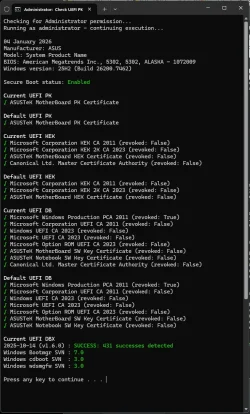
Then why should people be at all concerned about updating secure boot keys?
I thought the problem comes when Microsoft wants to push out updates in the future. In particular, that relates to updates to DBX for revocations. They won't be able to do that for 2011 keys since they can't 'sign' the updates with the expired certificates. In other words: you'd be stuck with a system that has all the current vulnerabilities, and the future ones that will come without regular updates.
In fact, how long will Microsoft continue to even support Windows 11 with 2011 signed boot manager files can't ever be revoked as vulnerabilities arise?
As I've repeated on several of these Secure Boot threads, the goal of the CA 2023 migration are:
1. Cancel CA 2011 because of the Black Lotus UEFI rootkit, which is a known threat and available to hackers.
2. Introduce CA 2023 because the CA 2011's 15 year lifetime is ending. MS would have done this regardless of Black Lotus being reported. W11 26H2 will be released right around the expiration date for CA 2011. They can't sign it using the old cert.
3. Future Windows won't include the CA 2011 boot file, for backward compatibility. You will have to replace your UEFI certs just to boot it. I have read from a GitHub comment by a MS dev that they're planning to push UEFI updates in future OOBE sessions. So they will presumably auto-upgrade you in 26H2.
4. MS has wanted to revoke the 2011 cert for the past 3-4 years, but it's been held up by slow moving PC OEM's who won't cooperate by releasing signed KEK CA 2023 certs, either by firmware updates or by giving them to MS. In the UEFI security model, MS presents a master KEK certificate to sign all its other certificates, but your PC maker has to bless the KEK by signing it with their Platform Key.
MS can't go around the OEM's PK. Except to offer a replacement PK for users who chose to go into Setup mode, this key functionally replaces your OEM's PK, and then
MS owns both the PK and KEK. That's a drastic step, and MS would prefer not to do that.



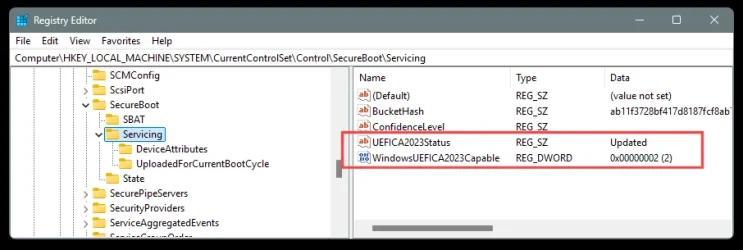


 , it's a good sign that "old" boards may get the needed update for the new keys.