I have a general question about whether it is safe for me to delete my checkpoints on a Hyper V Virtual Machine.
I want to do this as I am having problems exporting my Hyper V Virtual PC and I have read that deleting the checkpoints can solve my issue with the export.
Before I do this though I want to know if it is safe for me to delete the checkpoints. The Virtual machine is running just as I want it now and I don't want to lose anything on it or for it to revert to an older checkpoint.
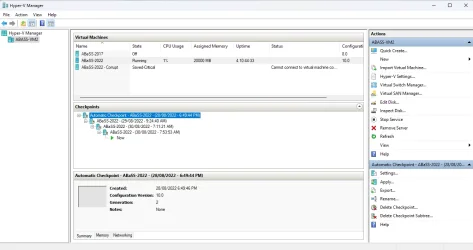
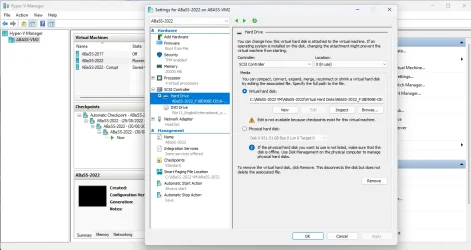
I have attached a screenshot of my Hyper V manager showing the checkpoints and also a screenshot of the .AVHDX and .VHDX files for that Virtual Machine.
What has me concerned is that if I right click on the actual Virtual machine and select settings and click on Hard Drive the Virtual Hard Drive is pointing to a checkpoint file ABaSS-2022_F18E906E-CB1A-45A9-90AC-DE64953A1ADD.avhdx instead of the VHDX file (This has me concerned that if I delete checkpoints this AVHDX file will be deleted?) See attached Screenshot. (Screen shot AVHDX)
If I right click the first checkpoint (Automatic Checkpoint -ABaSS 2022 28/08/2022 - See attached screenshot, Screen Shot VHDX) and click settings and click on Hard Drive the Virtual Hard Drive is pointing to the VHDX file for the Virtual PC. i.e. ABASS-2022.VHDX
If I delete the checkpoints will everything merge properly or am I at risk of corrupting the Virtual Machine?
Also, would it be safe to shutdown the Virtual Machine and copy all the files to another location as a backup before proceeding to delete the Checkpoints. (Can I safely get things to how they were with just a copy of the AVHDX and VHDX files?)
Yes, it's safe to delete checkpoints. You can even do so while the VM is up and running. Apart from making the VM a bit slower until the merge is complete it has no other effects.
You have automatic checkpoints turned on. I prefer to have that turned off, and only make a checkpoint when I feel one would be useful, such as just before an upgrade, or installing new software.
1366x768 native resolution, up to 2560x1440 with Radeon Virtual Super Resolution
Hard Drives
1TB Samsung EVO 870 SSD (from April 2026: 250GB EVO 850)
Internet Speed
150 Mbps
Browser
Edge, Firefox
Antivirus
Defender
Other Info
fully 'Windows 11 ready' laptop. Windows 10 C: partition migrated from my old unsupported 'main machine' then upgraded to 11. A test migration ran Insider builds for 2 months. When 11 was released on 5th October 2021 it was re-imaged back to 10 and was offered the upgrade in Windows Update on 20th October. Windows Update offered the 22H2 Feature Update on 20th September 2022. It got the 23H2 Feature Update on 4th November 2023 through Windows Update, 24H2 on 3rd October 2024 through Windows Update by setting the Target Release Version for 24H2, and 25H2 on 30th September 2025 through Windows Update by setting the Target Release Version for 25H2.
UPDATE - 11 April 2026: due to mechanical deterioration this PC has been retired from active duty. The OS with all software and files has been migrated to my System Seven below to carry on as my general purpose 'main machine'.
My SYSTEM THREE is a Dell Latitude 5410, i7-10610U, 32GB RAM, 512GB NVMe ssd, supported device running Windows 11 Pro.
My SYSTEM FOUR is a 2-in-1 convertible Lenovo Yoga 11e 20DA, Celeron N2930, 8GB RAM, 256GB ssd. Unsupported device: currently running Win10 Pro, plus Win11 Pro RTM and Insider Dev, Beta, and RP 24H2 as native boot vhdx.
My SYSTEM FIVE is a Dell Latitude 3190 2-in-1, Pentium Silver N5030, 8GB RAM, 1TB NVMe ssd, supported device running Windows 11 Pro, plus Insider Beta, Dev, and Canary builds (and a few others) as a native boot .vhdx.
My SYSTEM SIX is a Dell Latitude 5550, Core Ultra 7 165H, 64GB RAM, 1TB NVMe SSD, supported device, Windows 11 Pro 24H2, Hyper-V host machine. Updated to 25H2 on 30th September 2025.
My SYSTEM SEVEN is a Lenovo Thinkpad T580, Intel Core i7-8650U, 16GB RAM, 512GB NVMe SSD + 2nd 512GB NVMe SSD, a supported device for Windows 11. This is my current general purpose 'main machine'. The installed Windows 11 Home from my System One has been migrated to this machine.
Operating System
Windows 11 Pro
Computer type
Laptop
Manufacturer/Model
Dell Latitude E4310
CPU
Intel® Core™ i5-520M
Motherboard
0T6M8G
Memory
8GB
Graphics card(s)
(integrated graphics) Intel HD Graphics
Screen Resolution
1366x768
Hard Drives
500GB Crucial MX500 SSD
Browser
Firefox, Edge
Antivirus
Defender
Other Info
unsupported machine: Legacy bios, MBR, TPM 1.2, upgraded from W10 to W11 using W10/W11 hybrid install media workaround. In-place upgrade to 22H2 using ISO and a workaround. Feature Update to 23H2 by manually installing the Enablement Package. In-place upgrade to 24H2 using hybrid 23H2/24H2 install media. Upgraded to 25H2 by Enablement Package. Also running Insider Dev, and Canary builds and Windows 10 as native boot .vhdx.
My SYSTEM THREE is a Dell Latitude 5410, i7-10610U, 32GB RAM, 512GB NVMe ssd, supported device running Windows 11 Pro.
My SYSTEM FOUR is a 2-in-1 convertible Lenovo Yoga 11e 20DA, Celeron N2930, 8GB RAM, 256GB ssd. Unsupported device: currently running Win10 Pro, plus Win11 Pro RTM and Insider Dev, Beta, and RP 24H2 as native boot vhdx.
My SYSTEM FIVE is a Dell Latitude 3190 2-in-1, Pentium Silver N5030, 8GB RAM, 1TB NVMe ssd, supported device running Windows 11 Pro, plus Insider Beta, Dev, and Canary builds (and a few others) as a native boot .vhdx.
My SYSTEM SIX is a Dell Latitude 5550, Core Ultra 7 165H, 64GB RAM, 1TB NVMe SSD, supported device, Windows 11 Pro 24H2, Hyper-V host machine. Updated to 25H2 on 30th September 2025.
My SYSTEM SEVEN is a Lenovo Thinkpad T580, Intel Core i7-8650U, 16GB RAM, 512GB NVMe SSD + 2nd 512GB NVMe SSD, a supported device for Windows 11. This is my current general purpose 'main machine'. The installed Windows 11 Home from my System One has been migrated to this machine.
...would it be safe to shutdown the Virtual Machine and copy all the files to another location as a backup before proceeding to delete the Checkpoints. (Can I safely get things to how they were with just a copy of the AVHDX and VHDX files?)
No, that won't work. Checkpoints involve a lot more than just the .avhdx files. There's a whole lot of indecipherable configuration data in C:\ProgramData\Microsoft\Windows\Hyper-V\Virtual Machines.
1366x768 native resolution, up to 2560x1440 with Radeon Virtual Super Resolution
Hard Drives
1TB Samsung EVO 870 SSD (from April 2026: 250GB EVO 850)
Internet Speed
150 Mbps
Browser
Edge, Firefox
Antivirus
Defender
Other Info
fully 'Windows 11 ready' laptop. Windows 10 C: partition migrated from my old unsupported 'main machine' then upgraded to 11. A test migration ran Insider builds for 2 months. When 11 was released on 5th October 2021 it was re-imaged back to 10 and was offered the upgrade in Windows Update on 20th October. Windows Update offered the 22H2 Feature Update on 20th September 2022. It got the 23H2 Feature Update on 4th November 2023 through Windows Update, 24H2 on 3rd October 2024 through Windows Update by setting the Target Release Version for 24H2, and 25H2 on 30th September 2025 through Windows Update by setting the Target Release Version for 25H2.
UPDATE - 11 April 2026: due to mechanical deterioration this PC has been retired from active duty. The OS with all software and files has been migrated to my System Seven below to carry on as my general purpose 'main machine'.
My SYSTEM THREE is a Dell Latitude 5410, i7-10610U, 32GB RAM, 512GB NVMe ssd, supported device running Windows 11 Pro.
My SYSTEM FOUR is a 2-in-1 convertible Lenovo Yoga 11e 20DA, Celeron N2930, 8GB RAM, 256GB ssd. Unsupported device: currently running Win10 Pro, plus Win11 Pro RTM and Insider Dev, Beta, and RP 24H2 as native boot vhdx.
My SYSTEM FIVE is a Dell Latitude 3190 2-in-1, Pentium Silver N5030, 8GB RAM, 1TB NVMe ssd, supported device running Windows 11 Pro, plus Insider Beta, Dev, and Canary builds (and a few others) as a native boot .vhdx.
My SYSTEM SIX is a Dell Latitude 5550, Core Ultra 7 165H, 64GB RAM, 1TB NVMe SSD, supported device, Windows 11 Pro 24H2, Hyper-V host machine. Updated to 25H2 on 30th September 2025.
My SYSTEM SEVEN is a Lenovo Thinkpad T580, Intel Core i7-8650U, 16GB RAM, 512GB NVMe SSD + 2nd 512GB NVMe SSD, a supported device for Windows 11. This is my current general purpose 'main machine'. The installed Windows 11 Home from my System One has been migrated to this machine.
Operating System
Windows 11 Pro
Computer type
Laptop
Manufacturer/Model
Dell Latitude E4310
CPU
Intel® Core™ i5-520M
Motherboard
0T6M8G
Memory
8GB
Graphics card(s)
(integrated graphics) Intel HD Graphics
Screen Resolution
1366x768
Hard Drives
500GB Crucial MX500 SSD
Browser
Firefox, Edge
Antivirus
Defender
Other Info
unsupported machine: Legacy bios, MBR, TPM 1.2, upgraded from W10 to W11 using W10/W11 hybrid install media workaround. In-place upgrade to 22H2 using ISO and a workaround. Feature Update to 23H2 by manually installing the Enablement Package. In-place upgrade to 24H2 using hybrid 23H2/24H2 install media. Upgraded to 25H2 by Enablement Package. Also running Insider Dev, and Canary builds and Windows 10 as native boot .vhdx.
My SYSTEM THREE is a Dell Latitude 5410, i7-10610U, 32GB RAM, 512GB NVMe ssd, supported device running Windows 11 Pro.
My SYSTEM FOUR is a 2-in-1 convertible Lenovo Yoga 11e 20DA, Celeron N2930, 8GB RAM, 256GB ssd. Unsupported device: currently running Win10 Pro, plus Win11 Pro RTM and Insider Dev, Beta, and RP 24H2 as native boot vhdx.
My SYSTEM FIVE is a Dell Latitude 3190 2-in-1, Pentium Silver N5030, 8GB RAM, 1TB NVMe ssd, supported device running Windows 11 Pro, plus Insider Beta, Dev, and Canary builds (and a few others) as a native boot .vhdx.
My SYSTEM SIX is a Dell Latitude 5550, Core Ultra 7 165H, 64GB RAM, 1TB NVMe SSD, supported device, Windows 11 Pro 24H2, Hyper-V host machine. Updated to 25H2 on 30th September 2025.
My SYSTEM SEVEN is a Lenovo Thinkpad T580, Intel Core i7-8650U, 16GB RAM, 512GB NVMe SSD + 2nd 512GB NVMe SSD, a supported device for Windows 11. This is my current general purpose 'main machine'. The installed Windows 11 Home from my System One has been migrated to this machine.
You have automatic checkpoints turned on. I prefer to have that turned off, and only make a checkpoint when I feel one would be useful, such as just before an upgrade, or installing new software.
Should I be concerned that one of the AVHDX files looks to contain all the actual Virtual Machine data.
My VHDX file is only 11gb (No where near big enough with the data that is on the machine) and hasn't been modified for 2 years.
I have an AVHDX file which is 133gb (which has the latest modified date on it and must be the actual Virtual Machine Data).
I am concerned that if I delete my checkpoints, I will lose the 133gb AVHDX file or will Hyper V sort it out correctly and merge the data back into the VHDX file from the AVHDX file?
1366x768 native resolution, up to 2560x1440 with Radeon Virtual Super Resolution
Hard Drives
1TB Samsung EVO 870 SSD (from April 2026: 250GB EVO 850)
Internet Speed
150 Mbps
Browser
Edge, Firefox
Antivirus
Defender
Other Info
fully 'Windows 11 ready' laptop. Windows 10 C: partition migrated from my old unsupported 'main machine' then upgraded to 11. A test migration ran Insider builds for 2 months. When 11 was released on 5th October 2021 it was re-imaged back to 10 and was offered the upgrade in Windows Update on 20th October. Windows Update offered the 22H2 Feature Update on 20th September 2022. It got the 23H2 Feature Update on 4th November 2023 through Windows Update, 24H2 on 3rd October 2024 through Windows Update by setting the Target Release Version for 24H2, and 25H2 on 30th September 2025 through Windows Update by setting the Target Release Version for 25H2.
UPDATE - 11 April 2026: due to mechanical deterioration this PC has been retired from active duty. The OS with all software and files has been migrated to my System Seven below to carry on as my general purpose 'main machine'.
My SYSTEM THREE is a Dell Latitude 5410, i7-10610U, 32GB RAM, 512GB NVMe ssd, supported device running Windows 11 Pro.
My SYSTEM FOUR is a 2-in-1 convertible Lenovo Yoga 11e 20DA, Celeron N2930, 8GB RAM, 256GB ssd. Unsupported device: currently running Win10 Pro, plus Win11 Pro RTM and Insider Dev, Beta, and RP 24H2 as native boot vhdx.
My SYSTEM FIVE is a Dell Latitude 3190 2-in-1, Pentium Silver N5030, 8GB RAM, 1TB NVMe ssd, supported device running Windows 11 Pro, plus Insider Beta, Dev, and Canary builds (and a few others) as a native boot .vhdx.
My SYSTEM SIX is a Dell Latitude 5550, Core Ultra 7 165H, 64GB RAM, 1TB NVMe SSD, supported device, Windows 11 Pro 24H2, Hyper-V host machine. Updated to 25H2 on 30th September 2025.
My SYSTEM SEVEN is a Lenovo Thinkpad T580, Intel Core i7-8650U, 16GB RAM, 512GB NVMe SSD + 2nd 512GB NVMe SSD, a supported device for Windows 11. This is my current general purpose 'main machine'. The installed Windows 11 Home from my System One has been migrated to this machine.
Operating System
Windows 11 Pro
Computer type
Laptop
Manufacturer/Model
Dell Latitude E4310
CPU
Intel® Core™ i5-520M
Motherboard
0T6M8G
Memory
8GB
Graphics card(s)
(integrated graphics) Intel HD Graphics
Screen Resolution
1366x768
Hard Drives
500GB Crucial MX500 SSD
Browser
Firefox, Edge
Antivirus
Defender
Other Info
unsupported machine: Legacy bios, MBR, TPM 1.2, upgraded from W10 to W11 using W10/W11 hybrid install media workaround. In-place upgrade to 22H2 using ISO and a workaround. Feature Update to 23H2 by manually installing the Enablement Package. In-place upgrade to 24H2 using hybrid 23H2/24H2 install media. Upgraded to 25H2 by Enablement Package. Also running Insider Dev, and Canary builds and Windows 10 as native boot .vhdx.
My SYSTEM THREE is a Dell Latitude 5410, i7-10610U, 32GB RAM, 512GB NVMe ssd, supported device running Windows 11 Pro.
My SYSTEM FOUR is a 2-in-1 convertible Lenovo Yoga 11e 20DA, Celeron N2930, 8GB RAM, 256GB ssd. Unsupported device: currently running Win10 Pro, plus Win11 Pro RTM and Insider Dev, Beta, and RP 24H2 as native boot vhdx.
My SYSTEM FIVE is a Dell Latitude 3190 2-in-1, Pentium Silver N5030, 8GB RAM, 1TB NVMe ssd, supported device running Windows 11 Pro, plus Insider Beta, Dev, and Canary builds (and a few others) as a native boot .vhdx.
My SYSTEM SIX is a Dell Latitude 5550, Core Ultra 7 165H, 64GB RAM, 1TB NVMe SSD, supported device, Windows 11 Pro 24H2, Hyper-V host machine. Updated to 25H2 on 30th September 2025.
My SYSTEM SEVEN is a Lenovo Thinkpad T580, Intel Core i7-8650U, 16GB RAM, 512GB NVMe SSD + 2nd 512GB NVMe SSD, a supported device for Windows 11. This is my current general purpose 'main machine'. The installed Windows 11 Home from my System One has been migrated to this machine.