Need help upgrading to Windows 11 (boot disk is MBR)


NapMan

New member
Local time
7:41 PM
Posts
12
OS
Windows 10
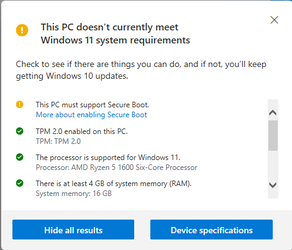
I discovered I will be unable to upgrade to Windows 11 because my boot disk is partitioned as MBR. PC Health Check says I need to enable Secure Boot, but it is enabled in the BIOS.
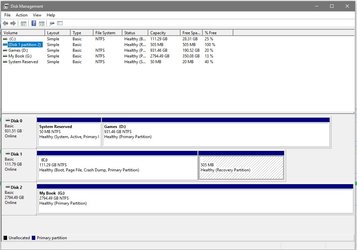
I did some searching and found ways to convert the disk to GPT without losing any data but it did not work. I tried a partitioning app (AOMEI) and it states that I cannot convert it because my boot partition and system partition are on different disks. I don't know why it ended up like this. I'm looking for help on how I can correct this without having to start from scratch. Here is what my disk info looks like:
IMG_0285.JPG

It looks like the system partition is small enough to fit onto the SSD (Disk 1) but I don't know how to move it. I'm looking for any advice and/or help in this matter.
I didn't build the system, my partner did.

I appreciate any help.
 

My Computer My Computer

At a glance

Windows 10AMD Ryzen 5 1600, 6-core, 3200Mhz16 GB
OS
Windows 10
CPU
AMD Ryzen 5 1600, 6-core, 3200Mhz
Motherboard
Asus B450M-A
Memory
16 GB
I discovered I will be unable to upgrade to Windows 11 because my boot disk is partitioned as MBR.
Welcome to Eleven Forum NapMan

That's not your only barrier to being offered the W11 upgrade. Your AMD Ryzen 5 1600 is not on Microsoft's list of supported AMD processors.

There are ways to install W11 or upgrade to W11 on unsupported devices. You'll find plenty of workarounds in Eleven Forum posts, and even Microsoft have published some ways to do it. But your existing Windows 10 will be fully supported with cumulative and feature updates until October 2025.

I would not recommend it if this is the machine that you rely on for daily use. I would only do it on a spare PC for test purposes, such as on my completely unsupported Legacy MBR, 1st gen i5, TPM 1.2 System Two below.

Microsoft said:
Warning:
  • Microsoft recommends against installing Windows 11 on a device that does not meet the Windows 11 minimum system requirements. If you choose to install Windows 11 on a device that does not meet these requirements, and you acknowledge and understand the risks, you can create the following registry key values and bypass the check for TPM 2.0 (at least TPM 1.2 is required) and the CPU family and model....
 
Last edited:

My Computers My Computers

  • At a glance

    Windows 11 HomeAMD Athlon Silver 3050U8GBRadeon Graphics
    OS
    Windows 11 Home
    Computer type
    Laptop
    Manufacturer/Model
    Acer Aspire 3 A315-23-R9VY
    CPU
    AMD Athlon Silver 3050U
    Memory
    8GB
    Graphics Card(s)
    Radeon Graphics
    Monitor(s) Displays
    laptop screen
    Screen Resolution
    1366x768 native resolution, up to 2560x1440 with Radeon Virtual Super Resolution
    Hard Drives
    1TB Samsung EVO 870 SSD (from April 2026: 250GB EVO 850)
    Internet Speed
    150 Mbps
    Browser
    Edge, Firefox
    Antivirus
    Defender
    Other Info
    UPDATE - 11 April 2026: due to lid hinges starting to break up this laptop has been retired from active duty. The OS with all software and files has been migrated to my System Seven in 'Other systems' to carry on as my general purpose 'main machine'.

    I've now clean installed 25H2 and used Garlin's scripts to update Secure Boot to CA 2023 and revoke the PCA 2011 certificates. It's new role is to test secure boot issues.

    Info for 2021-2026:
    fully 'Windows 11 ready' laptop. Windows 10 C: partition migrated from my old unsupported 'main machine' then upgraded to 11. A test migration ran Insider builds for 2 months. When 11 was released on 5th October 2021 it was re-imaged back to 10 and was offered the upgrade in Windows Update on 20th October. Windows Update offered the 22H2 Feature Update on 20th September 2022. It got the 23H2 Feature Update on 4th November 2023 through Windows Update, 24H2 on 3rd October 2024 through Windows Update by setting the Target Release Version for 24H2, and 25H2 on 30th September 2025 through Windows Update by setting the Target Release Version for 25H2.
  • At a glance

    Windows 11 ProIntel® Core™ i5-520M8GB(integrated graphics) Intel HD Graphics
    Operating System
    Windows 11 Pro
    Computer type
    Laptop
    Manufacturer/Model
    Dell Latitude E4310
    CPU
    Intel® Core™ i5-520M
    Motherboard
    0T6M8G
    Memory
    8GB
    Graphics card(s)
    (integrated graphics) Intel HD Graphics
    Screen Resolution
    1366x768
    Hard Drives
    500GB Crucial MX500 SSD
    Browser
    Firefox, Edge
    Antivirus
    Defender
    Other Info
    unsupported machine: Legacy bios, MBR, TPM 1.2, upgraded from W10 to W11 using W10/W11 hybrid install media workaround.

    In-place upgrade to 22H2 using ISO and a workaround.
    Feature Update to 23H2 by manually installing the Enablement Package.
    In-place upgrade to 24H2 using hybrid 23H2/24H2 install media.
    Upgraded to 25H2 by Enablement Package.

    Also running Insider Experimental 263xx and 29xxx builds and Windows 10 as native boot .vhdx.
  • My SYSTEM THREE is a Dell Latitude 5410, i7-10610U, 32GB RAM, 512GB NVMe ssd, supported device running Windows 11 Pro.

    My SYSTEM FOUR was a 2-in-1 convertible Lenovo Yoga 11e (1st gen) type 20DA, Celeron N2930, 8GB RAM, 256GB ssd. Unsupported device. This has now been sold. It has been replaced by my System Eight.

    My SYSTEM FIVE is a Dell Latitude 3190 2-in-1, Pentium Silver N5030, 8GB RAM, 1TB NVMe ssd, supported device running Windows 11 Pro, plus Insider Beta, Experimental 263xx and 29xxx builds (and a few others) as a native boot .vhdx.

    My SYSTEM SIX is a Dell Latitude 5550, Core Ultra 7 165H, 64GB RAM, 1TB NVMe SSD, supported device, Windows 11 Pro, Hyper-V host machine. Updated to 25H2 on 30th September 2025.

    My SYSTEM SEVEN is a Lenovo Thinkpad T580, 1920x1080 touchscreen, Intel Core i7-8650U, 16GB RAM, 512GB NVMe SSD + 2nd 512GB NVMe SSD, a supported device for Windows 11. This is my current general purpose 'main machine'. The installed Windows 11 Home from my System One has been migrated to this machine. As its new home has an existing digital licence for Pro I've been able to upgrade the migrated OS from Home to Pro.

    My SYSTEM EIGHT is a 2-in-1 convertible Lenovo Yoga 11e (5th gen) type 20LN, Celeron N4120, 8GB RAM, 512GB NVMe ssd, a supported device for Windows 11. Currently running Windows 11 Pro, plus Insider Beta, Experimental 263xx and 29xxx builds as native boot vhdx.
Welcome to Eleven Forum NapMan

That's not your only barrier to being offered the W11 upgrade. Your AMD Ryzen 5 1600 is not on Microsoft's list of supported AMD processors.

There are ways to install W11 or upgrade to W11 on unsupported devices. You'll find plenty of workarounds in Eleven Forum posts, and even Microsoft have published some ways to do it. But your existing Windows 10 will be fully supported with cumulative and feature updates until October 2025.

I would not recommend it if this is the machine that you rely on for daily use. I would only do it on a spare PC for test purposes, such as on my completely unsupported Legacy MBR, 1st gen i5, TPM 1.2 System Two below.


Thank you for the response. I'm confused because PC Health Check says something different:

IMG_0287.PNG
 

My Computer My Computer

At a glance

Windows 10AMD Ryzen 5 1600, 6-core, 3200Mhz16 GB
OS
Windows 10
CPU
AMD Ryzen 5 1600, 6-core, 3200Mhz
Motherboard
Asus B450M-A
Memory
16 GB

My Computer My Computer

At a glance

Windows 11 Home- RP - 26H2 -26300.9539AMD Ryzen 5 5600GG.SKILL Ripjaws V Series 64GB 4x16Nvidia geforce gtx titan x
OS
Windows 11 Home- RP - 26H2 -26300.9539
Computer type
PC/Desktop
Manufacturer/Model
Banana Junior 5600-G Series
CPU
AMD Ryzen 5 5600G
Motherboard
Asus ROG Strix B550-F
Memory
G.SKILL Ripjaws V Series 64GB 4x16
Graphics Card(s)
Nvidia geforce gtx titan x
Monitor(s) Displays
28" ASUS VP28U 4k
Screen Resolution
4K
Hard Drives
Primary SAMSUNG 970 EVO Plus
PSU
EVGA BQ 700w 80+ Bronze
Case
Zalman i3 NEO
Cooling
ARCTIC Freezer 7 X
Keyboard
Corsair
Mouse
Amazon Generic with Cord
Internet Speed
Download: 295.11 mbps Upload: 65.35 mbps T-Mobile Internet
Browser
Firefox and Edge
Antivirus
MS - Defender
Other Info
Speakers: Klipsch ProMedia 2.1

My Computer My Computer

At a glance

Windows 10AMD Ryzen 5 1600, 6-core, 3200Mhz16 GB
OS
Windows 10
CPU
AMD Ryzen 5 1600, 6-core, 3200Mhz
Motherboard
Asus B450M-A
Memory
16 GB
I'm confused because PC Health Check says something different:
That's odd, your processor isn't on the MS list here:
maybe MS have now added it to the supported processors, but not got round to updating their documentation yet.

Well, if your motherboard has a UEFI bios and a lack of Secure Boot with a GPT disk is your only impediment, then it is possible to convert a Legacy/MBR install to UEFI/GPT without data loss. Be sure to make a system image with something like Macrium Reflect Free before you try though.


My Computers My Computers

  • At a glance

    Windows 11 HomeAMD Athlon Silver 3050U8GBRadeon Graphics
    OS
    Windows 11 Home
    Computer type
    Laptop
    Manufacturer/Model
    Acer Aspire 3 A315-23-R9VY
    CPU
    AMD Athlon Silver 3050U
    Memory
    8GB
    Graphics Card(s)
    Radeon Graphics
    Monitor(s) Displays
    laptop screen
    Screen Resolution
    1366x768 native resolution, up to 2560x1440 with Radeon Virtual Super Resolution
    Hard Drives
    1TB Samsung EVO 870 SSD (from April 2026: 250GB EVO 850)
    Internet Speed
    150 Mbps
    Browser
    Edge, Firefox
    Antivirus
    Defender
    Other Info
    UPDATE - 11 April 2026: due to lid hinges starting to break up this laptop has been retired from active duty. The OS with all software and files has been migrated to my System Seven in 'Other systems' to carry on as my general purpose 'main machine'.

    I've now clean installed 25H2 and used Garlin's scripts to update Secure Boot to CA 2023 and revoke the PCA 2011 certificates. It's new role is to test secure boot issues.

    Info for 2021-2026:
    fully 'Windows 11 ready' laptop. Windows 10 C: partition migrated from my old unsupported 'main machine' then upgraded to 11. A test migration ran Insider builds for 2 months. When 11 was released on 5th October 2021 it was re-imaged back to 10 and was offered the upgrade in Windows Update on 20th October. Windows Update offered the 22H2 Feature Update on 20th September 2022. It got the 23H2 Feature Update on 4th November 2023 through Windows Update, 24H2 on 3rd October 2024 through Windows Update by setting the Target Release Version for 24H2, and 25H2 on 30th September 2025 through Windows Update by setting the Target Release Version for 25H2.
  • At a glance

    Windows 11 ProIntel® Core™ i5-520M8GB(integrated graphics) Intel HD Graphics
    Operating System
    Windows 11 Pro
    Computer type
    Laptop
    Manufacturer/Model
    Dell Latitude E4310
    CPU
    Intel® Core™ i5-520M
    Motherboard
    0T6M8G
    Memory
    8GB
    Graphics card(s)
    (integrated graphics) Intel HD Graphics
    Screen Resolution
    1366x768
    Hard Drives
    500GB Crucial MX500 SSD
    Browser
    Firefox, Edge
    Antivirus
    Defender
    Other Info
    unsupported machine: Legacy bios, MBR, TPM 1.2, upgraded from W10 to W11 using W10/W11 hybrid install media workaround.

    In-place upgrade to 22H2 using ISO and a workaround.
    Feature Update to 23H2 by manually installing the Enablement Package.
    In-place upgrade to 24H2 using hybrid 23H2/24H2 install media.
    Upgraded to 25H2 by Enablement Package.

    Also running Insider Experimental 263xx and 29xxx builds and Windows 10 as native boot .vhdx.
  • My SYSTEM THREE is a Dell Latitude 5410, i7-10610U, 32GB RAM, 512GB NVMe ssd, supported device running Windows 11 Pro.

    My SYSTEM FOUR was a 2-in-1 convertible Lenovo Yoga 11e (1st gen) type 20DA, Celeron N2930, 8GB RAM, 256GB ssd. Unsupported device. This has now been sold. It has been replaced by my System Eight.

    My SYSTEM FIVE is a Dell Latitude 3190 2-in-1, Pentium Silver N5030, 8GB RAM, 1TB NVMe ssd, supported device running Windows 11 Pro, plus Insider Beta, Experimental 263xx and 29xxx builds (and a few others) as a native boot .vhdx.

    My SYSTEM SIX is a Dell Latitude 5550, Core Ultra 7 165H, 64GB RAM, 1TB NVMe SSD, supported device, Windows 11 Pro, Hyper-V host machine. Updated to 25H2 on 30th September 2025.

    My SYSTEM SEVEN is a Lenovo Thinkpad T580, 1920x1080 touchscreen, Intel Core i7-8650U, 16GB RAM, 512GB NVMe SSD + 2nd 512GB NVMe SSD, a supported device for Windows 11. This is my current general purpose 'main machine'. The installed Windows 11 Home from my System One has been migrated to this machine. As its new home has an existing digital licence for Pro I've been able to upgrade the migrated OS from Home to Pro.

    My SYSTEM EIGHT is a 2-in-1 convertible Lenovo Yoga 11e (5th gen) type 20LN, Celeron N4120, 8GB RAM, 512GB NVMe ssd, a supported device for Windows 11. Currently running Windows 11 Pro, plus Insider Beta, Experimental 263xx and 29xxx builds as native boot vhdx.
That's odd, your processor isn't on the MS list here:
maybe MS have now added it to the supported processors, but not got round to updating their documentation yet.

Well, if your motherboard has a UEFI bios and a lack of Secure Boot with a GPT disk is your only impediment, then it is possible to convert a Legacy/MBR install to UEFI/GPT without data loss. Be sure to make a system image with something like Macrium Reflect Free before you try though.


Will that work even though my boot partition and system partition are on different disks? That's the issue I've encountered.
 

My Computer My Computer

At a glance

Windows 10AMD Ryzen 5 1600, 6-core, 3200Mhz16 GB
OS
Windows 10
CPU
AMD Ryzen 5 1600, 6-core, 3200Mhz
Motherboard
Asus B450M-A
Memory
16 GB
Will that work even though my boot partition and system partition are on different disks? That's the issue I've encountered.
That's just making life complicated for yourself ;)

@NavyLCDR is more knowledgeable about such things than I am, he may be able to help.
 

My Computers My Computers

  • At a glance

    Windows 11 HomeAMD Athlon Silver 3050U8GBRadeon Graphics
    OS
    Windows 11 Home
    Computer type
    Laptop
    Manufacturer/Model
    Acer Aspire 3 A315-23-R9VY
    CPU
    AMD Athlon Silver 3050U
    Memory
    8GB
    Graphics Card(s)
    Radeon Graphics
    Monitor(s) Displays
    laptop screen
    Screen Resolution
    1366x768 native resolution, up to 2560x1440 with Radeon Virtual Super Resolution
    Hard Drives
    1TB Samsung EVO 870 SSD (from April 2026: 250GB EVO 850)
    Internet Speed
    150 Mbps
    Browser
    Edge, Firefox
    Antivirus
    Defender
    Other Info
    UPDATE - 11 April 2026: due to lid hinges starting to break up this laptop has been retired from active duty. The OS with all software and files has been migrated to my System Seven in 'Other systems' to carry on as my general purpose 'main machine'.

    I've now clean installed 25H2 and used Garlin's scripts to update Secure Boot to CA 2023 and revoke the PCA 2011 certificates. It's new role is to test secure boot issues.

    Info for 2021-2026:
    fully 'Windows 11 ready' laptop. Windows 10 C: partition migrated from my old unsupported 'main machine' then upgraded to 11. A test migration ran Insider builds for 2 months. When 11 was released on 5th October 2021 it was re-imaged back to 10 and was offered the upgrade in Windows Update on 20th October. Windows Update offered the 22H2 Feature Update on 20th September 2022. It got the 23H2 Feature Update on 4th November 2023 through Windows Update, 24H2 on 3rd October 2024 through Windows Update by setting the Target Release Version for 24H2, and 25H2 on 30th September 2025 through Windows Update by setting the Target Release Version for 25H2.
  • At a glance

    Windows 11 ProIntel® Core™ i5-520M8GB(integrated graphics) Intel HD Graphics
    Operating System
    Windows 11 Pro
    Computer type
    Laptop
    Manufacturer/Model
    Dell Latitude E4310
    CPU
    Intel® Core™ i5-520M
    Motherboard
    0T6M8G
    Memory
    8GB
    Graphics card(s)
    (integrated graphics) Intel HD Graphics
    Screen Resolution
    1366x768
    Hard Drives
    500GB Crucial MX500 SSD
    Browser
    Firefox, Edge
    Antivirus
    Defender
    Other Info
    unsupported machine: Legacy bios, MBR, TPM 1.2, upgraded from W10 to W11 using W10/W11 hybrid install media workaround.

    In-place upgrade to 22H2 using ISO and a workaround.
    Feature Update to 23H2 by manually installing the Enablement Package.
    In-place upgrade to 24H2 using hybrid 23H2/24H2 install media.
    Upgraded to 25H2 by Enablement Package.

    Also running Insider Experimental 263xx and 29xxx builds and Windows 10 as native boot .vhdx.
  • My SYSTEM THREE is a Dell Latitude 5410, i7-10610U, 32GB RAM, 512GB NVMe ssd, supported device running Windows 11 Pro.

    My SYSTEM FOUR was a 2-in-1 convertible Lenovo Yoga 11e (1st gen) type 20DA, Celeron N2930, 8GB RAM, 256GB ssd. Unsupported device. This has now been sold. It has been replaced by my System Eight.

    My SYSTEM FIVE is a Dell Latitude 3190 2-in-1, Pentium Silver N5030, 8GB RAM, 1TB NVMe ssd, supported device running Windows 11 Pro, plus Insider Beta, Experimental 263xx and 29xxx builds (and a few others) as a native boot .vhdx.

    My SYSTEM SIX is a Dell Latitude 5550, Core Ultra 7 165H, 64GB RAM, 1TB NVMe SSD, supported device, Windows 11 Pro, Hyper-V host machine. Updated to 25H2 on 30th September 2025.

    My SYSTEM SEVEN is a Lenovo Thinkpad T580, 1920x1080 touchscreen, Intel Core i7-8650U, 16GB RAM, 512GB NVMe SSD + 2nd 512GB NVMe SSD, a supported device for Windows 11. This is my current general purpose 'main machine'. The installed Windows 11 Home from my System One has been migrated to this machine. As its new home has an existing digital licence for Pro I've been able to upgrade the migrated OS from Home to Pro.

    My SYSTEM EIGHT is a 2-in-1 convertible Lenovo Yoga 11e (5th gen) type 20LN, Celeron N4120, 8GB RAM, 512GB NVMe ssd, a supported device for Windows 11. Currently running Windows 11 Pro, plus Insider Beta, Experimental 263xx and 29xxx builds as native boot vhdx.
That's just making life complicated for yourself ;)

@NavyLCDR is more knowledgeable about such things than I am, he may be able to help.

Haha, I know. Hey, if he's a Navy Lt. Commander I'm sure he can help. I'm former Navy myself!

Here is what happens when I try the conversion. That error window always pops up too:

IMG_0288.PNG
 

My Computer My Computer

At a glance

Windows 10AMD Ryzen 5 1600, 6-core, 3200Mhz16 GB
OS
Windows 10
CPU
AMD Ryzen 5 1600, 6-core, 3200Mhz
Motherboard
Asus B450M-A
Memory
16 GB
Hi,

I had the same problem (WIN 10 / WIN 11 dual boot on 2 disks (!), not partitions (!)). I made backups with Macrium Backup, after having converted both disks from MBR to GPT / EFI (with the mbr2gpt tool which is in Windows as explained in the link above), I made backups with Macrium, but Macrium copied only 2 partitions from the first disk and NOT the WIN 11 partition I wanted to backup (and which was on the second disk).

But there is a tool in Macrium which (in my opinion) could resolve this. After installing Macrium, go to "Rescue" (upper left icon in the macrium window) and run it. It copied the two partition which were on the wrong disk to the right one (but not the "System reserved partition, which apparently is not necessary). (You then need to restart the computer).

When you then make the backup, please pay attention that the "hooks" before the partitions to be copied are all on the same disk (Macrium seems to prefer to backup the "originals" on the other disk and not the "copies" on the same disk.

I cannot garantee the outcome, because I had more partitions on my disk than you, but just try it. Macrium is free !
 

My Computer My Computer

At a glance

WIN 11 / WIN 10 dual bootIntel Pentium G 4400 (Skylake)DDR4 12 GBinternal (Intel HD 510)
OS
WIN 11 / WIN 10 dual boot
Computer type
PC/Desktop
Manufacturer/Model
No clue (x64 based) from 2016
CPU
Intel Pentium G 4400 (Skylake)
Motherboard
MS 7971, Bios: American Megatrend C.E0 (2018)
Memory
DDR4 12 GB
Graphics Card(s)
internal (Intel HD 510)
Hard Drives
2x Western Digital (no SSD)
Hi,

I had the same problem (WIN 10 / WIN 11 dual boot on 2 disks (!), not partitions (!)). I made backups with Macrium Backup, after having converted both disks from MBR to GPT / EFI (with the mbr2gpt tool which is in Windows as explained in the link above), I made backups with Macrium, but Macrium copied only 2 partitions from the first disk and NOT the WIN 11 partition I wanted to backup (and which was on the second disk).

But there is a tool in Macrium which (in my opinion) could resolve this. After installing Macrium, go to "Rescue" (upper left icon in the macrium window) and run it. It copied the two partition which were on the wrong disk to the right one (but not the "System reserved partition, which apparently is not necessary). (You then need to restart the computer).

When you then make the backup, please pay attention that the "hooks" before the partitions to be copied are all on the same disk (Macrium seems to prefer to backup the "originals" on the other disk and not the "copies" on the same disk.

I cannot garantee the outcome, because I had more partitions on my disk than you, but just try it. Macrium is free !

I installed the free version of Macrium Reflect 7. I don't see a "Rescue" option. There is a Restore option, and under Other Tasks there is "Create Rescue Media".
 

My Computer My Computer

At a glance

Windows 10AMD Ryzen 5 1600, 6-core, 3200Mhz16 GB
OS
Windows 10
CPU
AMD Ryzen 5 1600, 6-core, 3200Mhz
Motherboard
Asus B450M-A
Memory
16 GB
I installed the free version of Macrium Reflect 7. I don't see a "Rescue" option. There is a Restore option, and under Other Tasks there is "Create Rescue Media".
You need to make the Macrium rescue media USB and boot from that to see operations that can only be carried out while the system is not running. One such option that's only available when booted form a recovery USB is 'fix Windows boot problems' on the 'Restore' menu.
 

My Computers My Computers

  • At a glance

    Windows 11 HomeAMD Athlon Silver 3050U8GBRadeon Graphics
    OS
    Windows 11 Home
    Computer type
    Laptop
    Manufacturer/Model
    Acer Aspire 3 A315-23-R9VY
    CPU
    AMD Athlon Silver 3050U
    Memory
    8GB
    Graphics Card(s)
    Radeon Graphics
    Monitor(s) Displays
    laptop screen
    Screen Resolution
    1366x768 native resolution, up to 2560x1440 with Radeon Virtual Super Resolution
    Hard Drives
    1TB Samsung EVO 870 SSD (from April 2026: 250GB EVO 850)
    Internet Speed
    150 Mbps
    Browser
    Edge, Firefox
    Antivirus
    Defender
    Other Info
    UPDATE - 11 April 2026: due to lid hinges starting to break up this laptop has been retired from active duty. The OS with all software and files has been migrated to my System Seven in 'Other systems' to carry on as my general purpose 'main machine'.

    I've now clean installed 25H2 and used Garlin's scripts to update Secure Boot to CA 2023 and revoke the PCA 2011 certificates. It's new role is to test secure boot issues.

    Info for 2021-2026:
    fully 'Windows 11 ready' laptop. Windows 10 C: partition migrated from my old unsupported 'main machine' then upgraded to 11. A test migration ran Insider builds for 2 months. When 11 was released on 5th October 2021 it was re-imaged back to 10 and was offered the upgrade in Windows Update on 20th October. Windows Update offered the 22H2 Feature Update on 20th September 2022. It got the 23H2 Feature Update on 4th November 2023 through Windows Update, 24H2 on 3rd October 2024 through Windows Update by setting the Target Release Version for 24H2, and 25H2 on 30th September 2025 through Windows Update by setting the Target Release Version for 25H2.
  • At a glance

    Windows 11 ProIntel® Core™ i5-520M8GB(integrated graphics) Intel HD Graphics
    Operating System
    Windows 11 Pro
    Computer type
    Laptop
    Manufacturer/Model
    Dell Latitude E4310
    CPU
    Intel® Core™ i5-520M
    Motherboard
    0T6M8G
    Memory
    8GB
    Graphics card(s)
    (integrated graphics) Intel HD Graphics
    Screen Resolution
    1366x768
    Hard Drives
    500GB Crucial MX500 SSD
    Browser
    Firefox, Edge
    Antivirus
    Defender
    Other Info
    unsupported machine: Legacy bios, MBR, TPM 1.2, upgraded from W10 to W11 using W10/W11 hybrid install media workaround.

    In-place upgrade to 22H2 using ISO and a workaround.
    Feature Update to 23H2 by manually installing the Enablement Package.
    In-place upgrade to 24H2 using hybrid 23H2/24H2 install media.
    Upgraded to 25H2 by Enablement Package.

    Also running Insider Experimental 263xx and 29xxx builds and Windows 10 as native boot .vhdx.
  • My SYSTEM THREE is a Dell Latitude 5410, i7-10610U, 32GB RAM, 512GB NVMe ssd, supported device running Windows 11 Pro.

    My SYSTEM FOUR was a 2-in-1 convertible Lenovo Yoga 11e (1st gen) type 20DA, Celeron N2930, 8GB RAM, 256GB ssd. Unsupported device. This has now been sold. It has been replaced by my System Eight.

    My SYSTEM FIVE is a Dell Latitude 3190 2-in-1, Pentium Silver N5030, 8GB RAM, 1TB NVMe ssd, supported device running Windows 11 Pro, plus Insider Beta, Experimental 263xx and 29xxx builds (and a few others) as a native boot .vhdx.

    My SYSTEM SIX is a Dell Latitude 5550, Core Ultra 7 165H, 64GB RAM, 1TB NVMe SSD, supported device, Windows 11 Pro, Hyper-V host machine. Updated to 25H2 on 30th September 2025.

    My SYSTEM SEVEN is a Lenovo Thinkpad T580, 1920x1080 touchscreen, Intel Core i7-8650U, 16GB RAM, 512GB NVMe SSD + 2nd 512GB NVMe SSD, a supported device for Windows 11. This is my current general purpose 'main machine'. The installed Windows 11 Home from my System One has been migrated to this machine. As its new home has an existing digital licence for Pro I've been able to upgrade the migrated OS from Home to Pro.

    My SYSTEM EIGHT is a 2-in-1 convertible Lenovo Yoga 11e (5th gen) type 20LN, Celeron N4120, 8GB RAM, 512GB NVMe ssd, a supported device for Windows 11. Currently running Windows 11 Pro, plus Insider Beta, Experimental 263xx and 29xxx builds as native boot vhdx.
You need to make the Macrium rescue media USB and boot from that to see operations that can only be carried out while the system is not running. One such option that's only available when booted form a recovery USB is 'fix Windows boot problems' on the 'Restore' menu.

Ah, OK. I'll have to look into that later.
 

My Computer My Computer

At a glance

Windows 10AMD Ryzen 5 1600, 6-core, 3200Mhz16 GB
OS
Windows 10
CPU
AMD Ryzen 5 1600, 6-core, 3200Mhz
Motherboard
Asus B450M-A
Memory
16 GB
NapMan, because you already have installed Macrium Reflect, it would be wise to start from creating the backup of your current not converted OS drive. Looking at the error at your first attempt, the second one may make the drive non-operative, so your backup copy will be very useful. Of course I wish it's not your case, but anyway, an extra backup on removable drive is never excessive. You may easily delete it after conversion to UEFI when you made another backup of working OS.

And if you will have continuous problem with conversion, it's possible to install Windows 11 on MBR, even though it's officially counted non-supported configuration. You can convert the drive in Windows 11 later or keep it for a while, at least now "unsupported" PCs are still supported, they all got the last Tuesday update.
 

My Computer My Computer

At a glance

Windows 11 Pro 25H2AMD Rysen 5 4600H32 GB (2 x 16 GB Samsung SO-DIMM DDR4-3200)GeForce GTX 1650 Ti, 4 GB GDDR6
OS
Windows 11 Pro 25H2
Computer type
Laptop
Manufacturer/Model
Lenovo Legion 5-15ARH05
CPU
AMD Rysen 5 4600H
Memory
32 GB (2 x 16 GB Samsung SO-DIMM DDR4-3200)
Graphics Card(s)
GeForce GTX 1650 Ti, 4 GB GDDR6
Screen Resolution
1920x1080
Hard Drives
SSD M.2 512 GB SAMSUNG MZALQ512; SSD M.2 1 TB Seagate FireCuda 530
Mouse
Logitech M650L in Bluetooth mode
I cannot convert it because my boot partition and system partition are on different disks
Part of the problem is that your OS disk (disk 1) has no space on it for the System Reserved partition. You would need to first shrink the OS partition to create space.
Then, if you disconnect disk 0 from the power, the computer will think it has no MBR so you manually create a new System Reserved partition on the OS disk, and then rebuild the MBR.
When finished, you will have an OS partition with System Partition on the same disk.

Use a Recovery disk or an Installation disk to boot the computer without the MBR, and enter the command prompt from that environment.

How to Manually Rebuild the MBR System Reserved partition, follow this tutorial:

If you're starting with no system partition
The first thing we need to do is to create our system partition
At the command prompt type the following.
  • Type diskpart
  • Type list disk
  • If you only have 1 disk then type select disk 0
  • If you have multiple disks, you will want to select each in turn and type detail disk to identify the correct disk. Most of the time you will have the system partition on the same drive as the C volume. Typing detail disk will show you what volumes are on the selected disk

  • Now create the partition with create part primary
  • Type list part and ID the newly created partition. (If the system partition was deleted the new partition will be the same size and less than 1GB)
  • Now select the partition with select part # where # will be the number identified from the list command
  • With the new partition selected mark it active by typing active
  • Now format the partition with format fs=ntfs quick label="System Reserved"
  • Type list vol and make note of your new partition
  • Type select vol # where the # is the number assigned to your volume
  • Type assign letter E the letter can be any non-assigned drive letter (we'll need this in a later step, also make note of your OS assigned letter [it might not be C])
  • We're all done preparing the disk so type exit
If the system partition exists and you just cant boot start here (continue with the next section)
Now it's time to prepare or repair the system partition
  • First we need to make sure the system partition has a valid MBR on it by typing bootrec /fixmbr
  • Now we need to copy critical system files and BCD store. From my example above my system partition is E and my OS is C type the following bcdboot C:\Windows /s e:
With a rebuilt MBR on the new System Reserved partition, you can then proceed conversion to GPT.

Hope that helps
 

My Computers My Computers

  • At a glance

    Windows 11AMD Ryzen 5 560016 GBSapphire Radeon RX 6500XT (8 GB version)
    OS
    Windows 11
    Computer type
    PC/Desktop
    CPU
    AMD Ryzen 5 5600
    Motherboard
    MSI B550-A Pro
    Memory
    16 GB
    Graphics Card(s)
    Sapphire Radeon RX 6500XT (8 GB version)
    Monitor(s) Displays
    BenQ Mobuiz EX2710Q QHD, Iiyama ProLite X23377HDS
    Hard Drives
    MSI Spatium M461 4TB
  • At a glance

    Windows 11Intel Celeron N4020
    Operating System
    Windows 11
    Computer type
    Laptop
    Manufacturer/Model
    Acer A114
    CPU
    Intel Celeron N4020
NapMan, because you already have installed Macrium Reflect, it would be wise to start from creating the backup of your current not converted OS drive. Looking at the error at your first attempt, the second one may make the drive non-operative, so your backup copy will be very useful. Of course I wish it's not your case, but anyway, an extra backup on removable drive is never excessive. You may easily delete it after conversion to UEFI when you made another backup of working OS.

And if you will have continuous problem with conversion, it's possible to install Windows 11 on MBR, even though it's officially counted non-supported configuration. You can convert the drive in Windows 11 later or keep it for a while, at least now "unsupported" PCs are still supported, they all got the last Tuesday update.

I will make a backup before I do anything. Thanks for the suggestion.
 

My Computer My Computer

At a glance

Windows 10AMD Ryzen 5 1600, 6-core, 3200Mhz16 GB
OS
Windows 10
CPU
AMD Ryzen 5 1600, 6-core, 3200Mhz
Motherboard
Asus B450M-A
Memory
16 GB
Part of the problem is that your OS disk (disk 1) has no space on it for the System Reserved partition. You would need to first shrink the OS partition to create space.
Then, if you disconnect disk 0 from the power, the computer will think it has no MBR so you manually create a new System Reserved partition on the OS disk, and then rebuild the MBR.
When finished, you will have an OS partition with System Partition on the same disk.

Use a Recovery disk or an Installation disk to boot the computer without the MBR, and enter the command prompt from that environment.

How to Manually Rebuild the MBR System Reserved partition, follow this tutorial:


With a rebuilt MBR on the new System Reserved partition, you can then proceed conversion to GPT.

Hope that helps

Maybe I don't fully understand. When you say the "system reserved partition", is that not the 50 MB partition on Disk 0? The boot disk has 28 GB free.
 

My Computer My Computer

At a glance

Windows 10AMD Ryzen 5 1600, 6-core, 3200Mhz16 GB
OS
Windows 10
CPU
AMD Ryzen 5 1600, 6-core, 3200Mhz
Motherboard
Asus B450M-A
Memory
16 GB
Maybe I don't fully understand. When you say the "system reserved partition", is that not the 50 MB partition on Disk 0? The boot disk has 28 GB free.
Yes, I meant the 50 MB partition on Disk 0. That is the partition you are trying to move/recreate on the OS disk (Disk 1)?

The "boot disk", or rather the "OS partition" on disk 1, has 28GB free, but this is not useable in a scenario where you are re-creating the MBR on disk 1. That 28GB is only useable to the C: partition, so you would need free up some disk space by shrinking the C: partition.

That is just my suggestion, anyway.
 

My Computers My Computers

  • At a glance

    Windows 11AMD Ryzen 5 560016 GBSapphire Radeon RX 6500XT (8 GB version)
    OS
    Windows 11
    Computer type
    PC/Desktop
    CPU
    AMD Ryzen 5 5600
    Motherboard
    MSI B550-A Pro
    Memory
    16 GB
    Graphics Card(s)
    Sapphire Radeon RX 6500XT (8 GB version)
    Monitor(s) Displays
    BenQ Mobuiz EX2710Q QHD, Iiyama ProLite X23377HDS
    Hard Drives
    MSI Spatium M461 4TB
  • At a glance

    Windows 11Intel Celeron N4020
    Operating System
    Windows 11
    Computer type
    Laptop
    Manufacturer/Model
    Acer A114
    CPU
    Intel Celeron N4020
Yes, I meant the 50 MB partition on Disk 0. That is the partition you are trying to move/recreate on the OS disk (Disk 1)?

The "boot disk", or rather the "OS partition" on disk 1, has 28GB free, but this is not useable in a scenario where you are re-creating the MBR on disk 1. That 28GB is only useable to the C: partition, so you would need free up some disk space by shrinking the C: partition.

That is just my suggestion, anyway.

I appreciate your help. I guess I don't really understand freeing up disk space on the C: partition by shrinking the C: partition. If I make the C: partition smaller wouldn't that create less free space?
 

My Computer My Computer

At a glance

Windows 10AMD Ryzen 5 1600, 6-core, 3200Mhz16 GB
OS
Windows 10
CPU
AMD Ryzen 5 1600, 6-core, 3200Mhz
Motherboard
Asus B450M-A
Memory
16 GB
Back
Top Bottom