Why do you use a Virtual Machine?


I run VirtualBox (on Windows 10 right now) so I can install a Linux distribution without having to worry about the pitfalls of dual-boot. It makes things very simple.

Rob
 

My Computer My Computer

At a glance

Windows 11 Professional 25H2Intel Core i9 11900K64GBNVIDIA GeForce GTX 1650
OS
Windows 11 Professional 25H2
Computer type
PC/Desktop
Manufacturer/Model
Digital Storm VELOX
CPU
Intel Core i9 11900K
Motherboard
ASUS PRIME Z590-P
Memory
64GB
Graphics Card(s)
NVIDIA GeForce GTX 1650
Sound Card
Realtek onboard
Monitor(s) Displays
Acer R221Q 21.5"
Screen Resolution
1920 x 1080
Hard Drives
2 x Samsung SSD 990 EVO Plus (1 TB)
2 x Seagate ST4000NE001 (4 TB)
PSU
None
Case
VELOX
Cooling
Cooler Master
Keyboard
Logitech
Mouse
Kensington trackball
Browser
Firefox, Chrome
Antivirus
Windows Defender, Malwarebytes
I use my VM to help remove Virus & other junk and pop-ups to my clients, i also test new programs to see which remove the Malware the best,fast and cleanest ! I also use it to roam "the Dark Side" !!
Chuck
 

My Computer My Computer

At a glance

Windows11 23H2 (OS Build 22631.2428)2.90 gigahertz Intel Core i7-1070016214 Megabytes Usable Installed Memor
OS
Windows11 23H2 (OS Build 22631.2428)
Computer type
PC/Desktop
Manufacturer/Model
HP HP ENVY TE01
CPU
2.90 gigahertz Intel Core i7-10700
Motherboard
Board: HP 8767 A (SMVB)
Memory
16214 Megabytes Usable Installed Memor
Hard Drives
1511.52 Gigabytes Usable Hard Drive Capacity
1418.15 Gigabytes Hard Drive Free Space
Keyboard
Logitech wireless
Mouse
M 185 wireless
Internet Speed
12 ms Jitter 8 ms Download 10.5 Mbps Upload 1.7
Browser
Edge & FF
Antivirus
Windows Defender
I use VMs to help others on these forums. I can show them examples of how to do things in the VM that would destroy the data on my real disks. Did that once by mistake, wiped out my data drive when I entered a command on the host system rather than in the VM. Just as soon as I hit enter, it dawned on me what I had done - :ffs:
 

My Computers My Computers

  • At a glance

    Windows 11AMD Ryzen 7 3800XT32GBEVGA GeForce GTX 1080 Ti
    OS
    Windows 11
    Computer type
    PC/Desktop
    Manufacturer/Model
    Homebuilt
    CPU
    AMD Ryzen 7 3800XT
    Motherboard
    ASUS ROG Crosshair VII Hero (WiFi)
    Memory
    32GB
    Graphics Card(s)
    EVGA GeForce GTX 1080 Ti
  • At a glance

    Windows 11 EducationIntel i7-8550U32GBNvidia Geforce MX150
    Operating System
    Windows 11 Education
    Computer type
    Laptop
    Manufacturer/Model
    Dell Inspiron 7773
    CPU
    Intel i7-8550U
    Memory
    32GB
    Graphics card(s)
    Nvidia Geforce MX150
    Sound Card
    Realtek
    Monitor(s) Displays
    17"
    Screen Resolution
    1920 x 1080
    Hard Drives
    Toshiba 512GB NVMe SSD
    SK Hynix 512GB SATA SSD
    Internet Speed
    Fast!
I can count on the fingers of one hand the number of times I've set up any virtual Windows system. Even then, it's been just for play to see if I could do it. Never particularly excited by it or really needed it for anything. I've generally been able to accomplish what I want with the real thing.
Plus one, Larc! I've always built (or bought) my machines with adequate hdd/ssd storage space so I can partition them to run my choice of OS. Since I teach Windows 10 (and Windows 11 pretty soon) I only need the current version of both on my teaching machine. On the main machine at home, I run the current version of Windows 10 and DEV version of Windows 11.

Works for me and makes VMs unnecessary. That's just me.
 

My Computers My Computers

  • At a glance

    Windows 11 23H2 22631.2861Intel(R) Core(TM) i7-10700 CPU @ 2.90GHz 2.90...16384 MBytesIntel UHD Graphics 630
    OS
    Windows 11 23H2 22631.2861
    Computer type
    PC/Desktop
    Manufacturer/Model
    HP Envy TE01-1xxx
    CPU
    Intel(R) Core(TM) i7-10700 CPU @ 2.90GHz 2.90 GHz
    Motherboard
    16.0GB Dual-Channel Unknown @ 1463MHz (21-21-21-47)
    Memory
    16384 MBytes
    Graphics Card(s)
    Intel UHD Graphics 630
    Sound Card
    Realtek High Definition Audio
    Monitor(s) Displays
    Monitor 1 - Acer 27" Monitor 2 - Acer 27"
    Screen Resolution
    1920 x 1080
    Hard Drives
    WDC PC SN530 SDBPNPZ-512G-1006 (SSD)
    Seagate ST1000DM003-1SB102
    Seagate BUP Slim SCSI Disk Device (SSD)
    PSU
    HP
    Case
    HP
    Cooling
    Standard
    Keyboard
    Logitech Wave K350
    Mouse
    Logitech M705
    Internet Speed
    500 mbps
    Browser
    Firefox
    Antivirus
    Windows Defender
    Other Info
    That's all Folks!
  • At a glance

    Windows 11Intel Core i7 (10th gen) 1070016 GBIntel UHD Graphics 630
    Operating System
    Windows 11
    Computer type
    PC/Desktop
    Manufacturer/Model
    HP
    CPU
    Intel Core i7 (10th gen) 10700
    Motherboard
    Intel
    Memory
    16 GB
    Graphics card(s)
    Intel UHD Graphics 630
    Sound Card
    Built-in
    Monitor(s) Displays
    Acer 27" & Samsung 24"
    Screen Resolution
    1920 x
    Hard Drives
    SSD (512 GB)
    HDD (1 TB)
    Seagate
    PSU
    Intel i7 10th Generation
    Case
    HP
    Cooling
    HP/Intel?
    Keyboard
    Logitech Wave K350
    Mouse
    Logitech M705
    Internet Speed
    50 mbps
    Browser
    Firefox 90.2
    Antivirus
    Windows Defender
    Other Info
    Headphone/Microphone Combo
    SuperSpeed USB Type-A (4 on front)
    HP 3-in-One Card Readr
    SuperSpeed USB Type-C
    DVD Writer
Plus one, Larc! I've always built (or bought) my machines with adequate hdd/ssd storage space so I can partition them to run my choice of OS. Since I teach Windows 10 (and Windows 11 pretty soon) I only need the current version of both on my teaching machine. On the main machine at home, I run the current version of Windows 10 and DEV version of Windows 11.

Works for me and makes VMs unnecessary. That's just me.
I used to do it almost exclusively that way (separate partitions). But now I find that if I need something quickly from a different OS than I am running, it's much easier to just start the VM and get it, then it is to reboot the entire computer. For example, the settings menus are very different between Windows 10 and Windows 11. If I am going to show someone how to do something in Windows 10 it's much easier for me to just the start the Windows 10 VM that is residing on my Windows 11 computer than it is to reboot the computer into a partition (or vhdx drive) containing Windows 10.
 

My Computers My Computers

  • At a glance

    Windows 11AMD Ryzen 7 3800XT32GBEVGA GeForce GTX 1080 Ti
    OS
    Windows 11
    Computer type
    PC/Desktop
    Manufacturer/Model
    Homebuilt
    CPU
    AMD Ryzen 7 3800XT
    Motherboard
    ASUS ROG Crosshair VII Hero (WiFi)
    Memory
    32GB
    Graphics Card(s)
    EVGA GeForce GTX 1080 Ti
  • At a glance

    Windows 11 EducationIntel i7-8550U32GBNvidia Geforce MX150
    Operating System
    Windows 11 Education
    Computer type
    Laptop
    Manufacturer/Model
    Dell Inspiron 7773
    CPU
    Intel i7-8550U
    Memory
    32GB
    Graphics card(s)
    Nvidia Geforce MX150
    Sound Card
    Realtek
    Monitor(s) Displays
    17"
    Screen Resolution
    1920 x 1080
    Hard Drives
    Toshiba 512GB NVMe SSD
    SK Hynix 512GB SATA SSD
    Internet Speed
    Fast!
I use an Arch Linux VM for all my online activity. Linux is much less likely to be infected by some malware that is floating around on the internet. Whats more it allows me to learn about Linux in general without having to dual boot or using a second computer.
 

My Computer My Computer

At a glance

Windows 11AMD Ryzen 9 5950XCorsair Vengeance LPX CMK32GX4M2B3200C16 (64 GB)Asus ProArt RTX 5070 Ti OC
OS
Windows 11
Computer type
PC/Desktop
Manufacturer/Model
Custom
CPU
AMD Ryzen 9 5950X
Motherboard
Asus ROG Strix X570-F Gaming
Memory
Corsair Vengeance LPX CMK32GX4M2B3200C16 (64 GB)
Graphics Card(s)
Asus ProArt RTX 5070 Ti OC
Sound Card
Sound Blaster AE-9
Monitor(s) Displays
2 x Dell UltraSharp U2413f
Screen Resolution
1920 x 1200
Hard Drives
Samsung 990 Pro (2000 GB, M.2 2280)
Seagate Barracuda Pro (12TB, 3.5")
Seagate Exos X12 512E (12TB, 3.5")
WD Red Plus (12 TB, 3.5", CMR)
Corsair Force MP510 M.2 NVME SSD (1788 GB)
Samsung SSD 870 EVO 2TB (SATA)
PSU
Seasonic Vertex PX-1000 (1000 W)
Case
Corsair Obsidian 750D
Cooling
Deepcool GamerStorm Captain 240 Pro (12cm)
Keyboard
Logitech G910
Mouse
Logitech G502
Internet Speed
1000 Mbit/s (synchronous)
Browser
Firefox, Vivaldi
Antivirus
GDATA Internet Security
1. As an individual end user, what do YOU use the VM for?

- Run Debian Gnu\Linux, mainly for development
- Run Windows XP nostalgic reasons, and iTunes (wouldn't install iTunes anywhere else)
- Run a boxed from host system, secure envirnoment for web, torrent purposes
- Still trying to install Windows for Workgroups 3.11 for deeper nostalgic reasons, still not happening
- Install software I don't want on my host system, or to test it before installing on my host.
 

My Computers My Computers

  • At a glance

    Windows 10 Pro x64 - 22H2Intel Core i7 8700 Hex Core LGA 1151-2 3.20 G...32 GBGigabyte GeForce GTX 1050 Ti OC 4GB Low Profi...
    OS
    Windows 10 Pro x64 - 22H2
    Computer type
    PC/Desktop
    Manufacturer/Model
    Custom Built by Me
    CPU
    Intel Core i7 8700 Hex Core LGA 1151-2 3.20 GHz CPU
    Motherboard
    Gigabyte Intel Z370N WIFI (rev. 1.0) Mini-ITX
    Memory
    32 GB
    Graphics Card(s)
    Gigabyte GeForce GTX 1050 Ti OC 4GB Low Profile Video Card
    Sound Card
    Realtek Audio On Board
    Monitor(s) Displays
    2 x Asus 247 24"
    Screen Resolution
    1920x1080 @60Hz
    Hard Drives
    Samsung 970 EVO 500GB (System, Apps)
    Samsung SSD 860 EVO 1TB (Data)
    PSU
    850W
    Case
    Thermaltake Black Core V1 Mini-ITX Case
    Cooling
    Noctua NH-L12S Low Profile
    Keyboard
    Generic Wireless USB
    Mouse
    Digio 5 Button, Scroll Wheel Silent Mouse, Wireless USB
    Internet Speed
    Fast
    Browser
    Mozilla Firefox, Google Chrome, Microsoft Edge, Brave, LibreWolf, TorBrowser
    Antivirus
    Microsoft Windows Security
    Other Info
    ...and I still can't bl00dy run Windows 11!


    I can now after a BIOS update, but I won't.
  • At a glance

    Debian Gnu/Linux 12.x, KVM Virtual Machine Wh...Intel QuadCore (LGA1366 Socket)24GB DDR3Nvidia GeForce GTX 980 4GB
    Operating System
    Debian Gnu/Linux 12.x, KVM Virtual Machine Whonix (Gateway + Workstation)
    Computer type
    PC/Desktop
    Manufacturer/Model
    Custom Built by Me
    CPU
    Intel QuadCore (LGA1366 Socket)
    Motherboard
    ASUS Rampage III
    Memory
    24GB DDR3
    Graphics card(s)
    Nvidia GeForce GTX 980 4GB
    Sound Card
    RealTek On Board
    Monitor(s) Displays
    Samsung 24"
    Screen Resolution
    1920x1080
    Hard Drives
    Samsung SSD 1TB
    PSU
    1000watts
    Case
    Kolink Inspire K9 ARGB Tempered Glass Case
    Cooling
    Zalman CNPS9900MAX CPU Cooler with Blue LED Long Life
    Keyboard
    Generic
    Mouse
    Generic 5 Button
    Internet Speed
    Fast
    Browser
    Firefox, Brave, LibreWolf, Linx, TorBrowser
    Antivirus
    ClamAV, ClamTK
    Other Info
    My repurposed ex-Windows machine.
MAIN macOS - is that supposed to mean that you consider the mac hardware significantly superior to the one in your Windows machine? People normally limit their main machine for just their work and do all testing on a second machine.

I won’t be surprised if this is the M1+ Mac. :)
No, not at all; I have several machines at home, the one I referenced just happens to be the one that I do most of my toying around on- its a 2019 16-inch MacBook Pro. The VM's are isolated, so they have no impact to the host OS. This machine is great for what I use it for, and my Dell Precision 7530 is great for what I use it for. I do have a 13-inch MacBook Pro with M1 processor, and just received a new 16-inch MacBook Pro with M1 Pro chip (I really dislike the name) on Friday.
 

My Computer My Computer

At a glance

Windows 11 ProIntel Core i7-8750H48GB
OS
Windows 11 Pro
Computer type
Laptop
Manufacturer/Model
Dell
CPU
Intel Core i7-8750H
Memory
48GB
Hi folks

I still use an XP VM to run legacy hardware that won't run on more modern OS'es -- e,g I have hardware that cuts Vinyl records so I can make Vinyl records to taste from users music files !! (quite a nice little sideline). The hardware works perfectly so no reason to spend 1000's of USD on new studio gear -- I'm not recording the "Met Opera house in New York" !!

That XP VM also runs an old HP 3-D Plotter (still fine for CAD Engineering / Archtechtural blueprints) and a 35 MM agfa photo scanner to digitise old kodachromes and B&W negatives. Works perfectly so why "toss it away". Also runs an old pro "MiniDisc Recorder" - which creates minidiscs without drm being the pro model. I think it was drm that killed off the minidisc while cd's are still "just about" still being made -- especially for Classical Music releases. The minidisc was at the time infinitely better and more reliable than CD's.

Other VM's are just to test software etc -- however I find though on Windows I have less use for running VM's as I find creating a VHDX file and testing the OS on real hardware a better bet that creating a VM -- although on a VM you do get the advantage of being able to run the OS'es concurrently so can compare for example the difference (if any) in behavious of upgrades / software.

For new hardware I prefer the vhdx route as you are on real hardware rather than a paravirtualised "virtual mobo".

So VM's -- old legacy hardware / software, testing software, some testing of new OS'e
VHDX method -- testing new Windows builds etc on real hardware.

Advantage of VM's - concurrent running, and OS isolation.
Running Other OS's than Windows as well as different versions and releases of Windows.
Running legacy apps and hardware.

Disadvantages - Overhead of the Host OS - although with HYPER-V on modern hardware that should be fairly small.

At least on Windows systems -- possible activation and license issues as each VM is a separate machine.

Advantages of vhdx method -- can have as many Windows systems as will fit on storage space - including being able to boot and run totally from external devices (aks WindowstoGo).
no License issues - if your W10/W11 license is OK -- each Windows 10 / 11 system created via dism /Apply-Image will activate via a digital license

No overhead for Host OS

Runs on Real hardware so good for trying out new hardware etc.

You can also teach windows to students - when each one has a vhdx image then they can do all sorts of exercises -- on a hose up just restore their vhdx image.

Disadvantages -- separate boot (i.e can't concurrently run multiple systems on the same machine.

OS Isolation not as good as with a VM as the OS can still "See" and have R/W access to other vhdx files. However in practice this isn't an issue assuming the person booting vhdx files has the knowlege to create and use them in the first place. Note though only W10 and W11 can be booted this way,

Totally new Windows builds can't be upgraded directly (you can "indirectly" by importing into a Hyper-V VM and upgrading that way) although WU works fine for typical updates and minor release upgrades.

So there's all sorts of reasons for using / testing VM's etc.

BTW for people wanting to use Linux in a VM -- theres the WSL available instead -- it's getting better and better with ability to install almost any distro whether in the store or not. The main problem is still running a desktop GUI -- although running GUI apps is relatively easily done. Full GUI's will soon be available and you can attach external USB's to a Linux machine in WSL2.

Cheers
jimbo
 
Last edited:

My Computer My Computer

At a glance

Windows XP,11 Linux Fedora Rawhide pre-releas...2 X Intel i7
OS
Windows XP,11 Linux Fedora Rawhide pre-release 45
Computer type
PC/Desktop
CPU
2 X Intel i7
Screen Resolution
4KUHD X 2
Hi folks

I still use an XP VM to run legacy hardware that won't run on more modern OS'es -- e,g I have hardware that cuts Vinyl records so I can make Vinyl records to taste from users music files !! (quite a nice little sideline). The hardware works perfectly so no reason to spend 1000's of USD on new studio gear -- I'm not recording the "Met Opera house in New York" !!

That XP VM also runs an old HP 3-D Plotter (still fine for CAD Engineering / Archtechtural blueprints) and a 35 MM agfa photo scanner to digitise old kodachromes and B&W negatives. Works perfectly so why "toss it away". Also runs an old pro "MiniDisc Recorder" - which creates minidiscs without drm being the pro model. I think it was drm that killed off the minidisc while cd's are still "just about" still being made -- especially for Classical Music releases. The minidisc was at the time infinitely better and more reliable than CD's.

Other VM's are just to test software etc -- however I find though on Windows I have less use for running VM's as I find creating a VHDX file and testing the OS on real hardware a better bet that creating a VM -- although on a VM you do get the advantage of being able to run the OS'es concurrently so can compare for example the difference (if any) in behavious of upgrades / software.

For new hardware I prefer the vhdx route as you are on real hardware rather than a paravirtualised "virtual mobo".

So VM's -- old legacy hardware / software, testing software, some testing of new OS'e
VHDX method -- testing new Windows builds etc on real hardware.

Advantage of VM's - concurrent running, and OS isolation.
Running Other OS's than Windows as well as different versions and releases of Windows.
Running legacy apps and hardware.

Disadvantages - Overhead of the Host OS - although with HYPER-V on modern hardware that should be fairly small.

At least on Windows systems -- possible activation and license issues as each VM is a separate machine.

Advantages of vhdx method -- can have as many Windows systems as will fit on storage space - including being able to boot and run totally from external devices (aks WindowstoGo).
no License issues - if your W10/W11 license is OK -- each Windows 10 / 11 system created via dism /Apply-Image will activate via a digital license

No overhead for Host OS

Runs on Real hardware so good for trying out new hardware etc.

You can also teach windows to students - when each one has a vhdx image then they can do all sorts of exercises -- on a hose up just restore their vhdx image.

Disadvantages -- separate boot (i.e can't concurrently run multiple systems on the same machine.

OS Isolation not as good as with a VM as the OS can still "See" and have R/W access to other vhdx files. However in practice this isn't an issue assuming the person booting vhdx files has the knowlege to create and use them in the first place. Note though only W10 and W11 can be booted this way,

Totally new Windows builds can't be upgraded directly (you can "indirectly" by importing into a Hyper-V VM and upgrading that way) although WU works fine for typical updates and minor release upgrades.

So there's all sorts of reasons for using / testing VM's etc.

BTW for people wanting to use Linux in a VM -- theres the WSL available instead -- it's getting better and better with ability to install almost any distro whether in the store or not. The main problem is still running a desktop GUI -- although running GUI apps is relatively easily done. Full GUI's will soon be available and you can attach external USB's to a Linux machine in WSL2.

Cheers
jimbo
I think I will eventually move into the VHDX route. You're just too persistent. :love:
 

My Computer My Computer

At a glance

Windows 11Intel Core i7 3630QM16 GBIntel HD Graphics 4000 & Nvidia GeForce GT 635M
OS
Windows 11
Computer type
Laptop
Manufacturer/Model
HP Envy dv7
CPU
Intel Core i7 3630QM
Motherboard
HP
Memory
16 GB
Graphics Card(s)
Intel HD Graphics 4000 & Nvidia GeForce GT 635M
Sound Card
IDT High Definition
Screen Resolution
1080p
Hard Drives
1 TB Crucial MX500 on bay 1.
1 TB Seagate HDD on bay 2.
Antivirus
Windows Defender
Hi,
I just install an os on it's own ssd if I want to use it linux/...
2.5" easy swap evo comes in handy doing this so no other os is effected by attacks/... and it's pretty straight forward shut down insert a different os and no sharing resources.
 

My Computer My Computer

At a glance

Win-7-10-11Pro's10900k & 9940x & 5930kTrident-Z Royal 4000c16 2x16gb & Trident-Z 36...Titan Xp & 1080ti FTW3 & evga 980ti gaming
OS
Win-7-10-11Pro's
Computer type
PC/Desktop
Manufacturer/Model
Acer 17" Nitro 7840sn/ 2x16gb 5600c40/ 4060/ stock 1tb-os/ 4tb sn850x
CPU
10900k & 9940x & 5930k
Motherboard
z490-Apex & x299-Apex & x99-Sabertooth
Memory
Trident-Z Royal 4000c16 2x16gb & Trident-Z 3600c16 4x8gb & 3200c14 4x8gb
Graphics Card(s)
Titan Xp & 1080ti FTW3 & evga 980ti gaming
Sound Card
Onboard Realtek x3
Monitor(s) Displays
1-AOC G2460PG 24"G-Sync 144Hz/ 2nd 1-ASUS VG248QE 24"/ 3rd LG 43" series
Screen Resolution
1920-1080 not sure what the t.v is besides 43" class scales from 1920-1080 perfectly
Hard Drives
2-WD-sn850x 4tb/ 970evo+500gb/ 980 pro 2tb.
PSU
1000p2 & 1200p2 & 850p2
Case
D450 x2 & 1 Test bench in cherry Entertainment center
Cooling
Custom water loops x3 with 2x mora 360mm rads only 980ti gaming air cooled
Keyboard
G710+x3
Mouse
Redragon x3
Internet Speed
xfinity gigabyte
Browser
Firefox
Antivirus
mbam pro
I think I will eventually move into the VHDX route. You're just too persistent. :love:
Hi there
Sometimes newer ways of doing things are better than older traditional routes (not always though). Actually it was @cereberus (thanks !!) who started me off at looking at vhdx files !!!!

I always found the "Old way" of multi-booting a mega pain especially needing separate partions, uefi areas etc etc. Current method works perfectly even from external devices - just 1 X uefi partition, 1 X 128mb MSR partition and a bog standard data area filled with vhdx images -- no need to partition Windows to install --simply dism apply-image and update the boot manager via bcdboot !!

Running on a laptop from external 500 GB SSD

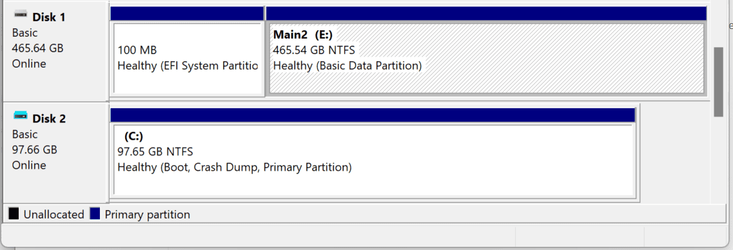
Windows sees "C" Disk as a 97 GB disk which is the Windows 11 install the 22518 rs-prerelease and the data drive E.


vhdx1.png

The data drive E contains the vhdx files

vhdx2.png

(Disk D is the laptiops internal HDD which is not the current boot drive so not shown)

Cheers
jimbo
 

My Computer My Computer

At a glance

Windows XP,11 Linux Fedora Rawhide pre-releas...2 X Intel i7
OS
Windows XP,11 Linux Fedora Rawhide pre-release 45
Computer type
PC/Desktop
CPU
2 X Intel i7
Screen Resolution
4KUHD X 2
Although the concept of Virtual Machine has existed for a long time, it is only used by a tiny fraction of individuals for personal use. The reasons are usually one of the following:

1. Lack of awareness
2. Low system specs
3. No requirement
To be honest I don't really understand these three points.
1. How so? Does one run a VM if they don"t know what is for? That might happen in a low percentage as beginner or out of curoisity.
2. In which way? Host? Guest? If you have low system specs on your host then this will reduce the chance you run VMs properly.
3. For what exactly?

1. As an individual end user, what do YOU use the VM for?

2. Is it true that activities inside a VM like VirtualBox cannot be tracked by Microsoft?
1. Mostly for testing and running older programs (in older OSes) , in my case.
2. Not true. A VM is like a separate computer with its own bells and whistles so all will run normally by default. If your VM is for instance offline / not connected though a virtual ethernet port then naturally nothing moves to the internet.
 

My Computers My Computers

  • At a glance

    Windows 11 Proi3 8109U16GB DDR4 @2400Intel Iris Plus Graphics 655
    OS
    Windows 11 Pro
    Computer type
    PC/Desktop
    Manufacturer/Model
    Intel NUC
    CPU
    i3 8109U
    Motherboard
    Intel
    Memory
    16GB DDR4 @2400
    Graphics Card(s)
    Intel Iris Plus Graphics 655
    Sound Card
    Intel / Realtek HD Audio
    Monitor(s) Displays
    LG-32ML600M
    Screen Resolution
    1920x1080
    Hard Drives
    Intel SSD 250GB + Samsung QVO SSD 1TB
    PSU
    Adapter
    Cooling
    The usual NUC airflow
    Keyboard
    Logitech Orion G610
    Mouse
    SteelSeries Rival 100 Red
    Internet Speed
    Good enough
    Browser
    Chromium, Edge, Firefox
    Antivirus
    Windows Defender
  • At a glance

    CentOS 9 Stream / Alma / Rocky / FedoraIntel i7 4800MQ32GB DDR3 @1600NVIDIA Quadro K2100M
    Operating System
    CentOS 9 Stream / Alma / Rocky / Fedora
    Computer type
    Laptop
    Manufacturer/Model
    TOSHIBA
    CPU
    Intel i7 4800MQ
    Motherboard
    TOSHIBA
    Memory
    32GB DDR3 @1600
    Graphics card(s)
    NVIDIA Quadro K2100M
    Sound Card
    Realtek HD Audio
    Monitor(s) Displays
    Built-in
    Screen Resolution
    1920x1080
I used to do it almost exclusively that way (separate partitions). But now I find that if I need something quickly from a different OS than I am running, it's much easier to just start the VM and get it, then it is to reboot the entire computer. For example, the settings menus are very different between Windows 10 and Windows 11. If I am going to show someone how to do something in Windows 10 it's much easier for me to just the start the Windows 10 VM that is residing on my Windows 11 computer than it is to reboot the computer into a partition (or vhdx drive) containing Windows 10.

Same here, used a VM at work today for this same purpose. Had another engineer who was having trouble installing the EPEL repository on a Red Hat Linux machine and then subsequently installing jq.

I discovered the host machines were running on Red Hat Enterprise 7.1...which is old and unpatched. Rather than experimenting on a production box, I grabbed the RH 7.1 ISO file, launched a RH 7.1 box and confirmed I had the same issue.

So, I turned off the VM and copied the 2GB .vhxd file into a backup folder. I then started the VM, ran yum update and after updating 300+ packages, we had no problems installing EPEL or jq. So, I turned it off, copied the 2GB hard drive file back. Turned it back on and installed about 1/2 of the updates and the issue wasn't resolved, did the 2nd half and it was fixed. So, restored it back and narrowed it down and ultimately discovered that it was curl and libcurl which needed to be updated in order to install EPEL and jq.

Copying that 2GB file on an NVMe drive sure beats the pants off setting up a dual boot or restoring a system backup from Macrium. In about 5 seconds, I can run a batch file to stop my VM, copy the file back and start it again to continue testing.
 

My Computers My Computers

  • At a glance

    Windows 11 ProIntel Core i5-8279u32GB DDR4 2666MhzIntel Iris Plus 655
    OS
    Windows 11 Pro
    Computer type
    PC/Desktop
    Manufacturer/Model
    Beelink SEI8
    CPU
    Intel Core i5-8279u
    Motherboard
    AZW SEI
    Memory
    32GB DDR4 2666Mhz
    Graphics Card(s)
    Intel Iris Plus 655
    Sound Card
    Intel SST
    Monitor(s) Displays
    Asus ProArt PA278QV
    Screen Resolution
    2560x1440
    Hard Drives
    512GB NVMe
    PSU
    NA
    Case
    NA
    Cooling
    NA
    Keyboard
    NA
    Mouse
    NA
    Internet Speed
    500/50
    Browser
    Edge
    Antivirus
    Defender
    Other Info
    Mini PC used for testing Windows 11.
  • At a glance

    Windows 10 ProRyzen 9 5900x64GB DDR4-3600EVGA GeForce 3080 FT3 Ultra
    Operating System
    Windows 10 Pro
    Computer type
    PC/Desktop
    Manufacturer/Model
    Custom
    CPU
    Ryzen 9 5900x
    Motherboard
    Asus Rog Strix X570-E Gaming
    Memory
    64GB DDR4-3600
    Graphics card(s)
    EVGA GeForce 3080 FT3 Ultra
    Sound Card
    Onboard
    Monitor(s) Displays
    ASUS TUF Gaming VG27AQ. ASUS ProArt Display PA278QV 27” WQHD
    Screen Resolution
    2560x1440
    Hard Drives
    2TB WD SN850 PCI-E Gen 4 NVMe
    2TB Sandisk Ultra 2.5" SATA SSD
    PSU
    Seasonic Focus 850
    Case
    Fractal Meshify S2 in White
    Cooling
    Dark Rock Pro CPU cooler, 3 x 140mm case fans
    Keyboard
    Corsiar K65 RGB Lux
    Mouse
    Logitech G9 Laser Mouse
    Internet Speed
    500/50
    Browser
    Chrome
    Antivirus
    Defender.
Several reasons. Testing and experimentation. Also, after I recycled two older PCs this weekend. I realized that a had developed and deployed a local website for managing my mineral collection using on older version of Visual Studio. Since I was not about to spend the time to tweak the code for the current VS and re-deploy it, along with the SQL data base, I decided to just restore their Macrium images virtual drives and attach them to an existing VM (Hyper-V). They work great. Only downside was the length of time it took to restore the images but since that’s a one time deal, no big deal.
 

My Computers My Computers

  • At a glance

    Windows 11 Pro10th Gen Intel(R) Core(TM) i7-10700, 2.90GHz32GB, 2x16GB, DDR4, 2933MhzNVIDIA(R) GeForce(R) RTX 2060 SUPER(TM) 8GB G...
    OS
    Windows 11 Pro
    Computer type
    PC/Desktop
    Manufacturer/Model
    Dell 8940 XPS
    CPU
    10th Gen Intel(R) Core(TM) i7-10700, 2.90GHz
    Motherboard
    Dell 0KV3RP (U3E1)
    Memory
    32GB, 2x16GB, DDR4, 2933Mhz
    Graphics Card(s)
    NVIDIA(R) GeForce(R) RTX 2060 SUPER(TM) 8GB GDDR6
    Sound Card
    Onboard, Realtek Codec, NVIDIA Hi Def Audio, Intel Display Audio
    Monitor(s) Displays
    Dell UltraSharp U3415W
    Screen Resolution
    3440x1440
    Hard Drives
    2TB M.2 PCIe NVMe SSD; 2TB Samsung SSD 860 EVO; 2TB Samsung SSD 860 EVO 2
    PSU
    500 W Dell
    Case
    Night Sky Bezel Chassis
    Cooling
    Dell
    Keyboard
    Logi Wireless
    Mouse
    Logi Wireless
    Internet Speed
    111 Mbps Download, 132 Mbps Upload
    Browser
    Edge, Chrome
    Antivirus
    Windows Defender, MalwareBytes
  • At a glance

    Windows 11 ProIntel 13900K Core I9 24 Core LGA 170032GB (2x16) Kingston Fury Beast 6000MHZ DDR5nVidia 4090 Founders Edition
    Operating System
    Windows 11 Pro
    Computer type
    PC/Desktop
    Manufacturer/Model
    Falcon Northwest Talon
    CPU
    Intel 13900K Core I9 24 Core LGA 1700
    Motherboard
    Asus ROG Z970 Maximus Hero
    Memory
    32GB (2x16) Kingston Fury Beast 6000MHZ DDR5
    Graphics card(s)
    nVidia 4090 Founders Edition
    Sound Card
    Motherboard
    Monitor(s) Displays
    Alienware 34” Curved OLED
    Screen Resolution
    4K
    Hard Drives
    SSD M.2 Kingston Renegade Fury 4 TB x 2; Western Digital Red Pro 8 TB SATA III
    PSU
    1000W ECGA Platinum Modular ATX
    Case
    Falcon NW Custom
    Cooling
    AIO Falcon NW 280mm Liquid Cooler
    Keyboard
    Logitech Pro Gamer
    Mouse
    Logitech G502
    Internet Speed
    111 Mbps Download, 132 Mbps Upload
    Browser
    Edge, Chrome
    Antivirus
    Windows Defender, MalwareBytes
    Other Info
    Noise Blocker Fans
Hi there
Sometimes newer ways of doing things are better than older traditional routes (not always though). Actually it was @cereberus (thanks !!) who started me off at looking at vhdx files !!!!

I always found the "Old way" of multi-booting a mega pain especially needing separate partions, uefi areas etc etc. Current method works perfectly even from external devices - just 1 X uefi partition, 1 X 128mb MSR partition and a bog standard data area filled with vhdx images -- no need to partition Windows to install --simply dism apply-image and update the boot manager via bcdboot !!

Running on a laptop from external 500 GB SSD

Windows sees "C" Disk as a 97 GB disk which is the Windows 11 install the 22518 rs-prerelease and the data drive E.


View attachment 16110

The data drive E contains the vhdx files

View attachment 16111

(Disk D is the laptiops internal HDD which is not the current boot drive so not shown)

Cheers
jimbo
If I get stuck and need help, will you help for free or fee? :love:
 

My Computer My Computer

At a glance

Windows 11Intel Core i7 3630QM16 GBIntel HD Graphics 4000 & Nvidia GeForce GT 635M
OS
Windows 11
Computer type
Laptop
Manufacturer/Model
HP Envy dv7
CPU
Intel Core i7 3630QM
Motherboard
HP
Memory
16 GB
Graphics Card(s)
Intel HD Graphics 4000 & Nvidia GeForce GT 635M
Sound Card
IDT High Definition
Screen Resolution
1080p
Hard Drives
1 TB Crucial MX500 on bay 1.
1 TB Seagate HDD on bay 2.
Antivirus
Windows Defender
To be honest I don't really understand these three points.
1. How so? Does one run a VM if they don"t know what is for? That might happen in a low percentage as beginner or out of curoisity.
2. In which way? Host? Guest? If you have low system specs on your host then this will reduce the chance you run VMs properly.
3. For what exactly?


1. Mostly for testing and running older programs (in older OSes) , in my case.
2. Not true. A VM is like a separate computer with its own bells and whistles so all will run normally by default. If your VM is for instance offline / not connected though a virtual ethernet port then naturally nothing moves to the internet.
1. Lack of awareness: Simply means people are not even aware that there is something called Virtual Machine. So obviously no question of them using one.

2. Host, of course: For a long time I thought VMs won't run smoothly on my old laptop. That proved to be wrong when I actually installed a VM.

3. There are many users with a high config computer and also aware of VMs. But they don't use it because they don't have a requirement to run multiple systems.
 

My Computer My Computer

At a glance

Windows 11Intel Core i7 3630QM16 GBIntel HD Graphics 4000 & Nvidia GeForce GT 635M
OS
Windows 11
Computer type
Laptop
Manufacturer/Model
HP Envy dv7
CPU
Intel Core i7 3630QM
Motherboard
HP
Memory
16 GB
Graphics Card(s)
Intel HD Graphics 4000 & Nvidia GeForce GT 635M
Sound Card
IDT High Definition
Screen Resolution
1080p
Hard Drives
1 TB Crucial MX500 on bay 1.
1 TB Seagate HDD on bay 2.
Antivirus
Windows Defender
1. Lack of awareness: Simply means people are not even aware that there is something called Virtual Machine. So obviously no question of them using one.

2. Host, of course: For a long time I thought VMs won't run smoothly on my old laptop. That proved to be wrong when I actually installed a VM.

3. There are many users with a high config computer and also aware of VMs. But they don't use it because they don't have a requirement to run multiple systems.
I don't run a virtual machine because I made made sure to have enough SSD/HDD space for dual or triple booting. And the reason I do that is because I want to test on actual rather than digital hardware.
 

My Computers My Computers

  • At a glance

    Windows 11 23H2 22631.2861Intel(R) Core(TM) i7-10700 CPU @ 2.90GHz 2.90...16384 MBytesIntel UHD Graphics 630
    OS
    Windows 11 23H2 22631.2861
    Computer type
    PC/Desktop
    Manufacturer/Model
    HP Envy TE01-1xxx
    CPU
    Intel(R) Core(TM) i7-10700 CPU @ 2.90GHz 2.90 GHz
    Motherboard
    16.0GB Dual-Channel Unknown @ 1463MHz (21-21-21-47)
    Memory
    16384 MBytes
    Graphics Card(s)
    Intel UHD Graphics 630
    Sound Card
    Realtek High Definition Audio
    Monitor(s) Displays
    Monitor 1 - Acer 27" Monitor 2 - Acer 27"
    Screen Resolution
    1920 x 1080
    Hard Drives
    WDC PC SN530 SDBPNPZ-512G-1006 (SSD)
    Seagate ST1000DM003-1SB102
    Seagate BUP Slim SCSI Disk Device (SSD)
    PSU
    HP
    Case
    HP
    Cooling
    Standard
    Keyboard
    Logitech Wave K350
    Mouse
    Logitech M705
    Internet Speed
    500 mbps
    Browser
    Firefox
    Antivirus
    Windows Defender
    Other Info
    That's all Folks!
  • At a glance

    Windows 11Intel Core i7 (10th gen) 1070016 GBIntel UHD Graphics 630
    Operating System
    Windows 11
    Computer type
    PC/Desktop
    Manufacturer/Model
    HP
    CPU
    Intel Core i7 (10th gen) 10700
    Motherboard
    Intel
    Memory
    16 GB
    Graphics card(s)
    Intel UHD Graphics 630
    Sound Card
    Built-in
    Monitor(s) Displays
    Acer 27" & Samsung 24"
    Screen Resolution
    1920 x
    Hard Drives
    SSD (512 GB)
    HDD (1 TB)
    Seagate
    PSU
    Intel i7 10th Generation
    Case
    HP
    Cooling
    HP/Intel?
    Keyboard
    Logitech Wave K350
    Mouse
    Logitech M705
    Internet Speed
    50 mbps
    Browser
    Firefox 90.2
    Antivirus
    Windows Defender
    Other Info
    Headphone/Microphone Combo
    SuperSpeed USB Type-A (4 on front)
    HP 3-in-One Card Readr
    SuperSpeed USB Type-C
    DVD Writer
I don't run a virtual machine because I made made sure to have enough SSD/HDD space for dual or triple booting. And the reason I do that is because I want to test on actual rather than digital hardware.
People often prefer VMs for the convenience of using them, testing software without risking their main (host) system, ease of backing them up, etc. With a decent hardware, VMs run just as fluidly as the host. So there are a lot of advantages of using VMs over multi-booting systems.
 

My Computer My Computer

At a glance

Windows 11Intel Core i7 3630QM16 GBIntel HD Graphics 4000 & Nvidia GeForce GT 635M
OS
Windows 11
Computer type
Laptop
Manufacturer/Model
HP Envy dv7
CPU
Intel Core i7 3630QM
Motherboard
HP
Memory
16 GB
Graphics Card(s)
Intel HD Graphics 4000 & Nvidia GeForce GT 635M
Sound Card
IDT High Definition
Screen Resolution
1080p
Hard Drives
1 TB Crucial MX500 on bay 1.
1 TB Seagate HDD on bay 2.
Antivirus
Windows Defender
I don't run a virtual machine because I made made sure to have enough SSD/HDD space for dual or triple booting. And the reason I do that is because I want to test on actual rather than digital hardware.
And that totally makes sense. Everything depends upon what it is that you are trying to accomplish. If I were needing higher performance and direct hardware support, I would hit it with a multiboot as well.

My usage of virtual machines revolves around learning about a technology. I don't always need speed and performance, but rather just a nice isolated place to run it. And it's nice when I still have my base OS up and running where I can write documentation, or use a web browser to research problems that I might be experiencing in my other system.

Nobody should really feel they are missing out by not running a virtual machine. They aren't the answer for everything.
 

My Computers My Computers

  • At a glance

    Windows 11 ProIntel Core i5-8279u32GB DDR4 2666MhzIntel Iris Plus 655
    OS
    Windows 11 Pro
    Computer type
    PC/Desktop
    Manufacturer/Model
    Beelink SEI8
    CPU
    Intel Core i5-8279u
    Motherboard
    AZW SEI
    Memory
    32GB DDR4 2666Mhz
    Graphics Card(s)
    Intel Iris Plus 655
    Sound Card
    Intel SST
    Monitor(s) Displays
    Asus ProArt PA278QV
    Screen Resolution
    2560x1440
    Hard Drives
    512GB NVMe
    PSU
    NA
    Case
    NA
    Cooling
    NA
    Keyboard
    NA
    Mouse
    NA
    Internet Speed
    500/50
    Browser
    Edge
    Antivirus
    Defender
    Other Info
    Mini PC used for testing Windows 11.
  • At a glance

    Windows 10 ProRyzen 9 5900x64GB DDR4-3600EVGA GeForce 3080 FT3 Ultra
    Operating System
    Windows 10 Pro
    Computer type
    PC/Desktop
    Manufacturer/Model
    Custom
    CPU
    Ryzen 9 5900x
    Motherboard
    Asus Rog Strix X570-E Gaming
    Memory
    64GB DDR4-3600
    Graphics card(s)
    EVGA GeForce 3080 FT3 Ultra
    Sound Card
    Onboard
    Monitor(s) Displays
    ASUS TUF Gaming VG27AQ. ASUS ProArt Display PA278QV 27” WQHD
    Screen Resolution
    2560x1440
    Hard Drives
    2TB WD SN850 PCI-E Gen 4 NVMe
    2TB Sandisk Ultra 2.5" SATA SSD
    PSU
    Seasonic Focus 850
    Case
    Fractal Meshify S2 in White
    Cooling
    Dark Rock Pro CPU cooler, 3 x 140mm case fans
    Keyboard
    Corsiar K65 RGB Lux
    Mouse
    Logitech G9 Laser Mouse
    Internet Speed
    500/50
    Browser
    Chrome
    Antivirus
    Defender.
Back
Top Bottom