Cloning and backup question(s)


Local time
7:28 AM
Posts
19
OS
Windows 11
I have W11 home 23H2 on an NVME SSD drive and would like to create a clone to experiment and trial some rather delicate software. (i.e. do some upgrades and see if it's fit for production use). This might take a week of testing during which I need both "production" W11 and it's "testing" W11 clone bootable.

So I cloned the SSD to a hard disk (boot Puppy linux and use dd for a sector by sector copy) and, encountered a "signature collision". I understand what that is now but I would have to remove the SSD to boot the hard drive. Sitting under the CPU cooler makes it even more difficult, and I can't seem to just disable the SSD in the BIOS/setup either.

I have Macrium (the old free version at the moment) installed and thought I'd just restore an image to "new hardware", the hard drive but alas... this feature isn't part of the free version. It's a bit unclear if the paid version would suit my purposes here. I want both installations bootable and especially the "production" W11 undisturbed by the testing. And the "Fix boot problems" feature doesn't work because the cloned hard drive isn't visible (perhaps winpe also can't handle a duplicate drive signature so it's offline as in W11).

Is there another tool that will change the hard drive signature and modify the (also cloned) EFI system boot files to allow it to boot? Would the paid Macrium work this way?
 

My Computer My Computer

At a glance

Windows 11i9-12900K64 GBNVidea Quardro P620
OS
Windows 11
Computer type
PC/Desktop
Manufacturer/Model
Home build
CPU
i9-12900K
Motherboard
GigABYTE Z690 AORUS ELITE AX D5
Memory
64 GB
Graphics Card(s)
NVidea Quardro P620
Bring it online in windows disk management. Windows will change the sig on the disk that has just been brought online..

Then fix the bcd entry on the newly onlined disk using bcdboot command.

It is quick to do and not difficult.

for example if the windows partition on the newly onlined disk is G

and you have assigned Z to the esp partition on the newly onlined disk

at admin cmd prompt

bcdboot g:\windows /s z:

( that is to add an entry for windows on G to the bcd store on Z )

alternatively you could use the device path of the esp partition on the newly onlined disk if you cant be bothered assigning it a letter.

for example

bcdboot g:\windows /s \Device\HarddiskVolume6
 
Last edited:

My Computers My Computers

  • At a glance

    Win7,Win11i7-97002x16gb 3600mhz
    OS
    Win7,Win11
    Computer type
    PC/Desktop
    CPU
    i7-9700
    Motherboard
    gigabyte b365m ds3h
    Memory
    2x16gb 3600mhz
    Monitor(s) Displays
    benq gw2480
    PSU
    bequiet pure power 11 400CM
    Cooling
    cryorig m9i
  • At a glance

    win7,win11i5-84002x8gb 3200
    Operating System
    win7,win11
    Computer type
    PC/Desktop
    CPU
    i5-8400
    Motherboard
    gigabyte b365m ds3h
    Memory
    2x8gb 3200
    PSU
    xfx pro 450
Have you done it yet. Takes only a few seconds.
 

My Computers My Computers

  • At a glance

    Win7,Win11i7-97002x16gb 3600mhz
    OS
    Win7,Win11
    Computer type
    PC/Desktop
    CPU
    i7-9700
    Motherboard
    gigabyte b365m ds3h
    Memory
    2x16gb 3600mhz
    Monitor(s) Displays
    benq gw2480
    PSU
    bequiet pure power 11 400CM
    Cooling
    cryorig m9i
  • At a glance

    win7,win11i5-84002x8gb 3200
    Operating System
    win7,win11
    Computer type
    PC/Desktop
    CPU
    i5-8400
    Motherboard
    gigabyte b365m ds3h
    Memory
    2x8gb 3200
    PSU
    xfx pro 450
There's no entry for the clone just: the SSD and Macrium... :-(

C:\Windows\System32>bcdedit /enum

Windows Boot Manager
--------------------
identifier {bootmgr}
device partition=\Device\HarddiskVolume1
path \EFI\Microsoft\Boot\bootmgfw.efi
description Windows Boot Manager
locale en-US
inherit {globalsettings}
default {current}
resumeobject {276ed21b-41af-11ee-98f7-f2ded35d2c71}
displayorder {current}
{7dee93cc-20f1-11ef-8ed9-60e9aa1ff7d5}
toolsdisplayorder {memdiag}
timeout 10

Windows Boot Loader
-------------------
identifier {current}
device partition=C:
path \Windows\system32\winload.efi
description Windows 11
locale en-US
inherit {bootloadersettings}
recoverysequence {276ed21d-41af-11ee-98f7-f2ded35d2c71}
displaymessageoverride Recovery
recoveryenabled Yes
isolatedcontext Yes
allowedinmemorysettings 0x15000075
osdevice partition=C:
systemroot \Windows
resumeobject {276ed21b-41af-11ee-98f7-f2ded35d2c71}
nx OptIn
bootmenupolicy Standard

Windows Boot Loader
-------------------
identifier {7dee93cc-20f1-11ef-8ed9-60e9aa1ff7d5}
device ramdisk=[C:]\boot\macrium\WinREFiles\media\sources\boot.wim,{ramdiskoptions}
path \windows\system32\boot\winload.efi
description Macrium Reflect System Recovery
osdevice ramdisk=[C:]\boot\macrium\WinREFiles\media\sources\boot.wim,{ramdiskoptions}
systemroot \Windows
detecthal Yes
winpe Yes

C:\Windows\System32>
 

My Computer My Computer

At a glance

Windows 11i9-12900K64 GBNVidea Quardro P620
OS
Windows 11
Computer type
PC/Desktop
Manufacturer/Model
Home build
CPU
i9-12900K
Motherboard
GigABYTE Z690 AORUS ELITE AX D5
Memory
64 GB
Graphics Card(s)
NVidea Quardro P620
Oh wait... this is the ESP on the NVME... How to say... use the disk 3 ESP?
 

My Computer My Computer

At a glance

Windows 11i9-12900K64 GBNVidea Quardro P620
OS
Windows 11
Computer type
PC/Desktop
Manufacturer/Model
Home build
CPU
i9-12900K
Motherboard
GigABYTE Z690 AORUS ELITE AX D5
Memory
64 GB
Graphics Card(s)
NVidea Quardro P620
Hmmmm.... F12 takes me to the (??) BIOS boot menu and there's an entry for the clones hard drive, so boot that and :

C:\Windows\System32>bcdedit /enum

Windows Boot Manager
--------------------
identifier {bootmgr}
device partition=\Device\HarddiskVolume1
path \EFI\Microsoft\Boot\bootmgfw.efi
description Windows Boot Manager
locale en-US
inherit {globalsettings}
default {current}
resumeobject {276ed21b-41af-11ee-98f7-f2ded35d2c71}
displayorder {current}
toolsdisplayorder {memdiag}
timeout 30

Windows Boot Loader
-------------------
identifier {current}
device partition=C:
path \Windows\system32\winload.efi
description Windows 11
locale en-US
inherit {bootloadersettings}
recoverysequence {276ed21d-41af-11ee-98f7-f2ded35d2c71}
displaymessageoverride Recovery
recoveryenabled Yes
isolatedcontext Yes
allowedinmemorysettings 0x15000075
osdevice partition=C:
systemroot \Windows
resumeobject {276ed21b-41af-11ee-98f7-f2ded35d2c71}
nx OptIn
bootmenupolicy Standard

C:\Windows\System32>


partition=C: seems to point back to the NVME SSD because I'm seeing the files in C. I need to make that partition=G: ? Which, is the hard drive's clone of the windows partition drive letter. Those files are as expected on G: .. as of the cloning a week ago. but that's not the C: drive.
 

My Computer My Computer

At a glance

Windows 11i9-12900K64 GBNVidea Quardro P620
OS
Windows 11
Computer type
PC/Desktop
Manufacturer/Model
Home build
CPU
i9-12900K
Motherboard
GigABYTE Z690 AORUS ELITE AX D5
Memory
64 GB
Graphics Card(s)
NVidea Quardro P620
Why? I already explained how to update the bcd store on the other disk.

What is the point of looking at it?

you would need to load it using the store switch

if the device path is \Device\HarddiskVolume6

bcdedit -store \\?\GLOBALROOT\Device\HarddiskVolume6\EFI\Microsoft\Boot\bcd

or if you have assigned letter Z to the other esp partion

bcdedit -store Z:\EFI\Microsoft\Boot\bcd
 

My Computers My Computers

  • At a glance

    Win7,Win11i7-97002x16gb 3600mhz
    OS
    Win7,Win11
    Computer type
    PC/Desktop
    CPU
    i7-9700
    Motherboard
    gigabyte b365m ds3h
    Memory
    2x16gb 3600mhz
    Monitor(s) Displays
    benq gw2480
    PSU
    bequiet pure power 11 400CM
    Cooling
    cryorig m9i
  • At a glance

    win7,win11i5-84002x8gb 3200
    Operating System
    win7,win11
    Computer type
    PC/Desktop
    CPU
    i5-8400
    Motherboard
    gigabyte b365m ds3h
    Memory
    2x8gb 3200
    PSU
    xfx pro 450
So I used:
bcdboot G:\Windows /s \Device\HarddiskVolume3
"3" because that's the drive number in Disk Management but I see above Volume1 seems to refer to the NVME SSD which Disk Management is calling drive number 5 actually. And I can't seem to assign a drive letter to the ESP on the hard drive. So.... how do I refer to it?
 

My Computer My Computer

At a glance

Windows 11i9-12900K64 GBNVidea Quardro P620
OS
Windows 11
Computer type
PC/Desktop
Manufacturer/Model
Home build
CPU
i9-12900K
Motherboard
GigABYTE Z690 AORUS ELITE AX D5
Memory
64 GB
Graphics Card(s)
NVidea Quardro P620
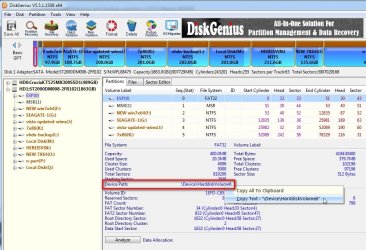
the device path is not the drive number ( whatever that means )

you can find it easily with any decent partition manager

dg-devicepath6.jpg


Or you could use \Device\Harddisk1\Partition1 if you are sure the esp partition is disk 1 partition 1.

bcdboot G:\Windows /s \Device\Harddisk1\Partition1
 
Last edited:

My Computers My Computers

  • At a glance

    Win7,Win11i7-97002x16gb 3600mhz
    OS
    Win7,Win11
    Computer type
    PC/Desktop
    CPU
    i7-9700
    Motherboard
    gigabyte b365m ds3h
    Memory
    2x16gb 3600mhz
    Monitor(s) Displays
    benq gw2480
    PSU
    bequiet pure power 11 400CM
    Cooling
    cryorig m9i
  • At a glance

    win7,win11i5-84002x8gb 3200
    Operating System
    win7,win11
    Computer type
    PC/Desktop
    CPU
    i5-8400
    Motherboard
    gigabyte b365m ds3h
    Memory
    2x8gb 3200
    PSU
    xfx pro 450
Well, now, bcdedit /enum is showing the on the hard drive but it's booting the SSD. The bcdboot command didn't seem to work but perhaps \Device\HarddiskVolume3 doesn't refer to the hard drive's ESP. There wasn't an error. How is "Volume6" defined? I doesn't seem to be the drive number from Disk Management. So what is it?
 

My Computer My Computer

At a glance

Windows 11i9-12900K64 GBNVidea Quardro P620
OS
Windows 11
Computer type
PC/Desktop
Manufacturer/Model
Home build
CPU
i9-12900K
Motherboard
GigABYTE Z690 AORUS ELITE AX D5
Memory
64 GB
Graphics Card(s)
NVidea Quardro P620
How is "Volume6" defined?

it is a symbolic link. For your purpose it is an alias for the disk and partition id, similar to the way a drive letter is an alias for the disk and partition id.

if enthusiasts are interested they can poke around with winobj WinObj - Sysinternals

winobj.jpg


but any decent partition manager will show the device paths. Have you read my previous posts? Everything you need is there with screenshots.

As I explained in my previous post if you know for sure that the esp is disk 1 partition 1 you could do this way instead

bcdboot G:\Windows /s \Device\Harddisk1\Partition1
 
Last edited:

My Computers My Computers

  • At a glance

    Win7,Win11i7-97002x16gb 3600mhz
    OS
    Win7,Win11
    Computer type
    PC/Desktop
    CPU
    i7-9700
    Motherboard
    gigabyte b365m ds3h
    Memory
    2x16gb 3600mhz
    Monitor(s) Displays
    benq gw2480
    PSU
    bequiet pure power 11 400CM
    Cooling
    cryorig m9i
  • At a glance

    win7,win11i5-84002x8gb 3200
    Operating System
    win7,win11
    Computer type
    PC/Desktop
    CPU
    i5-8400
    Motherboard
    gigabyte b365m ds3h
    Memory
    2x8gb 3200
    PSU
    xfx pro 450
Installed Disk Genius for the proper volume path. Ok. It's time for bed but I was seeing the options to boot the hard drive, tried it but it didn't start. Black screens and a mouse pointer with the busy/spinning circle for 15 minutes. I'll look more later. Of course, I can boot the SSD (running now).
 

My Computer My Computer

At a glance

Windows 11i9-12900K64 GBNVidea Quardro P620
OS
Windows 11
Computer type
PC/Desktop
Manufacturer/Model
Home build
CPU
i9-12900K
Motherboard
GigABYTE Z690 AORUS ELITE AX D5
Memory
64 GB
Graphics Card(s)
NVidea Quardro P620
Looking at your requirements, there is a much easier way to do what you want.

I would create a virtual hard drive (.vhdx) then initialise it as gpt (assuming uefi pc), then clone main OS to vhd.

Then it is a simple step to make a boot entry for vhd. Lets assume vhdx is connected as drive F.

BCDEDIT F:\windows /p /d

No disk clashes - works EVERY TIME.

Preferably put .vhdx file on a second drive.

If you want to delete 2nd OS - just delete.vhdx and remove boot entry using msconfig.
 

My Computer My Computer

At a glance

Windows 11 Pro + Win11 Canary VM.I9 13th gen i9-13900H 2.60 GHZ16 GB solderedIntegrated Intel Iris XE
OS
Windows 11 Pro + Win11 Canary VM.
Computer type
Laptop
Manufacturer/Model
ASUS Zenbook 14
CPU
I9 13th gen i9-13900H 2.60 GHZ
Motherboard
Yep, Laptop has one.
Memory
16 GB soldered
Graphics Card(s)
Integrated Intel Iris XE
Sound Card
Realtek built in
Monitor(s) Displays
laptop OLED screen
Screen Resolution
2880x1800 touchscreen
Hard Drives
1 TB NVME SSD (only weakness is only one slot)
PSU
Internal + 65W thunderbolt USB4 charger
Case
Yep, got one
Cooling
Stella Artois (UK pint cans - 568 ml) - extra cost.
Keyboard
Built in UK keybd
Mouse
Bluetooth , wireless dongled, wired
Internet Speed
900 mbs (ethernet), wifi 6 typical 350-450 mb/s both up and down
Browser
Edge
Antivirus
Defender
Other Info
TPM 2.0, 2xUSB4 thunderbolt, 1xUsb3 (usb a), 1xUsb-c, hdmi out, 3.5 mm audio out/in combo, ASUS backlit trackpad (inc. switchable number pad)

Macrium Reflect Home V8
Office 365 Family (6 users each 1TB onedrive space)
Hyper-V (a vm runs almost as fast as my older laptop)
I don't really know what a virtual disk is...

Along with a test environment, I was also trying to prove I can backup and restore images of the windows installation. So far... my backups don't restore like I thought. So, I have to understand all this much better.
 

My Computer My Computer

At a glance

Windows 11i9-12900K64 GBNVidea Quardro P620
OS
Windows 11
Computer type
PC/Desktop
Manufacturer/Model
Home build
CPU
i9-12900K
Motherboard
GigABYTE Z690 AORUS ELITE AX D5
Memory
64 GB
Graphics Card(s)
NVidea Quardro P620
I don't really know what a virtual disk is...

Along with a test environment, I was also trying to prove I can backup and restore images of the windows installation. So far... my backups don't restore like I thought. So, I have to understand all this much better.
Read tutorials on tenforums.com
 

My Computer My Computer

At a glance

Windows 11 Pro + Win11 Canary VM.I9 13th gen i9-13900H 2.60 GHZ16 GB solderedIntegrated Intel Iris XE
OS
Windows 11 Pro + Win11 Canary VM.
Computer type
Laptop
Manufacturer/Model
ASUS Zenbook 14
CPU
I9 13th gen i9-13900H 2.60 GHZ
Motherboard
Yep, Laptop has one.
Memory
16 GB soldered
Graphics Card(s)
Integrated Intel Iris XE
Sound Card
Realtek built in
Monitor(s) Displays
laptop OLED screen
Screen Resolution
2880x1800 touchscreen
Hard Drives
1 TB NVME SSD (only weakness is only one slot)
PSU
Internal + 65W thunderbolt USB4 charger
Case
Yep, got one
Cooling
Stella Artois (UK pint cans - 568 ml) - extra cost.
Keyboard
Built in UK keybd
Mouse
Bluetooth , wireless dongled, wired
Internet Speed
900 mbs (ethernet), wifi 6 typical 350-450 mb/s both up and down
Browser
Edge
Antivirus
Defender
Other Info
TPM 2.0, 2xUSB4 thunderbolt, 1xUsb3 (usb a), 1xUsb-c, hdmi out, 3.5 mm audio out/in combo, ASUS backlit trackpad (inc. switchable number pad)

Macrium Reflect Home V8
Office 365 Family (6 users each 1TB onedrive space)
Hyper-V (a vm runs almost as fast as my older laptop)
Looking at your requirements, there is a much easier way to do what you want.

I would create a virtual hard drive (.vhdx) then initialise it as gpt (assuming uefi pc), then clone main OS to vhd.

Then it is a simple step to make a boot entry for vhd. Lets assume vhdx is connected as drive F.

BCDEDIT F:\windows /p /d

No disk clashes - works EVERY TIME.

Preferably put .vhdx file on a second drive.

If you want to delete 2nd OS - just delete.vhdx and remove boot entry using msconfig.
Or even bcdedit !!! bcdedit /delete {identfier}. bcdedit without parameters lists the boot os'es. copy from the screen and paste into the command to avoid making mistakes.

Cheers
jimbo
 

My Computer My Computer

At a glance

Windows XP,11 Linux Fedora Rawhide pre-releas...2 X Intel i7
OS
Windows XP,11 Linux Fedora Rawhide pre-release 45
Computer type
PC/Desktop
CPU
2 X Intel i7
Screen Resolution
4KUHD X 2
Thanks jimbo. I' think I've figured out the bcd parts to point to and start available installations. But my clone of the "main" ssd boot drive (all partitions) won't boot. It hangs with a black screen, never see the windows logo, desktop or anything. Boot log at the end shows:
BOOTLOG_NOT_LOADED \SystemRoot\System32\drivers\dxgkrnl.sys


BOOTLOG_NOT_LOADED \SystemRoot\System32\drivers\dxgkrnl.sys
 

Attachments

My Computer My Computer

At a glance

Windows 11i9-12900K64 GBNVidea Quardro P620
OS
Windows 11
Computer type
PC/Desktop
Manufacturer/Model
Home build
CPU
i9-12900K
Motherboard
GigABYTE Z690 AORUS ELITE AX D5
Memory
64 GB
Graphics Card(s)
NVidea Quardro P620
I see lots of cloning programs and in videos, people always remove the source hardware before booting into the clone. i.e.

Video demonstrates Samsung Data Migration (now part of the Samsung Magician app), DiskGenius, Clonezilla Live, and the Linux DD command.

Why is that? Simply point to what to boot from.
 

My Computer My Computer

At a glance

Windows 11i9-12900K64 GBNVidea Quardro P620
OS
Windows 11
Computer type
PC/Desktop
Manufacturer/Model
Home build
CPU
i9-12900K
Motherboard
GigABYTE Z690 AORUS ELITE AX D5
Memory
64 GB
Graphics Card(s)
NVidea Quardro P620

Latest Support Threads

Back
Top Bottom