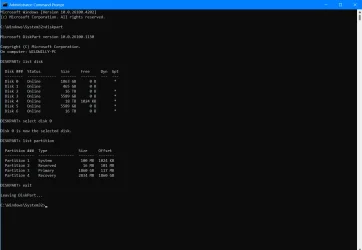
Once again, thanks to all who responded. I have used Macrium Reflect to do what I wanted. I created their rescue media. I booted to their rescue media. I created a backup image of my boot drive, omitting the inactive recovery partition. I blasted my boot SSD, which is to say, my boot drive. Yes, I deleted all the partitions on my boot NVMe SSD. I restored the backup image I had just taken, still booted to the Reflect rescue media. I did that by positioning the 2 unavoidable unlettered partitions at the front of the drive, positioning the active recovery partition at the back of the drive, & positioning the actual boot partition (C drive) to fill the remaining space in the middle. That is all so ridiculously easy & intuitive, dragging & dropping the parts of the backup image onto the boot drive. Clicked Go. Poof. Magic. My boot drive now has only 4 partitions: the 2 unavoidable ones, the standard W11 C drive boot partition, the only valid recovery partition. And how do I know it worked? I'm here posting this. My system is running exactly the same as it was before I did this backup/restore cycle. I have verified via diskpart & reagentc that things are the way they should be & that the recovery partition I meant to be active is indeed the active recovery partition. The whole backup/restore cycle took less than a half hour. Take it from me. It all looks scary. And then you do it. And then you wonder why you were scared in the first place.
My Computer
At a glance
Windows 11 Pro 64-bit 25H2Intel Core i9-13900K4x32G Teamgroup TForce Vulcan DDR5 6000 DIMMsMSI/NVidia GeForce RTX 4070 Gaming X Trio 12G...
- OS
- Windows 11 Pro 64-bit 25H2
- Computer type
- PC/Desktop
- Manufacturer/Model
- Self build
- CPU
- Intel Core i9-13900K
- Motherboard
- ASUS Z790-Plus WiFi TUF Gaming
- Memory
- 4x32G Teamgroup TForce Vulcan DDR5 6000 DIMMs
- Graphics Card(s)
- MSI/NVidia GeForce RTX 4070 Gaming X Trio 12G GDDR6X + built into motherboard Intel UHD Graphics
- Sound Card
- Built into graphics card + built into motherboard Realtek Audio
- Monitor(s) Displays
- Two connected to the NVidia adapter - Primary: Dell SE2417HGX 23" diagonal connected via HDMI-to-DisplayPort dongle, Secondary: Toshiba TV 32" diagonal connected via HDMI through Onkyo TX-NR717 surround receiver. Third: Viewsonic VS19151 32" diagonal connected wirelessly via WiFi/Miracast & j5create JVAW56 dongle.
- Screen Resolution
- 1920x1080 on all 3 monitors
- Hard Drives
- Samsung 970 EVO Plus NVMe M.2 2T
6xSATA-to-USB 3.0 Fideco external enclosures holding SATA drives of various brands & sizes 1x20T, 2x18T, 2x6T, 1x500G, all connected to a multi-port USB hub
For backups: USB 3.0 HDDs of various brands & sizes 3x20T, 1x1T + SSDs of various brands & sizes 2x480G, 1x1T, all connected to another multi-port USB hub, powered on only while actually performing backups & (may it never happen) restores
- PSU
- MSI MPG A1000G PCIe5 1000W, TrippLite Smart1500TSU 1200W UPS for the main system, TrippLite ECO850LCD 850W UPS for the DASD & my Internet connectivity boxes (no reason to throw out legacy equipment that stil works fine)
- Case
- Fractal North
- Cooling
- DeepCool AK620 CPU cooler (air, 2 fans), 2 case fans, 1 fan in PSU, 3 fans in graphics adapter; 4xpersonal cooling fans strategically placed to cool the external HDDs
- Keyboard
- Cherry MX 11900 USB (wired)
- Mouse
- Touchpad built into the keyboard
- Internet Speed
- 500Mbps via Spectrum cable TV/cell phone bundle
- Browser
- Firefox
- Antivirus
- Built into Windows 11
- Other Info
- The ethernet adapter integrated into the motherboard died. I am now using a TPLink TX201 ethernet adapter in a PCIe expansion slot for Internet connectivity.