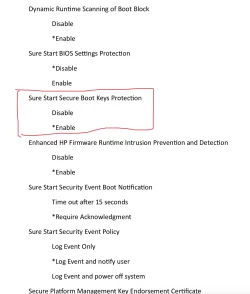
If you expand deeper, HP models with Sure Start have a self-protection feature that prevents certain UEFI changes (as a security mechanism).For those having HP Sure Start technology, the following screenshot is taken from
For some models, HP has released a new BIOS version where they display the version string "'SBKPFV3". This indicates it's compatible with the update process. Anything other than "'SBKPFV3", like "'SBKPFV2" or "'SBKPFV" will not be compatible.
I'll add a change to both scripts to check if you own a HP, and detect if the BIOS is supported or not. It sounds like the unsupported PC's (due to age) won't get a fix to Sure Start. Sure Starts sound like why some HP's don't take the UEFI certificates.
Sure Start is an onboard mechanism to confirm if UEFI changes are authorized. If recent changes aren't confirmed (by an outside server), then the UEFI automatically restores a backup copy to undo the change. It sounds like when HP introduced this feature, they thought it was a good anti-tampering mechanism, but couldn't predict the UEFI keys needed updating 10 years later.
You can't turn off Sure Start (otherwise it could be defeated by attackers), so the only away to allow changes is because HP re-programmed your BIOS to allow the Secure Boot migration to happen. It may be that a whole lot of older HP machines can never be updated, if HP decided to abandon them by not providing an updated version of BIOS firmware.
My Computer
At a glance
Windows 7
- OS
- Windows 7